
 View on Asset Store (opens in new tab)
Package details
- Latest version
- 0.3.0
- Last updated
- First released
- Unity version
- 6000.3.8 or later
- Package size
- 3.5 MB
- Files
- 172
- Favorites
- 3
- Views in the past week
- 10
Price tracking
- Last checked
- Tracked since
- Lowest recorded
- $45.00 on
Keywords

Cenote Voxel Suite (Beta)
Cenote is a lightweight, artist-friendly voxel toolkit with a composition style workflow. Rapidly build anything from fully handpainted levels to completely procedural infinite worlds with ease.
Affiliate link · Purchases support this site
Price history
Last 6 months
USDAsset preview
1 / 7
Cenote Voxel Suite (Beta) screenshot 1

About this asset
Generate and Sculpt levels fast
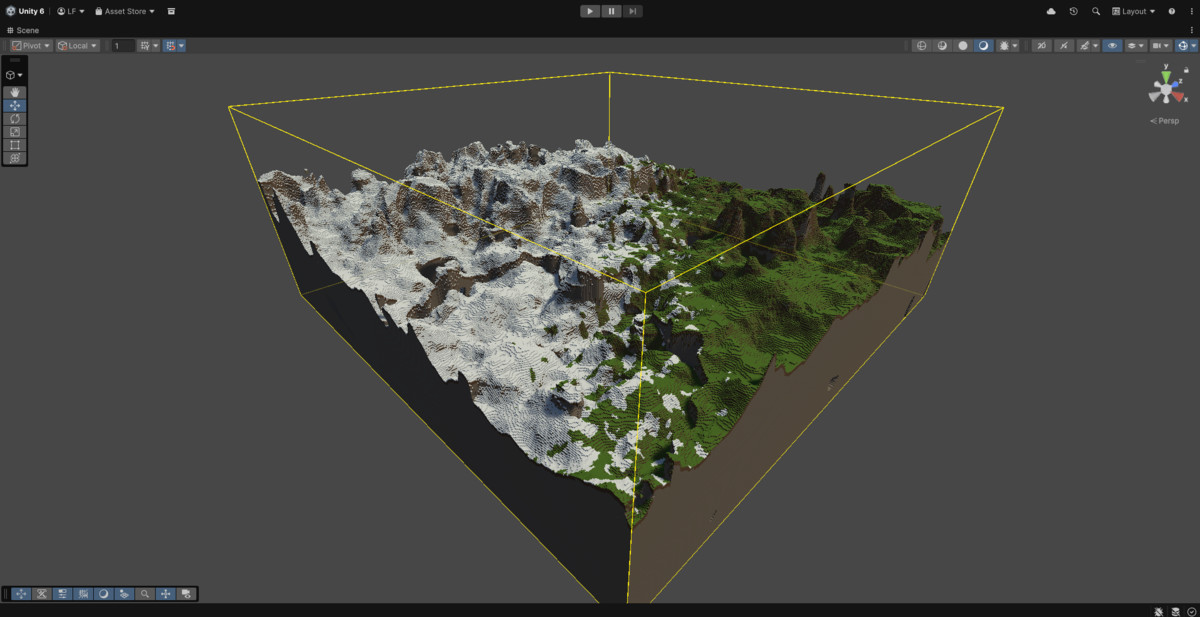
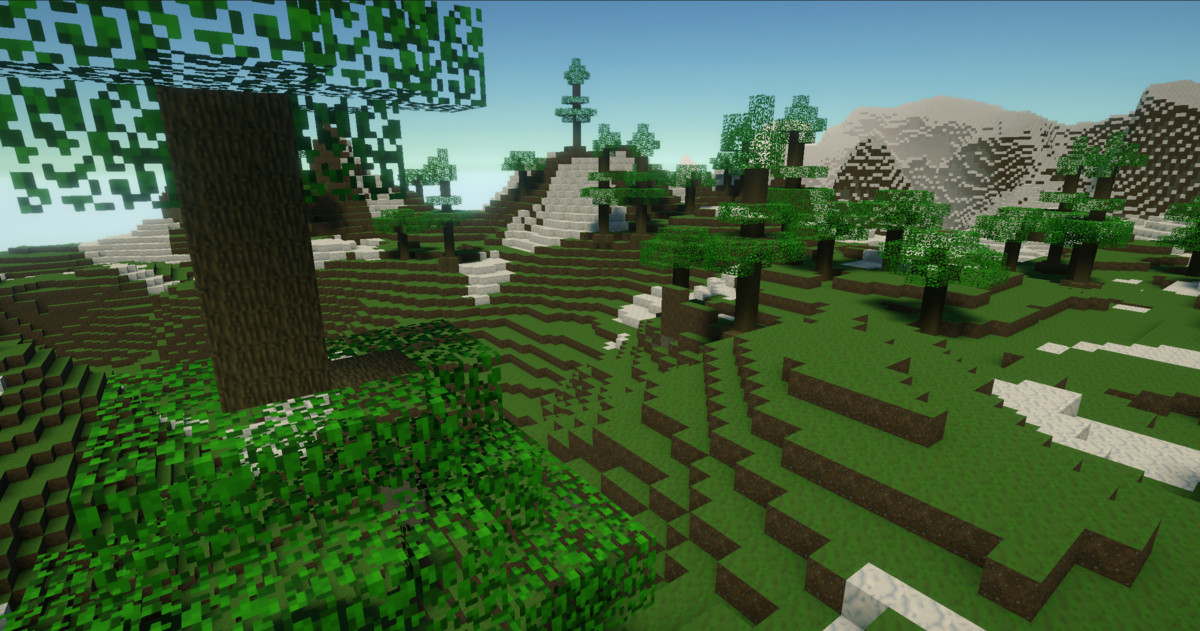
Cenote is a lightweight, artist-friendly world generation and voxel painting toolkit that turns Unity's editor into a fast 3D level-design canvas. Sketch out or design any caves, dungeons, terrain, and structures by painting voxels directly or by configuring a proc-gen pipeline - Cenote handles the rest, generating smooth, real-time meshes as you work.
Proc-Gen Design Features
A core feature of Cenote is the Procedural Generation pipeline. You can setup your own pipeline or use the existing Proc gen pipeline which allows you to make Density passes -> Voxel Type passes -> Feature passes. Each pass can contain any number of mutators in the stack for that pass group. This allows for huge variety in how your world is generated and is easily extensible with your own pass handlers.
- Composition based procedural generation pipeline for infinite worlds
- ScriptableObject Data Assets. Your voxel volume lives in a .asset file which is easily version-controllable, reusable across scenes, and shareable between team members without scene conflicts
- Scene components target volume .assets for mutations.
- The Proc-gen pipeline configuration is also SO driven, meaning you serialize DNA + delta-data mutations instead of entire chunks.
- Easy Voxel Type interface to add textures and reference the types everywhere later.
- Biome generation via 2D temperature map - assign biomes to temperature bands and voxel types to biomes.
Design Features
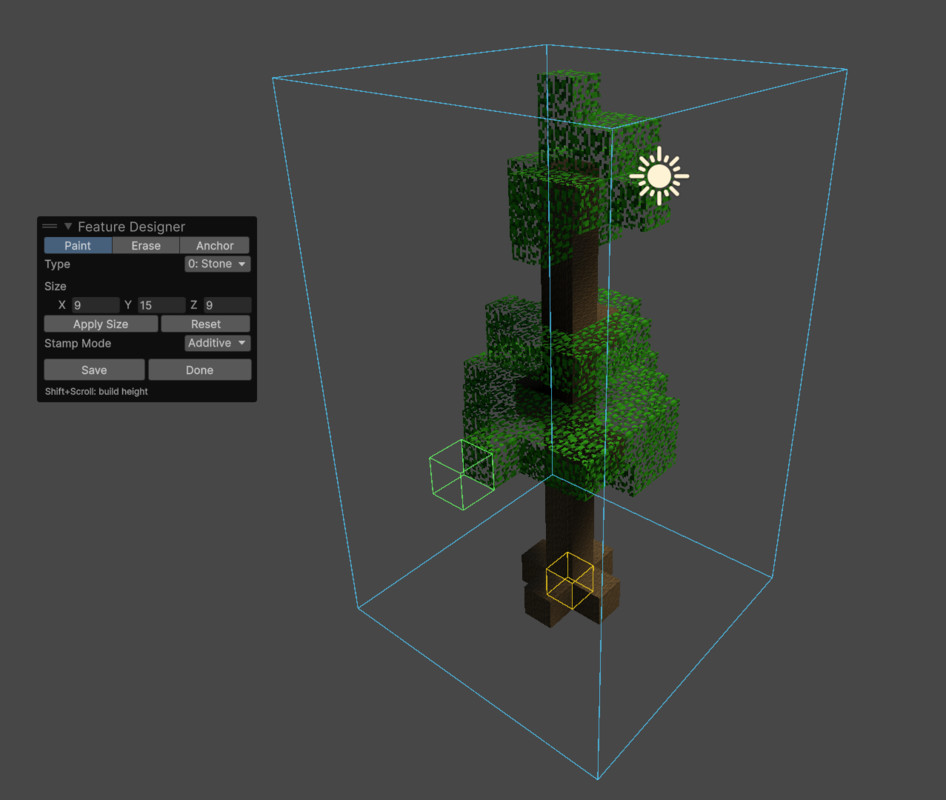
Build your placement content directly in the scene view! Need a tree or a house to be placed somewhere in the world based on rules? Simply create a new Feature and edit it with any Voxel types you want directly in the scene view and reference it in the proc gen pipeline to get it everywhere in the world.
Scuplting (Mutation) Features
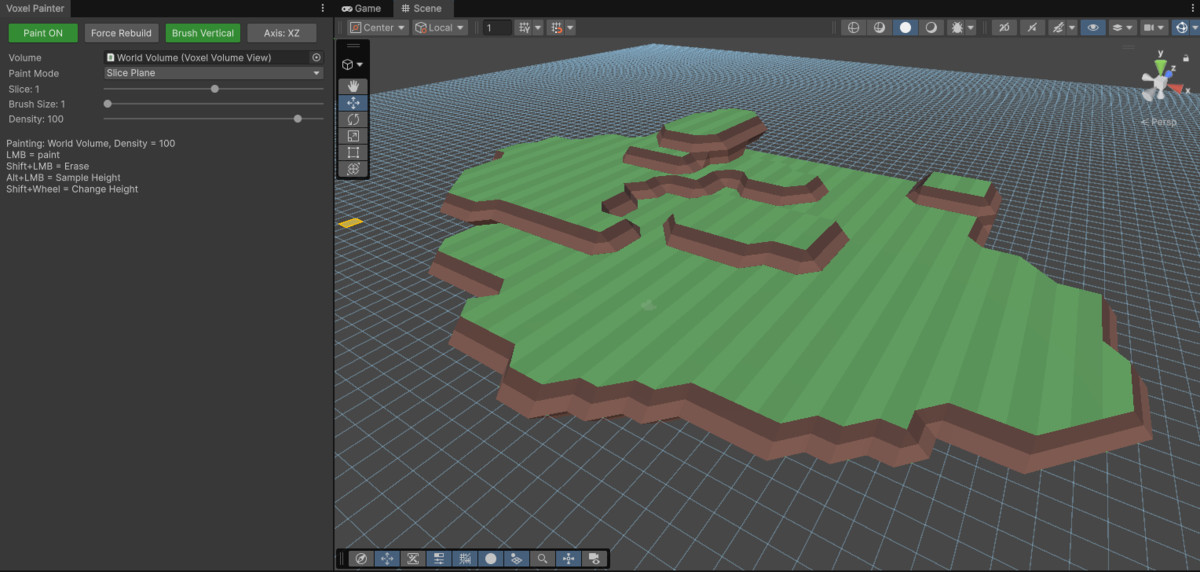
If you're looking for a tool that is less proc-gen and more hands-on then you also get that with Cenote. Since the data it serializes is only the mutated cell data, you can simply generate volumes that are only air/empty cells, then just manually set the type with editor tools and brushes. This allows you to paint levels in a few different ways, and is especially useful if you are accustomed to Tile-Based design tools.
- Slice-Plane Painting (precise, technical)
- Brush-based Painting (broad, organic)
- Write mutations and serialize only the mutations
Performance Features
No process is useful if it fails to be performant. Every descision in Cenote is driven by the fact that it must be incredibly performant.
- Burst and Jobs support throughout
- Greedy Mesh topology generation where possible
- 32³ Chunks of voxels for dirtying
- Proximity based Chunk Streaming
Style Features
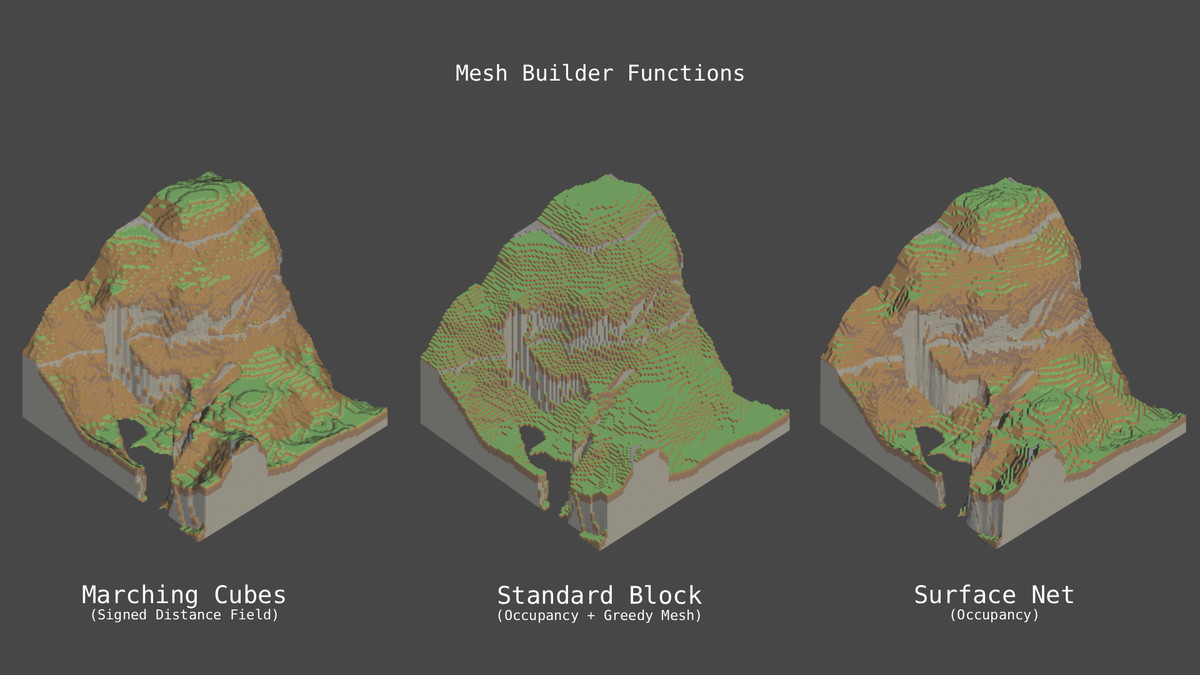
Voxels are kind of like 3d pixels with some data, and you have to render those points in some way in order to get the look you expect. With Cenote you can Occupancy or Density fields of data. If you want to leverage SDF tooling on top of your world data then go ahead, the system supports it. If you only want binary on/off Occupancy data fields then that is also intrinsically available as well and would gain you some significant performance improvements. There are several included Mesh Builder options and you are free to change them whenever you wish.
- Block (Occupancy)
- Block (SDF)
- Marching Cubes (SDF)
- Surface Net (Occupancy)
Who It's For
- Solo developers and small teams building procedural or hand-crafted 3D voxel levels
- Technical artists who want full source access and a clean, extensible architecture
- Anyone building large scale voxel worlds with high performance requirements
Notable By-Design Choices
1. Design flexibility affects performance:
Because of the incredibly flexible nature of the noise design pipeline we lose some potential performance potential versus simpler approaches such as height-based-only surfaces. You'll have more potential for interesting, compelling and controlled world shaping results with Cenote, but the trade-off is less-than-perfect memory usage and access if your world doesn't need the extra quality control. If there is sufficient interest, we would consider adding an alternative pipeline for heightmap-only worlds with ideal performance.
2. Chunk shape is cubic and infinite:
Because there are an immense number of usages for Voxel Engines we've made Cenote deliberately infinite and fixed-chunk size with spatial deterministic generation. The tradeoff is that if your world has a fixed size then there's no path to optimize for that constraint - everything is infinite. Minecraft, for example, uses 16x16x384 chunks for world storage, which makes memory footprint predictable and more accessible in terms of height. Cenote is infinite, assuming your world has no limits and voxels are fixed at 32x32x32.
Requirements
- Unity Burst & Jobs
- Unity Collections
- Unity Mathematics
- Unity URP for the Triplanar shader included
- Unity Shader Graph for the Triplanar shader included
From the publisher's Asset Store listing.
Technical details
Current version uses a Triplanar shader made in Shader Graph.
Compatibility
| Unity version | Built-in | URP | HDRP |
|---|---|---|---|
| 6000.3.8f1 | Not listed | Compatible | Not listed |
Included shader is URP, but you can easily swap it out for your own.
As listed on the Asset Store.