
 View on Asset Store (opens in new tab)
Package details
- Latest version
- 1.1
- Last updated
- First released
- Unity version
- 6000.3.7 or later
- Package size
- 7.1 MB
- Files
- 76
- Favorites
- 8
- Views in the past week
- 14
Price tracking
- Last checked
- Tracked since
- Lowest recorded
- $34.30 on
Keywords

Particles Ghost Mesh
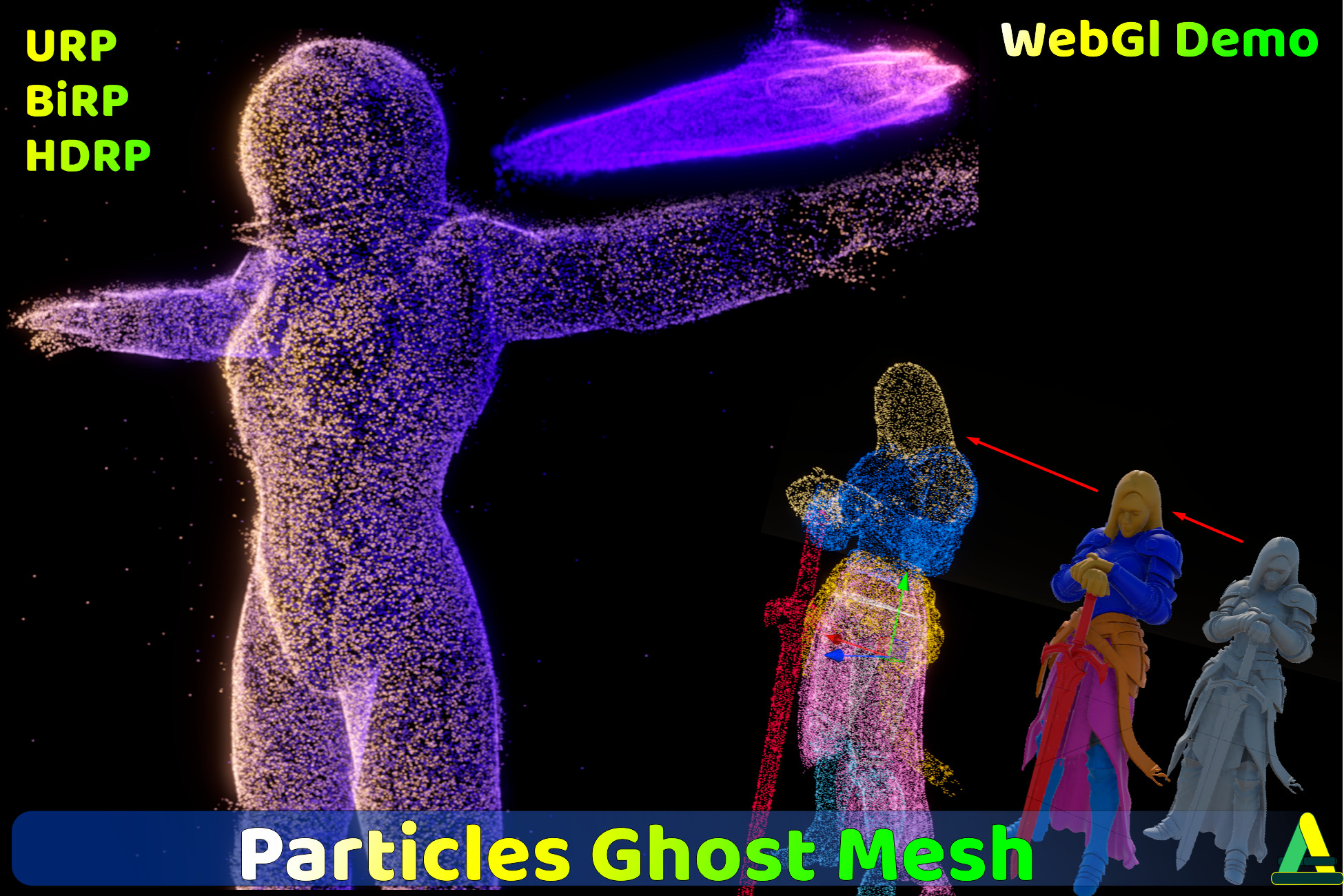
Particles Ghost Mesh turns any mesh into a ghostly cloud of glowing points that reacts to the pointer, drifts with wind and flows along an axis. Everything runs on the GPU in a single draw call.
Affiliate link · Purchases support this site
Price history
Last 6 months
USDAsset preview
1 / 5

Particles Ghost Mesh screenshot 1




About this asset
LIVE WEBGL DEMO also on my site main page
Turn your mesh into a ghost, a hologram or a cloud of drifting embers.
Bake a static prop and it becomes a self contained point cloud. Bake a rigged character and the cloud dances with any Animator, throwing sparks behind every moving limb. The baker converts geometry into a point cloud stored in two compact textures.
A static cloud does not reference the source mesh, so the model can stay out of the build entirely. Any mesh you can import is a valid source, from a single prop to a whole environment hierarchy or a character. That is how you get dancing spirits and apparitions, holographic UI and sci fi scanners, dissolve and respawn transitions, logo intros, data visualization and landing page scenes, all from models you already have in the project.
At runtime the cloud is one mesh and one material. There are no compute shaders and no GraphicsBuffers anywhere in the pipeline, skinning included, which is why it runs in a browser tab and on a phone where compute based particle systems refuse to start.
★ URP, HDRP AND BUILT-IN ★
One package for all three render pipelines. Every shader carries a SubShader per pipeline and Unity picks the matching one automatically. Demo scenes are included for each pipeline, including a dancing character scene.
★ BUILT FOR MOBILE AND WEB ★
The simulation is a fragment shader blit on a pair of ping pong render textures.
Shader target is 3.5. That keeps the asset compatible with WebGL2, WebGPU,
Android and iOS, where compute based particle systems simply refuse to work.
Point size is clamped in pixels, so a 160k point cloud stays readable and cheap
at any resolution and on any screen.
★ ANIMATED GHOSTS ★
Drop a character with a SkinnedMeshRenderer into the baker and you get a cloud plus a skin asset that binds every point to its bones. Assign the animated character as Skin Root and the cloud follows clips, blend trees and Timeline with no code. The trail system records 32 frames of bone history, so sparks follow the real past path of each limb, cool from hot to cold color and fade. A still body leaves no trail.
★ ONE COMPONENT, SEVEN SYSTEMS ★
Pointer repulsion, wind, flow, spark trail, HDR gradient, material palette tinting and self occlusion, all from one Liquid Mesh Particles inspector. Every system is independent and switches off from a single field, with no shader variants per system.
★ A REAL BAKER, NOT A RANDOM SCATTER ★
The Point Cloud Baker merges every MeshFilter under a source object, welds
coincident vertices, distributes points by triangle area and then runs a
Poisson rejection pass so the result has an even minimum spacing instead of the
clumps you get from naive sampling. Hard edges can be walked separately so
silhouettes and creases stay sharp at low point counts. Material colors are
collected into a palette of up to 32 entries, so a multi material model keeps
its color identity in the cloud.
★ FULL SOURCE, NO BLACK BOXES ★
Three C# files, three shader files, one shared HLSL include. No DLLs, no third
party dependencies, no hidden runtime. Read it, edit it, ship it.
Perfect for holographic UI, ghosts and spirits, dancing characters, dissolve and respawn effects, sci fi scanners, data visualization, logo intros, landing pages and portfolio scenes.
From the publisher's Asset Store listing.
Technical details
- URP, HDRP and Built-in. One package, one SubShader per pipeline, demo scenes for each.
- Any mesh to point cloud. Bake a whole hierarchy of MeshFilters and SkinnedMeshRenderers into one cloud in a few seconds.
- Up to 500 000 baked points and up to 1 000 000 rendered particles.
- Skinned clouds. Points are bound to bones with 4 influences per point and follow any Animator: clips, blend trees and Timeline. No code required.
- GPU skinning without compute. Bone matrices go into a texture and two blit passes skin positions and normals every frame.
- Spark trail. Trail points lag behind moving limbs along their real past path, cool from a hot to a cold HDR color and fade by age. A still body shows no trail.
- Self occlusion. An optional depth pass hides points behind the front surface, so the back of a body never shows through.
- Effect pool. Wind and trail points come from surplus particles or a reserved share of the cloud, thinned evenly with no holes.
- Morphing playlist. Chain baked clouds in a list and let each shape dissolve into the next. Hold time and transition time are set per entry. A resting cloud costs exactly what a single cloud costs, only the transition pays for two.
- Every setting travels with the cloud. Each entry is a prefab with its own colors, wind, flow, gradient, scale and orientation, and all of them interpolate across a transition.
- Turntable rotation. One speed field spins the whole playlist around Y for showreels and product shots.
- One mesh, one material. No per particle CPU work, no GraphicsBuffer, no instancing overhead.
- No compute shaders. Simulation and skinning are fragment blits, so the asset works on WebGL2, WebGPU, Android and iOS in URP and Built-in.
- SRP Batcher compatible draw shader. The material palette lives in a texture, every per material value stays in one constant buffer.
- Pointer and touch interaction. Points are pushed away in screen space with an exponential follow and settle back smoothly. Mouse and touch, new Input System and legacy.
- Wind system. Direction, facing selection, normal bias, per point spread, travel distance, speed, fade in and falloff.
- Flow system. Particles travel along an object space axis, hugging the surface, and ghost out at the geometric boundary.
- HDR gradient. Two HDR colors projected on any axis, with an adjustable midpoint and a blend slider against the baked material palette. On skinned clouds colors stay attached to body parts.
- 32 material palette. Colors are read from _BaseColor or _Color at bake time and preserved per point.
- Poisson disk distribution. Even spacing instead of clustered noise, with a deterministic seed for reproducible bakes.
- Hard edge sampling. Dedicated point budget for creases and silhouettes, controlled by a dihedral angle threshold.
- Pixel clamped point size. Minimum and maximum on screen size keep the cloud readable from any distance and on any resolution.
- Live scene view preview. Skinning, wind, flow, gradients and density update without entering Play mode.
- Full C# and HLSL source included. No DLLs, no external dependencies.
- Documented in the editor. A welcome window renders the full README inside Unity.
Compatibility
| Unity version | Built-in | URP | HDRP |
|---|---|---|---|
| 6000.3.7f1 | Compatible | Compatible | Compatible |
As listed on the Asset Store.