
 View on Asset Store (opens in new tab)
Package details
- Latest version
- 1.0.0
- Last updated
- First released
- Unity version
- 6000.3.10 or later
- Package size
- 181 KB
- Files
- 123
- Favorites
- 2
- Views in the past week
- 10
Price tracking
- Last checked
- Tracked since
- Lowest recorded
- $11.19 on
Keywords
- Search for URP
- Search for Asset Optimization
- Search for srp batcher
- Search for Shader Analysis
- Search for material audit
- Search for Addressables analysis
- Search for Dependency Graph
- Search for shader variant analysis
- Search for build optimization
- Search for shader governance
- Search for HDRP
- Search for Project audit

ShaderOS Pro
Shader and material governance for Unity. Scan for variant and keyword risk, enforce standards through versioned policy, and generate build-ready reports.
Affiliate link · Purchases support this site
Price history
Last 6 months
USDAsset preview
1 / 11
ShaderOS Pro screenshot 1
About this asset
ShaderOS Pro is an editor-only analysis and governance tool for Unity projects. It performs read-only inspection of materials, shaders, dependencies, and rendering workflow risk, then adds a policy layer on top so a rendering lead can set explicit standards and track a project against them over time.
It's built for rendering leads and technical artists who need an accurate, current picture of a project's shader and material health — not a one-time audit that goes stale the day after it runs. Shader and material problems tend to surface late: a keyword combination nobody tracked pushes variant counts past what a build can absorb, a broken shader reference goes unnoticed until a material renders pink, and technical debt has no record anywhere once "fix it later" becomes now. ShaderOS Pro turns a project's shader and material state into a structured, navigable picture, and keeps it that way as the project changes.
Key Features
Material & Shader Analysis
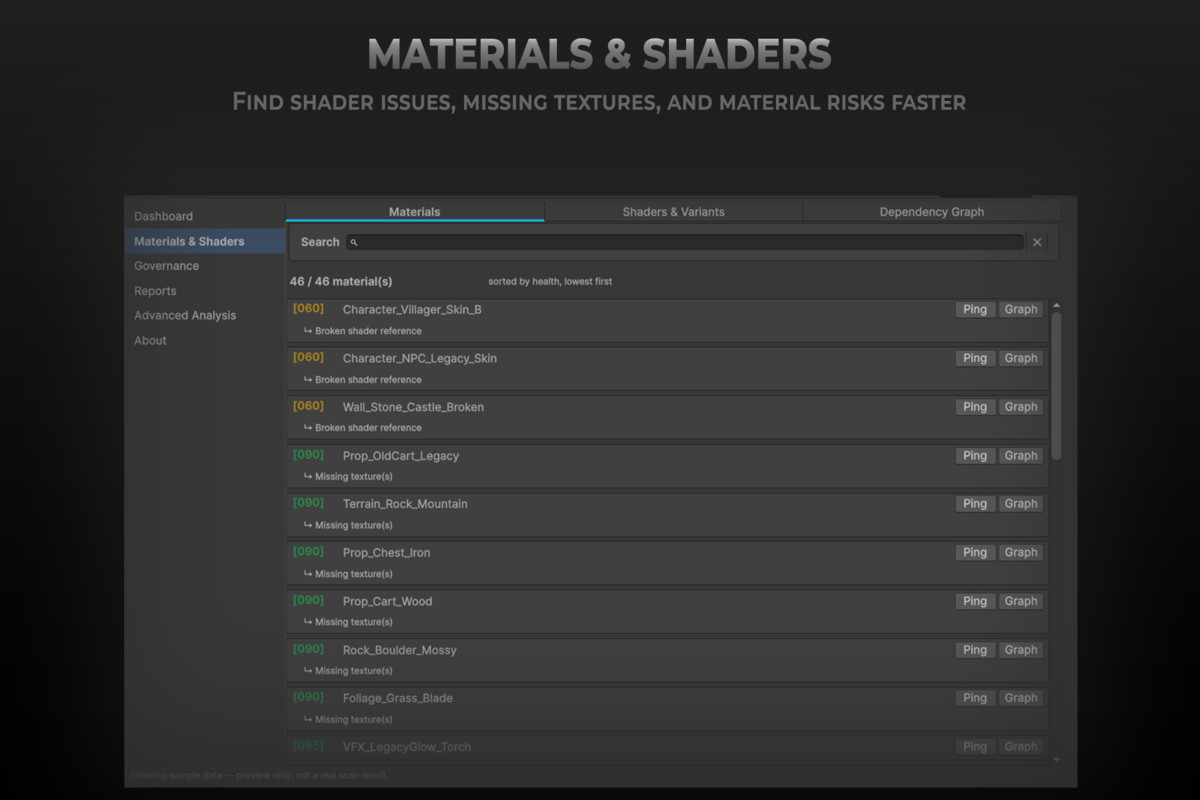
Scans every material and shader in a project and surfaces broken shader references, missing texture slots, per-material health scores, and SRP Batcher compatibility issues with the specific incompatibility reason for each one.
Dependency Visualization
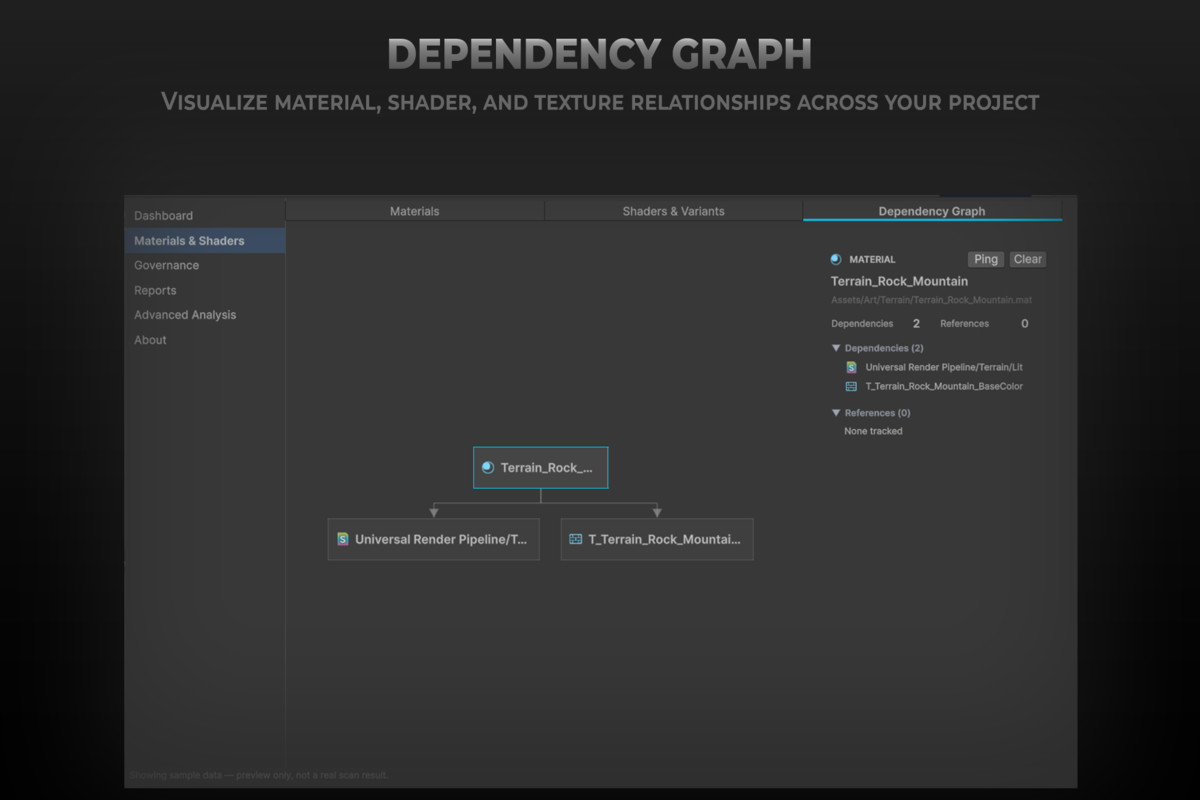
A read-only, node-based graph of how materials, shaders, and textures relate to one another. Selecting a node opens its dependencies and references in a side panel without altering the graph itself.
Project Health Insights
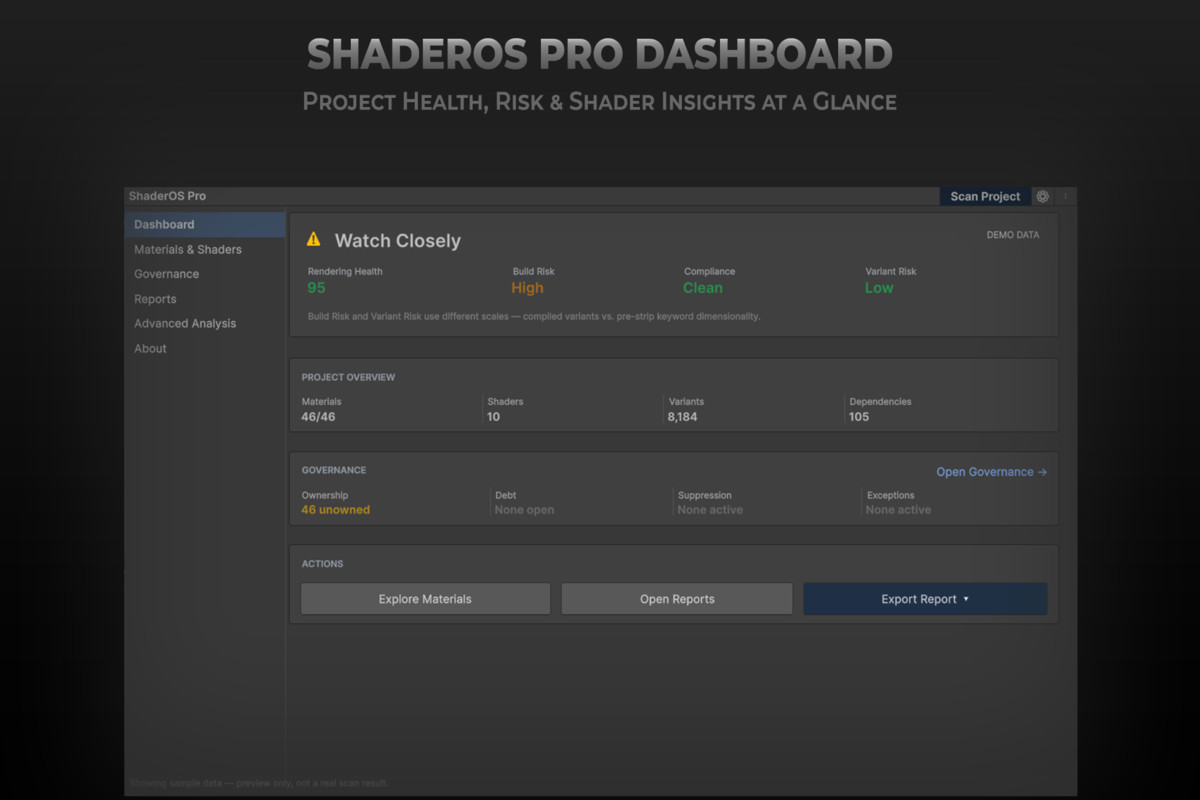
A dashboard summarizing project-wide rendering health, variant and keyword risk, governance status, and compliance at a glance, so a lead can see where a project stands before drilling into any one area.
Governance Workflow
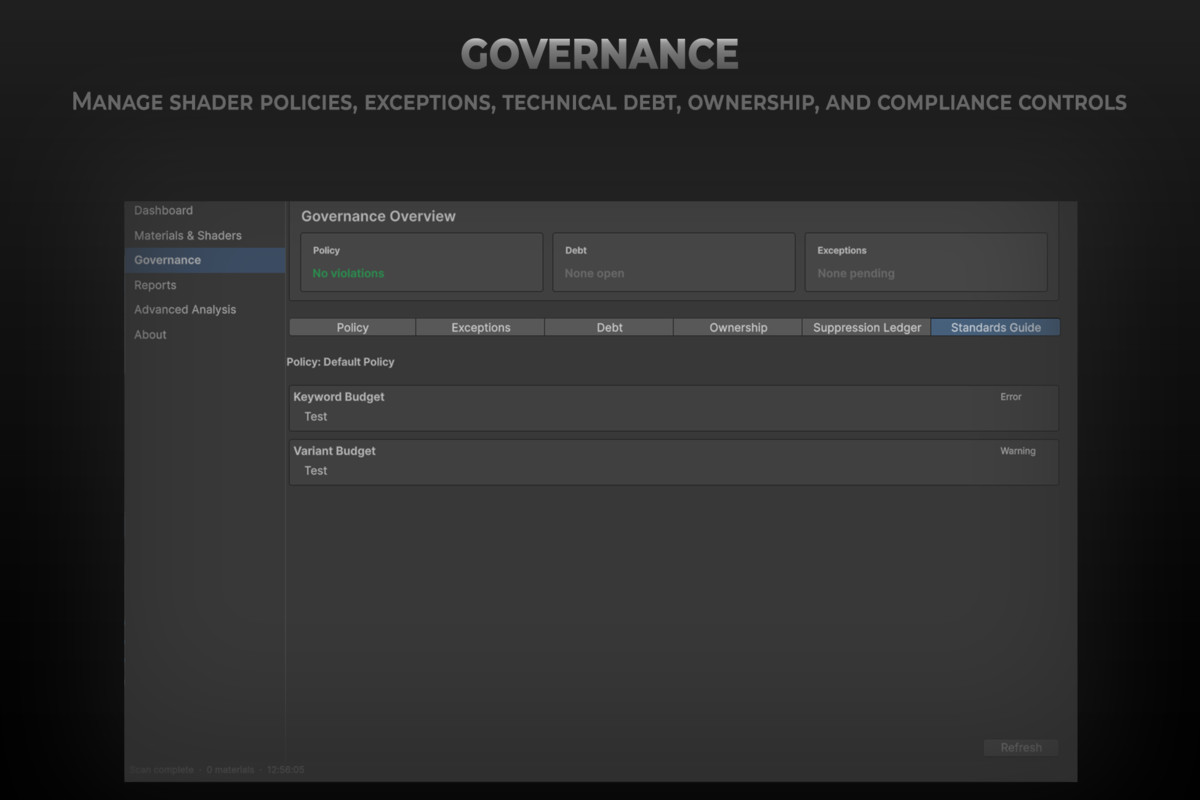
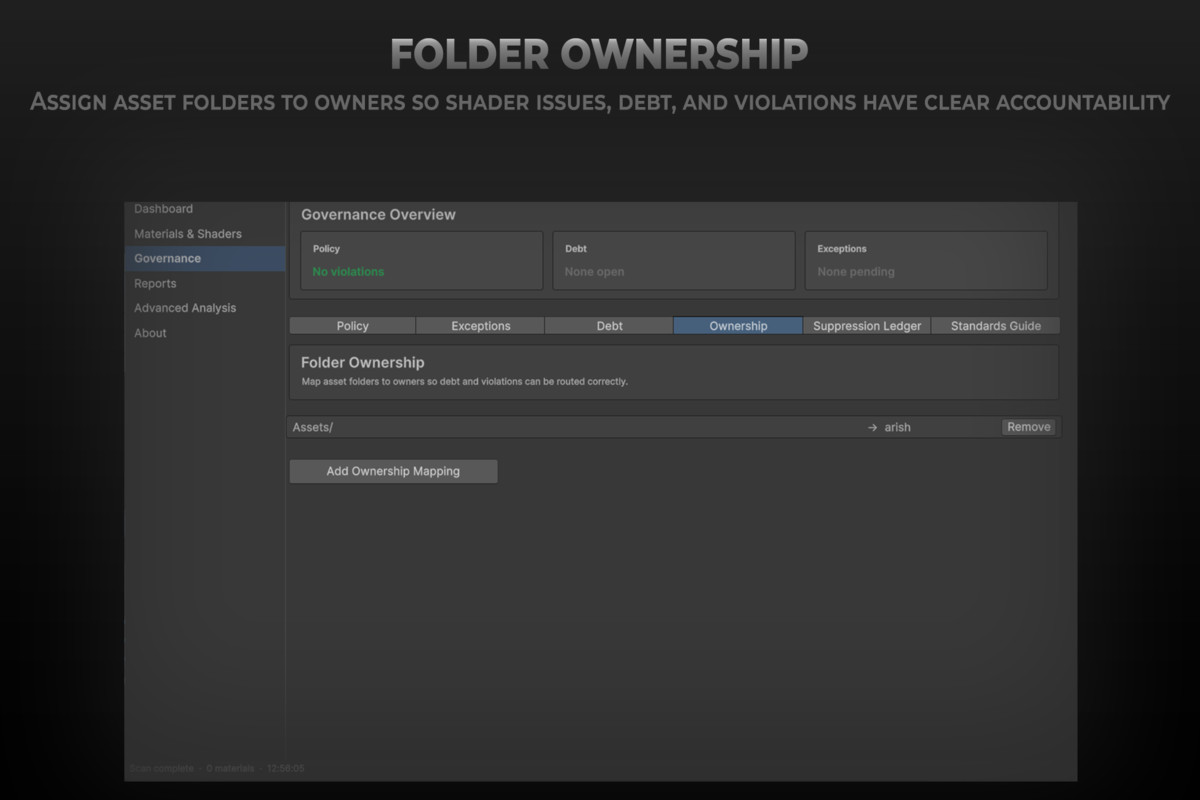
Author policy rules as versioned project assets and enforce them across every material and shader in scope, with folder-level ownership so debt and violations route to the right person. Violations, exceptions, and rendering debt stay visible and tracked rather than sitting behind a pass/fail checkmark.
Reports & Export
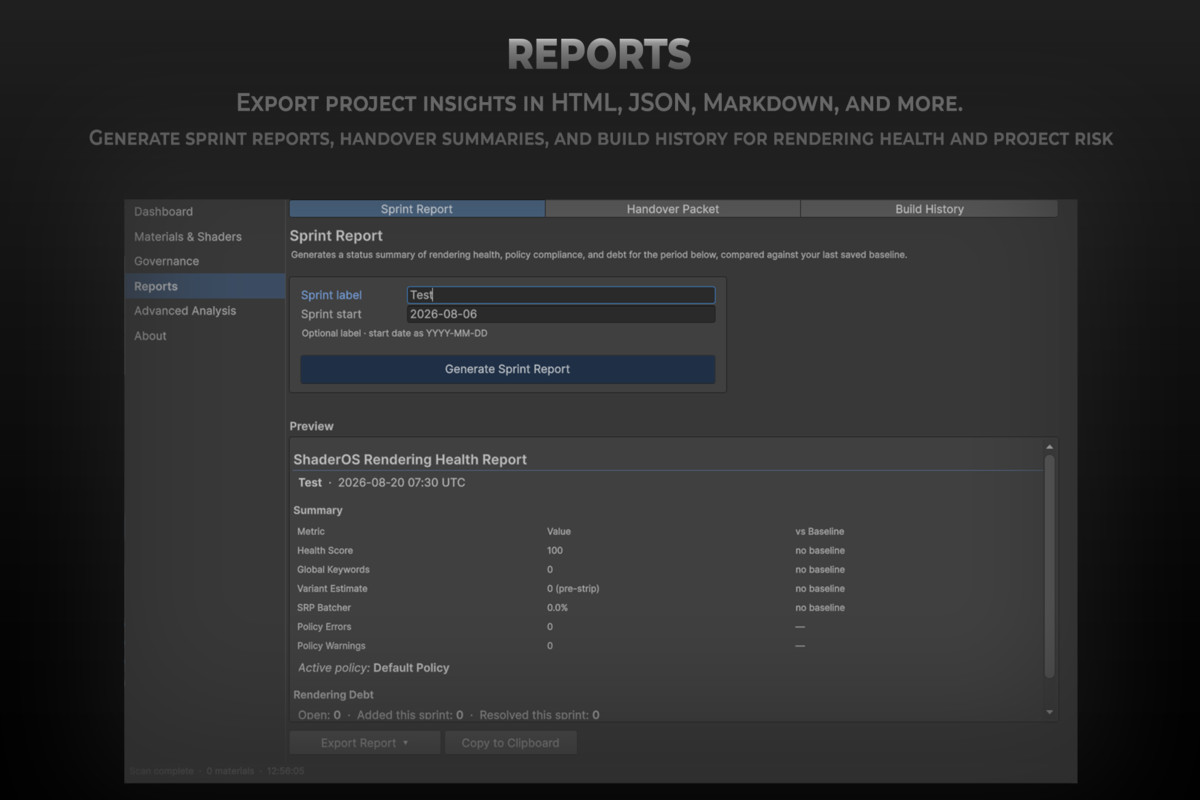
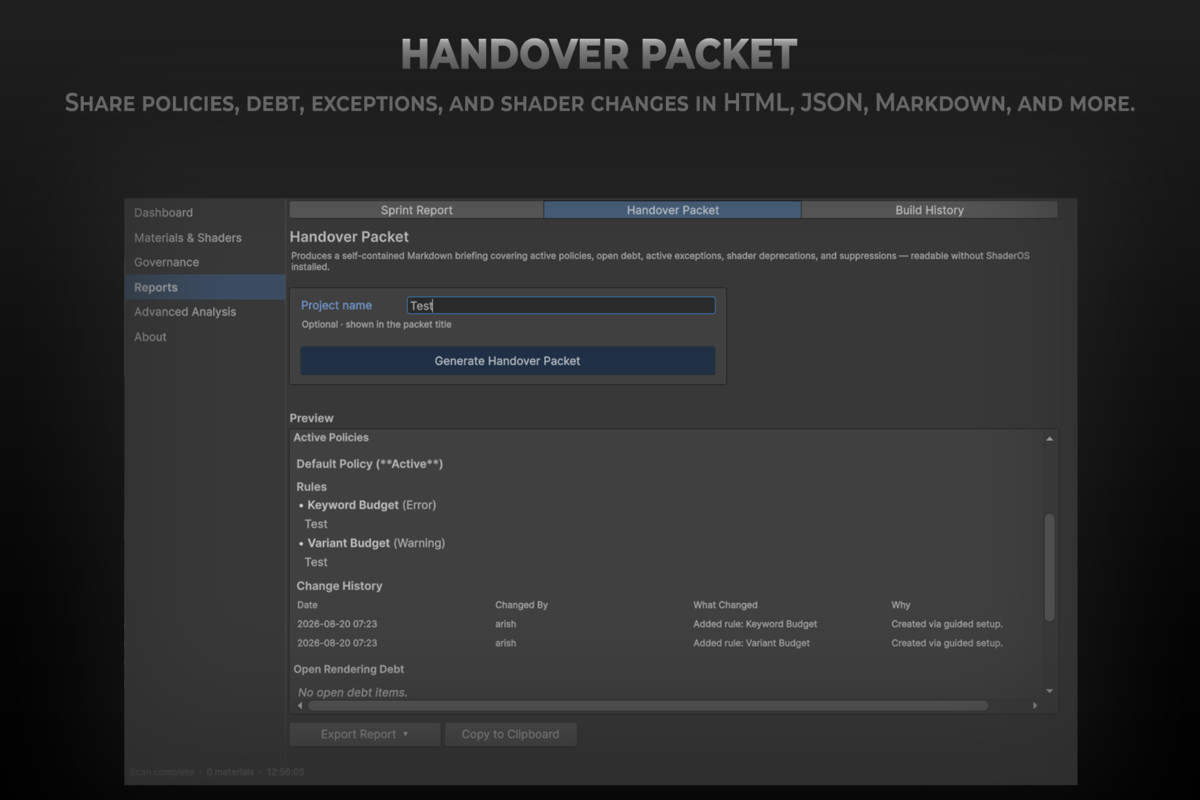
Generates Sprint Report and Handover Packet documents on demand, in Markdown, from captured scan and build history — output built for a person to read during a review or a handoff, not just raw scan data.
Advanced Analysis
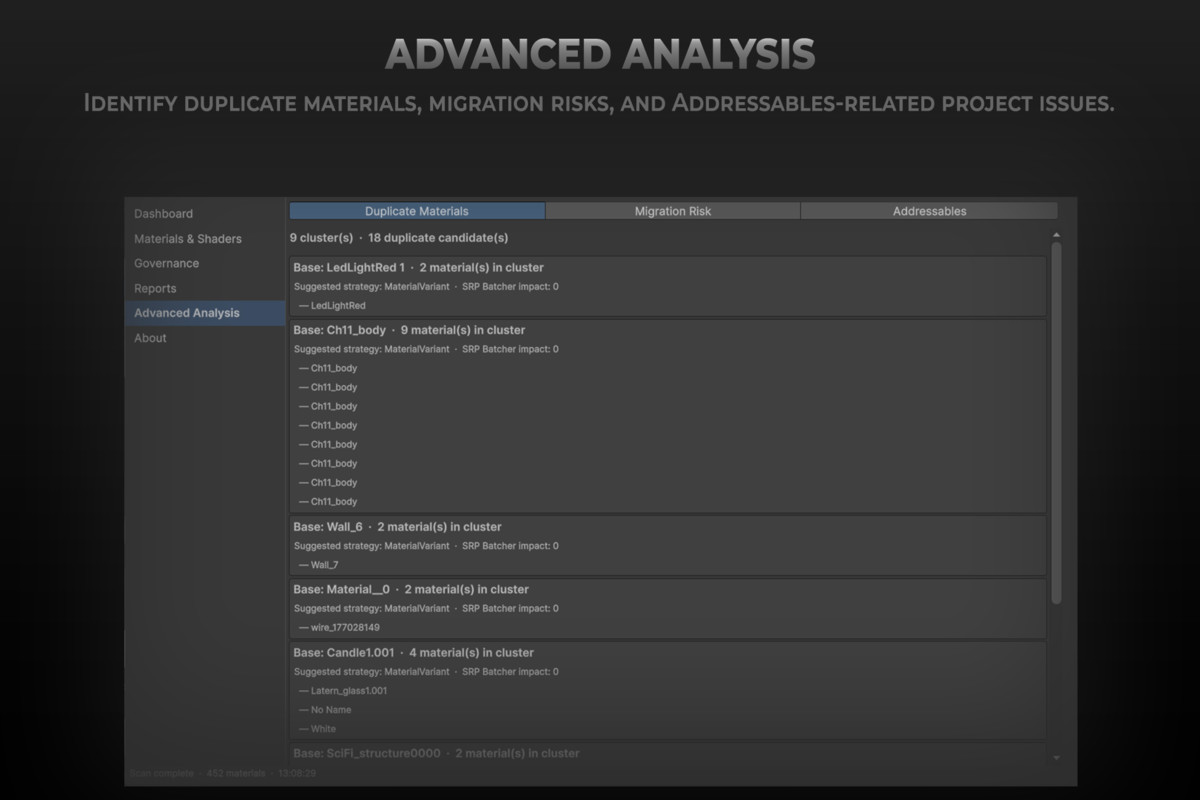
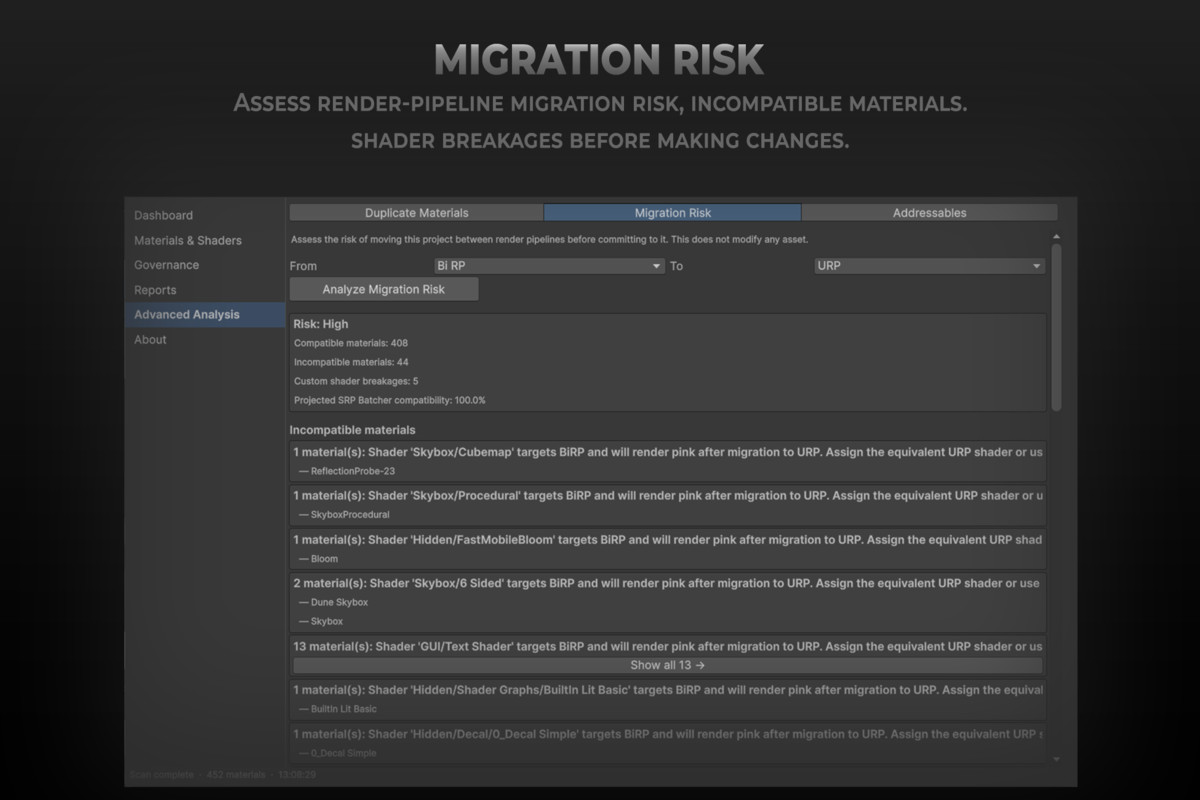
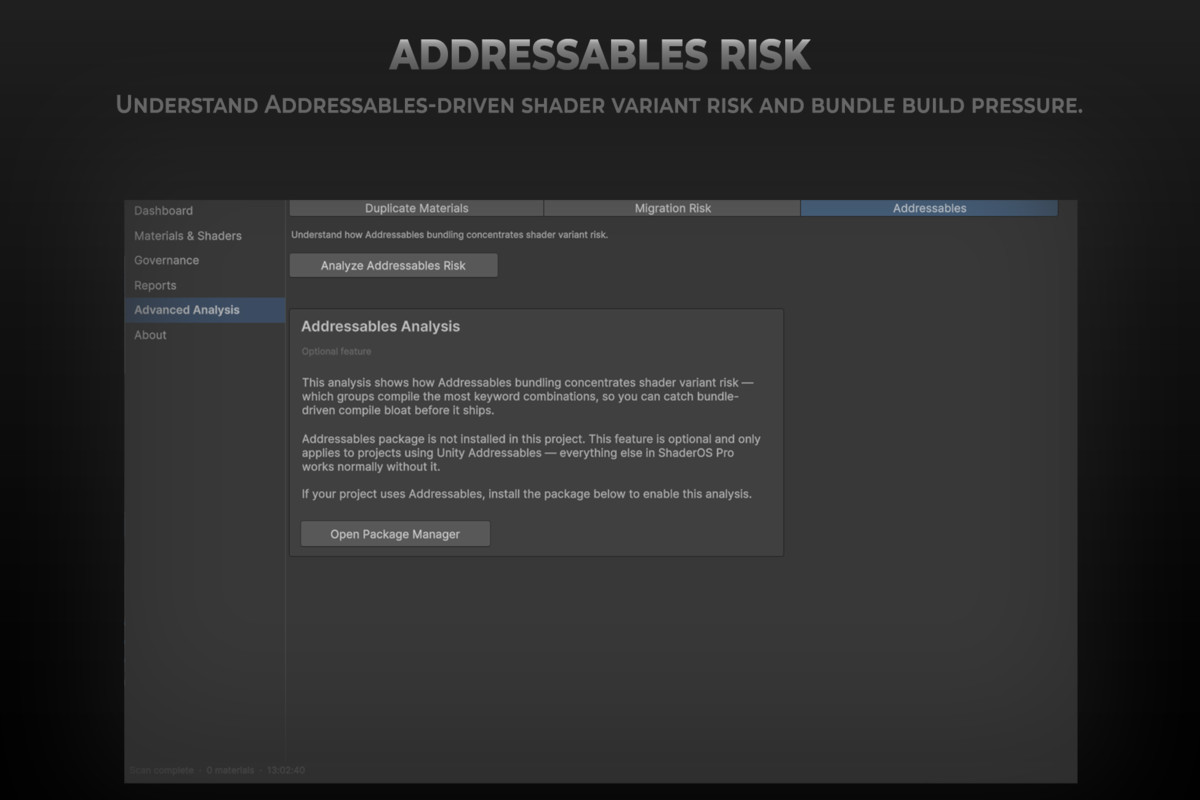
Detects near-duplicate materials, assesses render-pipeline migration risk between Built-in, URP, and HDRP with specific incompatible-material call-outs, and evaluates Addressables-aware variant risk for projects using that workflow.
ShaderOS Free vs ShaderOS Pro
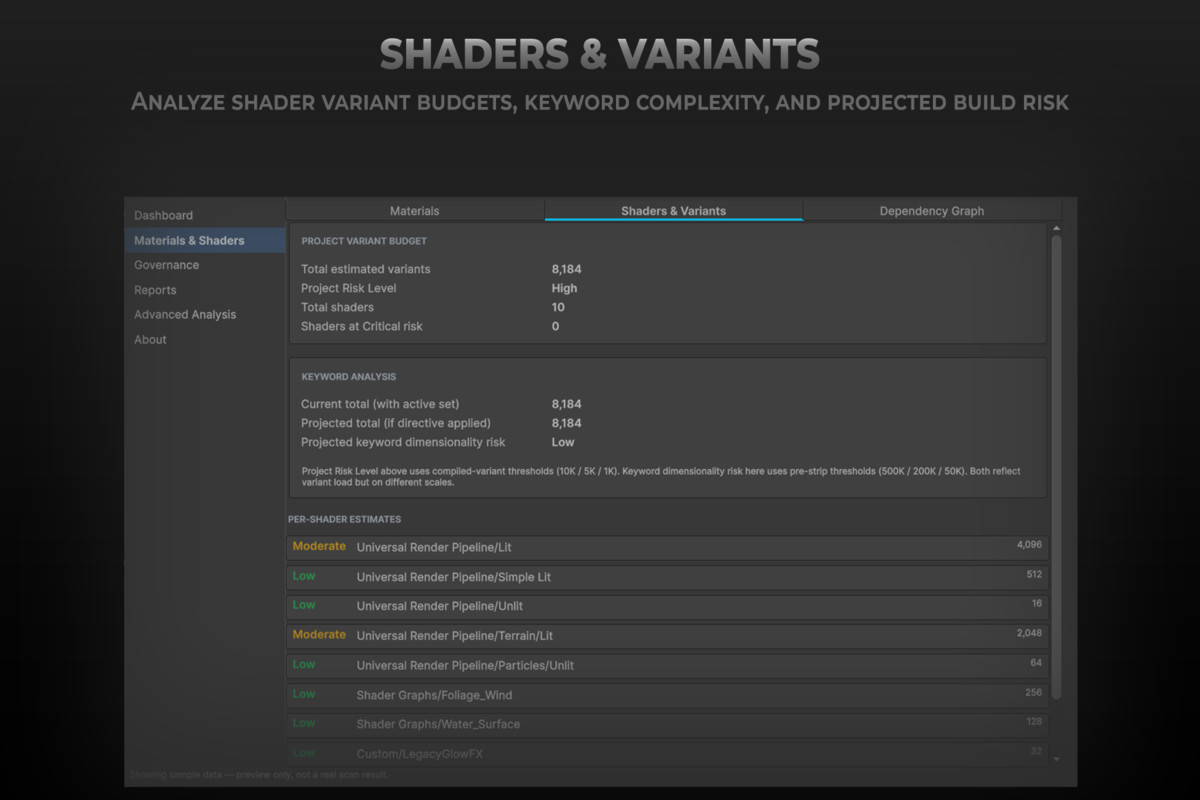
ShaderOS Free is the entry point into the same core workflow: a one-click material and shader scan, per-material health scoring, broken-reference and missing-texture detection, SRP Batcher compatibility flags, a keyword budget tracker, a pre-strip variant estimator, build history tracking, and the same read-only dependency graph — scoped to 100 materials per scan.
ShaderOS Pro removes that scan limit and adds the tooling for running this as an ongoing standard rather than a one-time check: versioned Governance policy rules with folder-level ownership, Compliance tracking for violations, exceptions, and rendering debt, side-by-side pre-strip and post-strip variant comparison against a configurable budget, on-demand Sprint Report and Handover Packet generation, extended build history, and the Advanced Analysis tools for duplicate materials, render-pipeline migration risk, and Addressables-aware variant risk.
Documentation & Support
Support: [email protected]
From the publisher's Asset Store listing.
Technical details
ShaderOS Pro runs entirely in the Unity Editor. No runtime component or assembly is added to a built player, and every scan, analysis view, and the dependency graph are read-only — nothing is modified, renamed, or deleted automatically. Governance rules are stored as versioned project assets rather than code, so they move through source control and review the same way any other project asset does. Reports export as Markdown by default, with HTML and JSON export also available. Addressables-aware analysis is detected automatically when the Addressables package is present in a project, and the rest of the tool works normally without it.
Workflow
Import ShaderOS Pro
↓
Complete first-run setup
↓
Configure scan scope
↓
Run a project scan
↓
Review the dashboard and flagged results
↓
Author policy rules and generate reports
Requirements
Unity Version: 2021.3 LTS or newer
Render Pipeline: Built-in, Universal (URP), High Definition (HDRP)
Required Packages: None
Platform: Unity Editor
Compatibility
| Unity version | Built-in | URP | HDRP |
|---|---|---|---|
| 6000.3.10f1 | Compatible | Compatible | Compatible |
ShaderOS Pro analyzes materials and shaders across Shader Graph, hand-written HLSL/ShaderLab, and Surface Shaders. SRP Batcher compatibility reporting works with Built-in, URP, and HDRP pipelines. Migration analysis identifies risks when moving from Built-in to URP or HDRP. Custom Render Pipelines can import the package but are not currently validated or supported for migration analysis.
As listed on the Asset Store.