
 View on Asset Store (opens in new tab)
Package details
- Latest version
- 1.1
- Last updated
- First released
- Unity version
- 6000.3.7 or later
- Package size
- 22.8 MB
- Files
- 74
- Favorites
- 3
- Views in the past week
- 59
Price tracking
- Last checked
- Tracked since
- Lowest recorded
- $13.50 on
Keywords

Aurora Borealis Snow
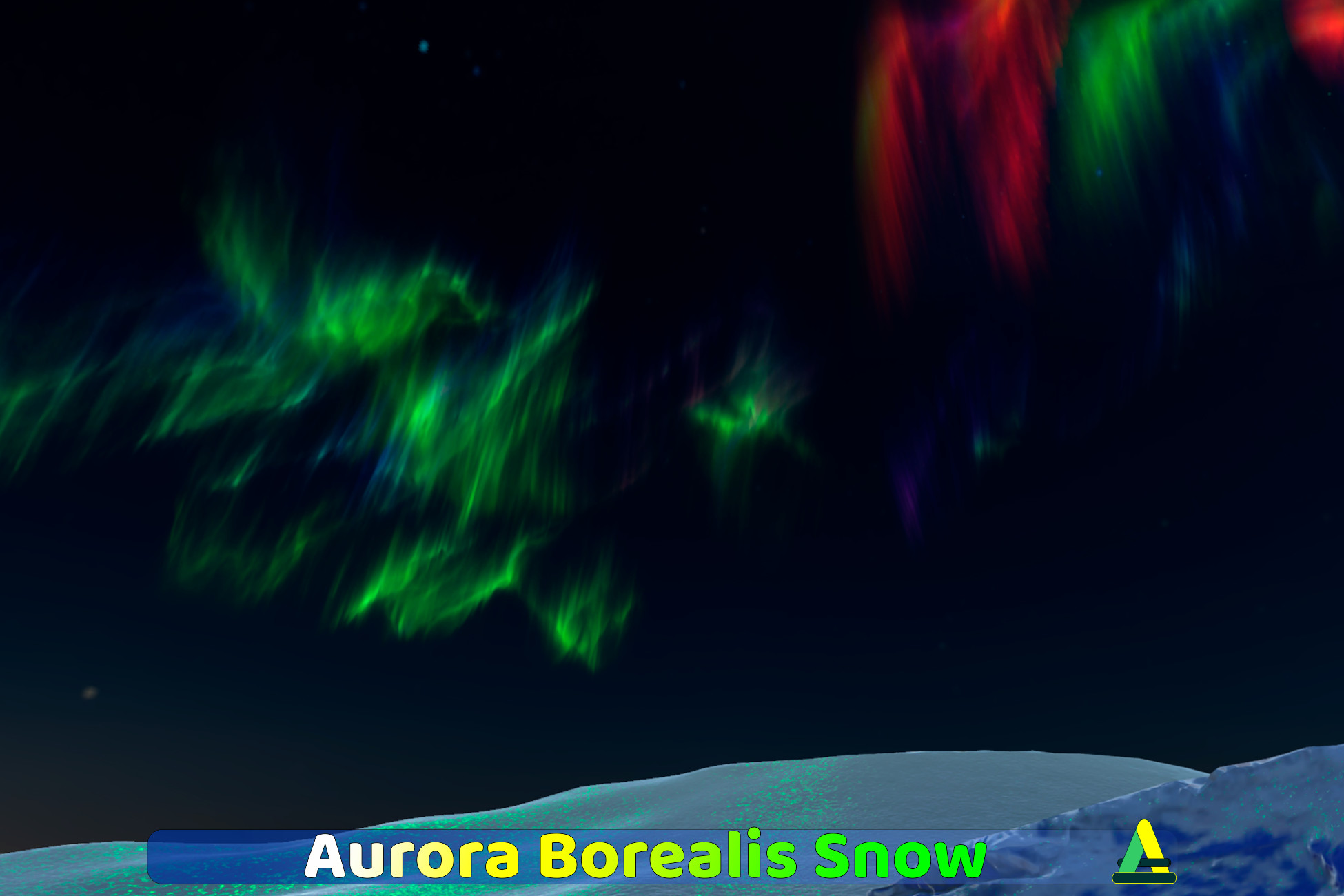
Realtime aurora borealis for URP. A live cubemap drives per-flake sparkle color, so your snow and terrain are actually lit by the sky above them.
Affiliate link · Purchases support this site
Price history
Last 6 months
USDAsset preview
1 / 10

Aurora Borealis Snow screenshot 1



About this asset
Most aurora assets paint the sky. This one lights the ground.
Aurora Borealis Snow is a complete night-scene toolkit for the Universal Render Pipeline: an animated aurora curtain system, a snow and ice mesh shader, and a snow terrain shader — built so that all three talk to each other.
Live in App "lumasphere" on google play market or apple store
The aurora is captured every few frames into a small realtime cubemap. Every sparkle on the snow samples that cubemap along its own reflection vector, which means a flake facing north picks up the green sheet drifting overhead while a flake beside it, tilted the other way, stays cold and blue. Nothing is averaged into a single tint. Move the camera, and the color of the ground changes with the sky.
The aurora
Curtains spawn around the camera in a configurable ring and track it as it moves, so the aurora keeps its apparent distance and reads as a genuine sky element rather than geometry you can walk into. Each curtain is a deformed plane driven by two sine waves, textured by two independent flipbook atlas layers that can be combined with Add, Multiply or Screen. Curtains fade in, drift, and fade out over randomized lifetimes, and they are pooled — nothing is instantiated at runtime.
Every parameter lives on a ScriptableObject, so you can build several aurora moods and swap them in one field. An Editor Preview toggle runs the whole system in the Scene View without entering Play Mode.
The snow
Two shaders, one lighting model. The mesh shader is built on URP's Lit stack with parallax offset, packed mask maps, and a transmission term that lets thin snow and ice glow when the moon — or the aurora — is behind them. The terrain shader is a full URP TerrainLit derivative, so you keep height blending, per-pixel normals for instanced terrain, terrain holes, deferred GBuffer output, lightmap baking, and multi-pass layers beyond four — with the sparkle and transmission model layered on top.
Meshes can also melt into the terrain: a noise-driven ground blend reads the live terrain heightmap and softens the base of boulders and ice formations into flat snow, so nothing sits on the surface with a hard intersection line.
Made to be read
Full source, no compiled libraries, no node graphs to reverse-engineer. Every shader is hand-written HLSL you can open, follow, and extend, and the sparkle model is isolated in a single include file you can drop into your own shaders in three lines. A detailed manual covers setup step by step, explains every property, documents the global shader properties, and lists the known limitations up front.
Requirements
- Unity 6000.3 or newer
- Universal Render Pipeline
- Forward or Forward+ rendering path (the terrain shader also supports Deferred)
- Linear color space and HDR enabled; a Bloom override is strongly recommended
From the publisher's Asset Store listing.
Technical details
Aurora system
- Pooled, camera-anchored curtains — no runtime instantiation, no garbage
- Two independent flipbook atlas layers with Add / Multiply / Screen blending
- Dual sine wave vertex deformation, anchored at the base and swinging at the top
- Texture-driven edge mask, so the quad silhouette never shows
- Randomized lifetime, drift, yaw, atlas frame and scroll speed per curtain
- Smooth fade-in / fade-out lifecycle driven by a single ScriptableObject
- Editor Preview: full system in the Scene View without entering Play Mode
Aurora-driven lighting
- Small realtime cubemap probe captures only the aurora, on its own layer
- Time-sliced capture with adjustable resolution (16–256 px) and refresh interval
- Per-flake directional sampling — sparkle color varies correctly across a surface
- Fade-weighted aurora direction and color published as global shader properties
- Disabling the probe removes the entire aurora contribution in one value
Snow & ice mesh shader
- URP Lit based: shadows, additional lights, reflection probes, SSAO, fog
- Quixel Megascans packed mask layout supported directly (R rough, G AO, B transmission, A height)
- Parallax offset from the height channel
- Subsurface transmission from both the main light and the aurora
- Distance-stabilized world-space sparkle with albedo and slope masking
- Noise-driven ground blend that sinks meshes into the terrain snow
- Full pass set: forward, shadow caster, depth, depth-normals
Snow terrain shader
- Complete URP TerrainLit derivative — nothing lost from the standard shader
- Height-based layer blending with custom material inspector
- Per-pixel normals for instanced terrain, terrain holes, basemap generation
- GBuffer pass for Deferred, meta pass for lightmap baking
- Multi-pass support for more than four layers
- Same sparkle and transmission model as the mesh shader, so materials match
Everything else
- Fully commented documentation, no black boxes
- Sparkle model isolated in one include — three lines to add it to your own shader
- Detailed manual: setup, property reference, performance tuning, troubleshooting
- Known limitations documented honestly, not hidden
Compatibility
| Unity version | Built-in | URP | HDRP |
|---|---|---|---|
| 6000.3.7f1 | Compatible | Compatible | Not listed |
As listed on the Asset Store.