
 View on Asset Store (opens in new tab)
Package details
- Latest version
- 1.0
- Last updated
- First released
- Unity version
- 6000.5.0 or later
- Package size
- 6.3 MB
- Files
- 72
- Favorites
- 1
- Views in the past week
- 7
Price tracking
- Last checked
- Tracked since
- Lowest recorded
- $9.99 on
Keywords
2Dx Procedural Generator Editor
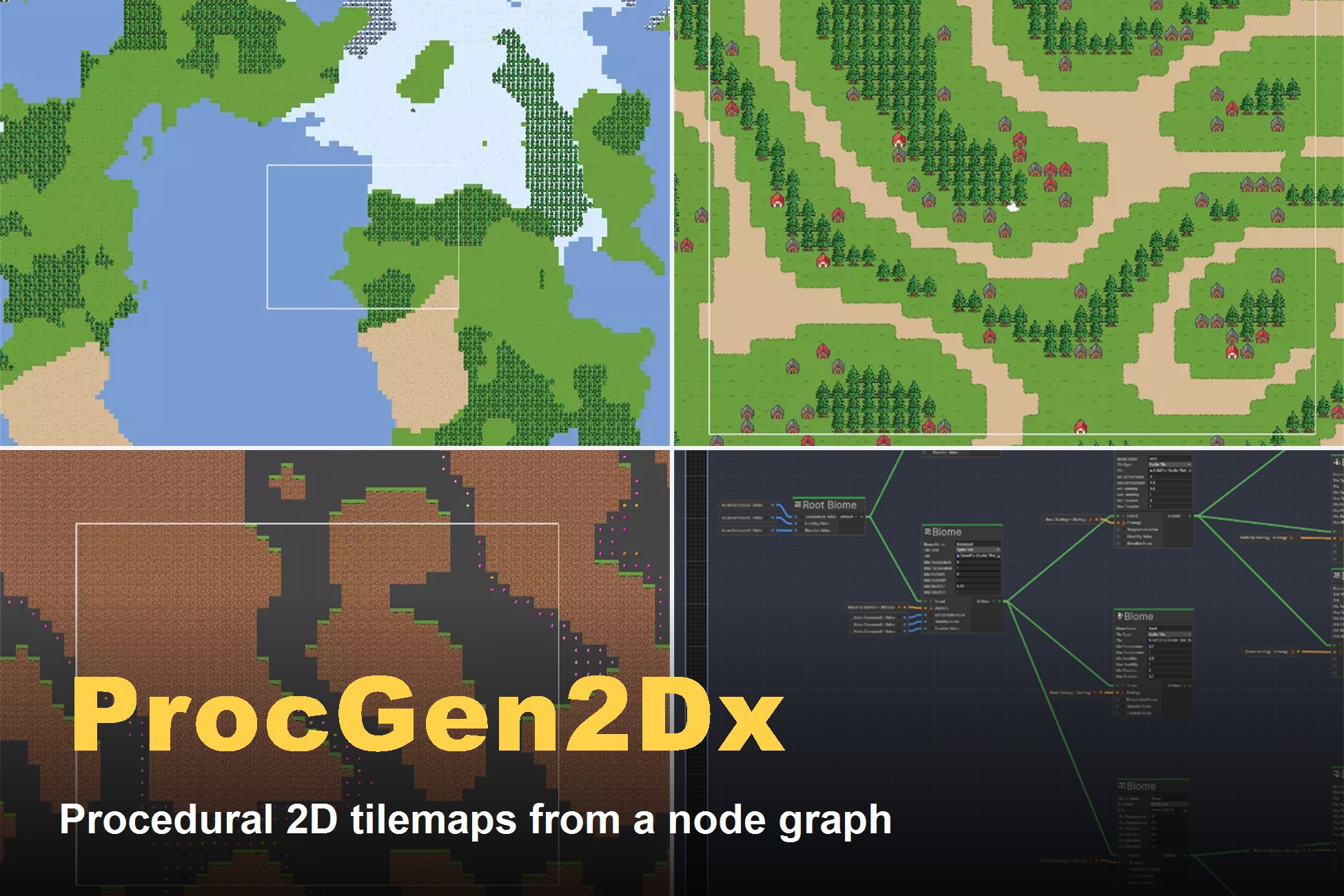
A 2D procedural tilemap generator for Unity. Combine noise, biomes, and placement strategies in Graph Toolkit graph to quickly create layered, customizable worlds.
Affiliate link · Purchases support this site
Price history
Last 6 months
USDAsset preview
1 / 6
2Dx Procedural Generator Editor screenshot 1
About this asset
OVERVIEW
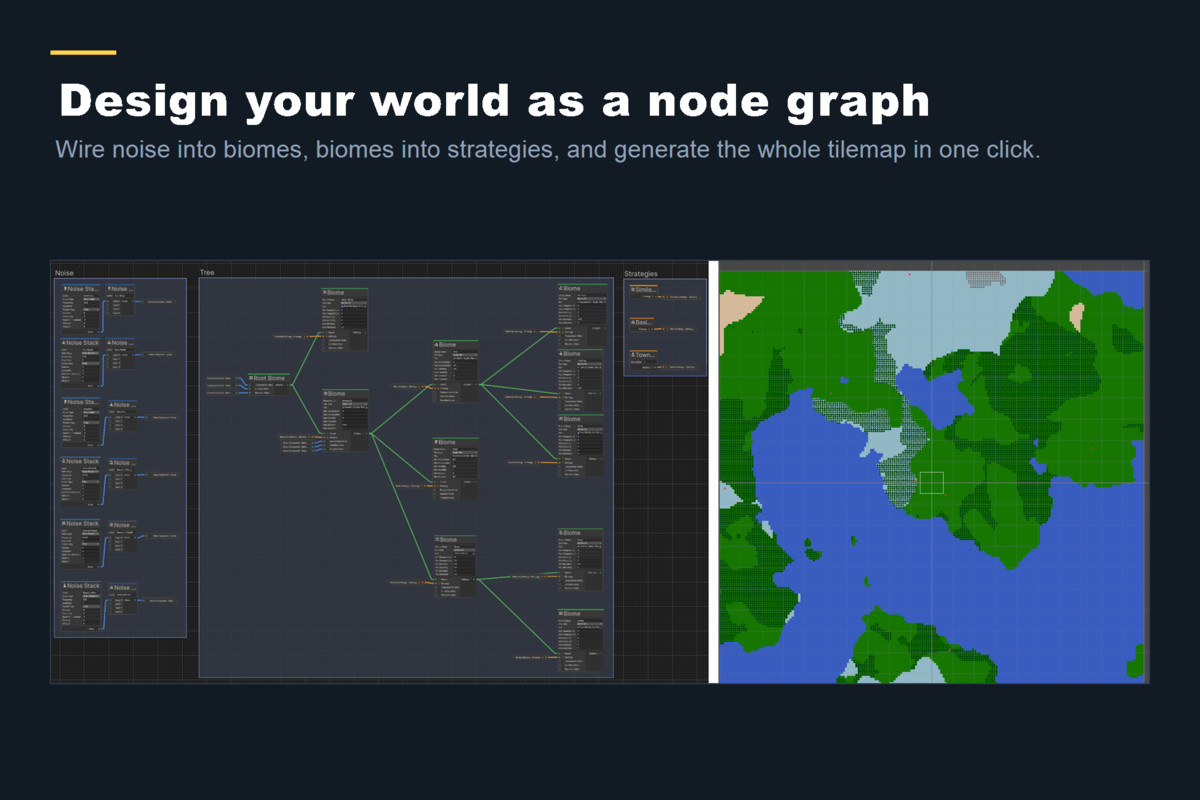
ProcGen2Dx is a powerful yet intuitive solution for 2D procedural tilemap generation in
Unity 6.5 and later. Built on Unity's own Graph Toolkit, it gives you a native visual node
graph where noise maps, biomes, and placement strategies combine into diverse, layered
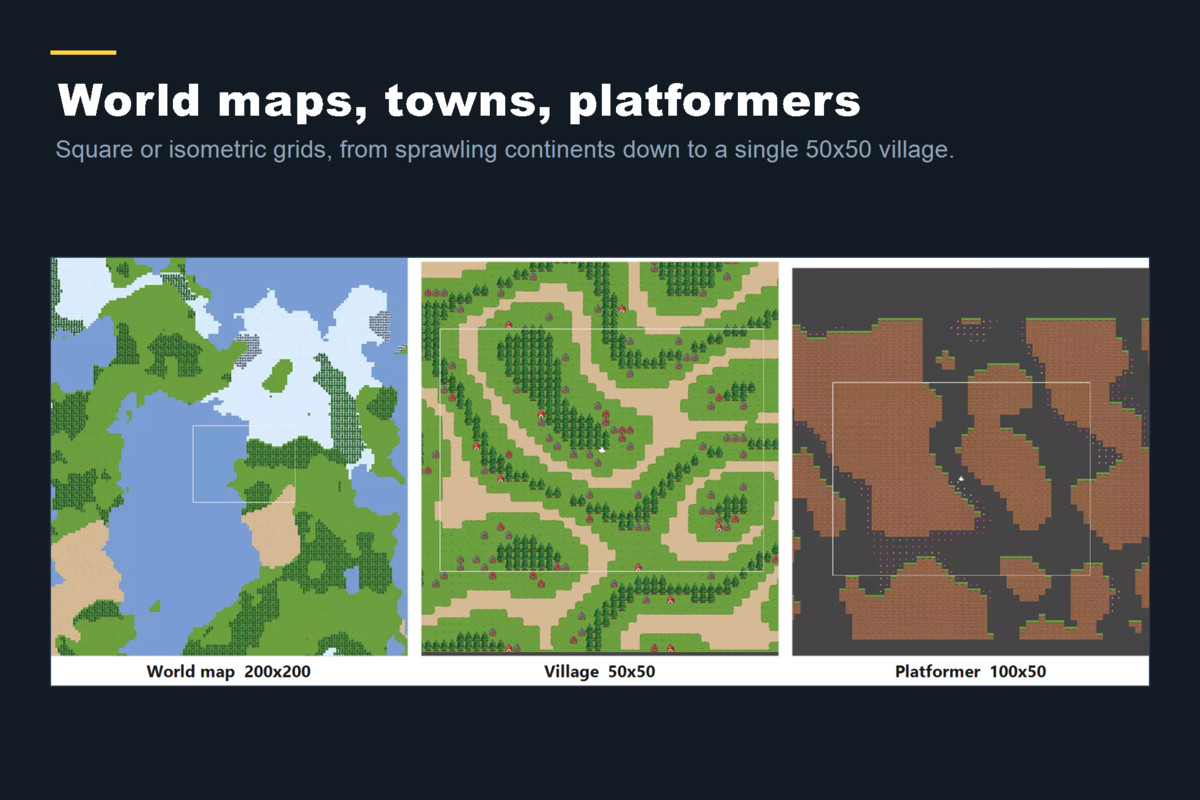
worlds with minimal manual effort — top-down RPGs, roguelikes, strategy and survival
games, overworld maps, or side-scrolling platformers, on square or isometric grids.
NOISE
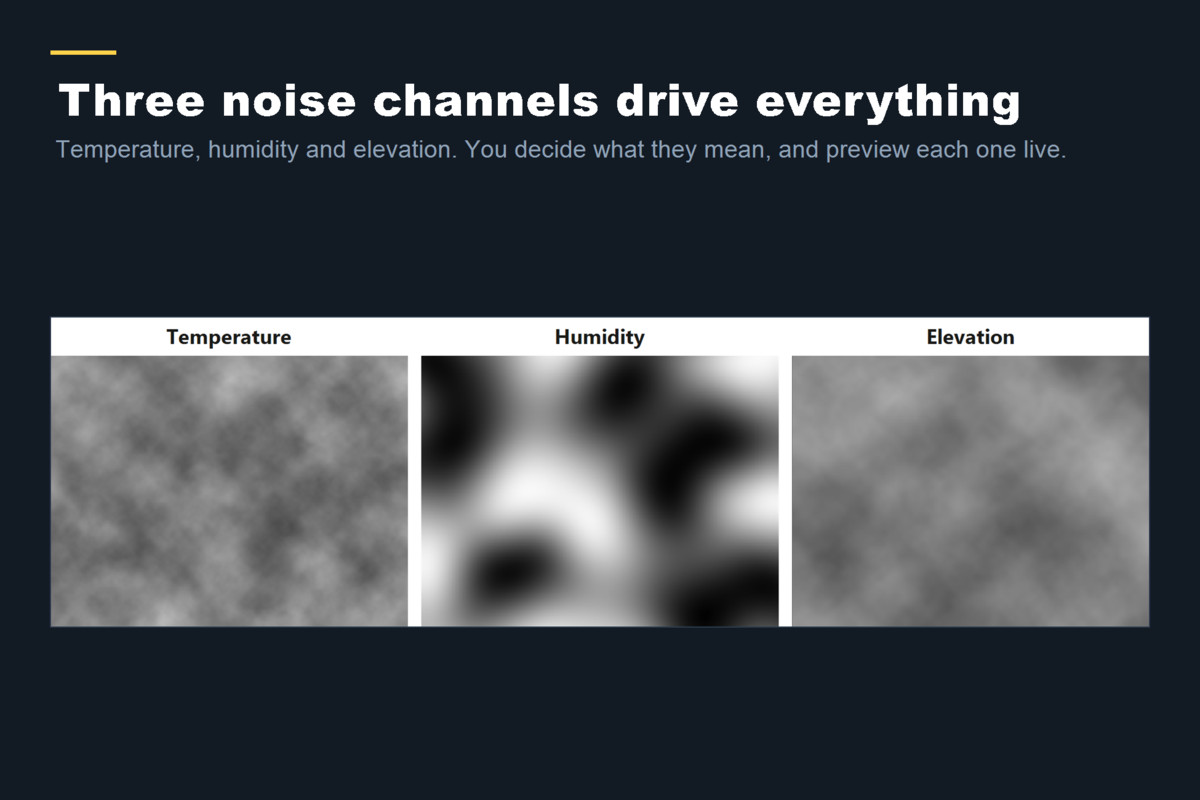
With support for multiple noise types (Perlin, Simplex, fractal), customizable biome
constraints, and reusable strategy logic, you can precisely control both large-scale
terrain features and fine-grained tile placement. Whether you want natural landscapes,
layered biome structures, or experimental map designs, the system adapts to your creative
needs.
TILES
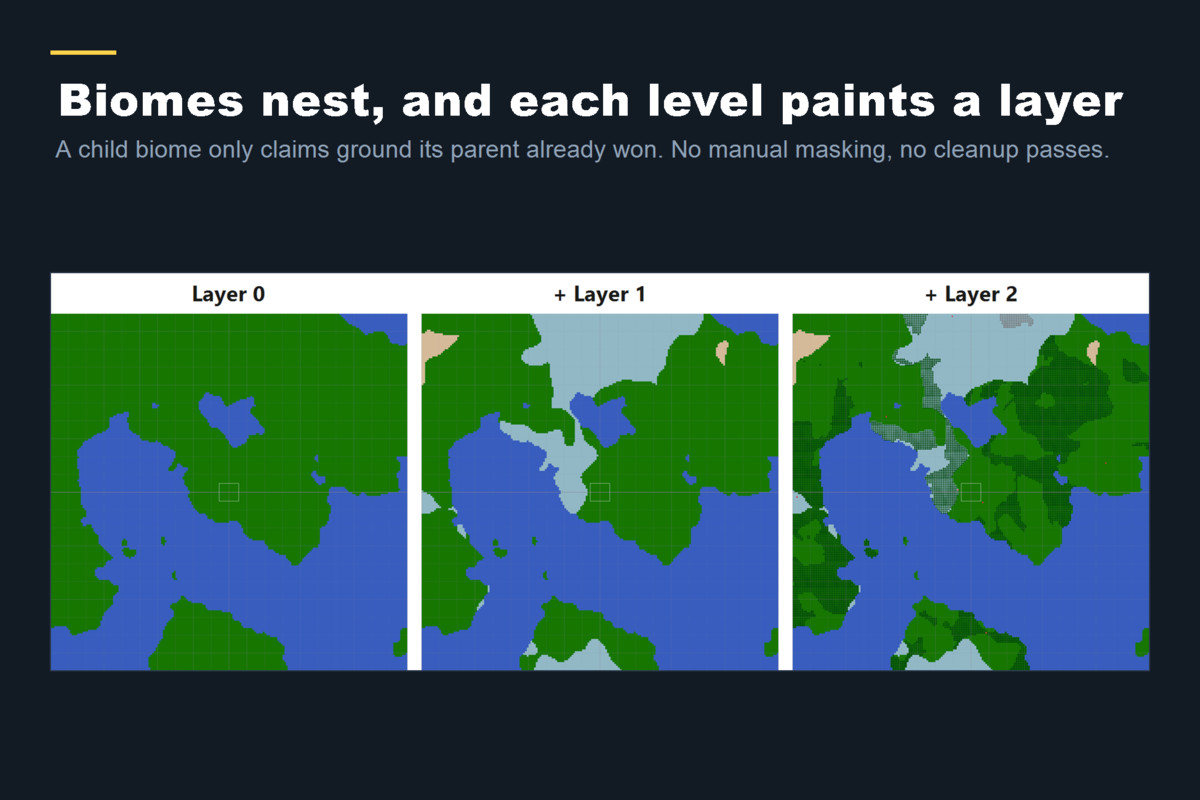
Biomes are where your world takes shape. Each one carries a tile and a set of climate
bands, and nests inside its parent — so every level of the hierarchy paints its own
tilemap layer. Any Unity tile asset works, including Rule Tiles for automatic edge transitions and animated tiles for moving water or foliage
RULES
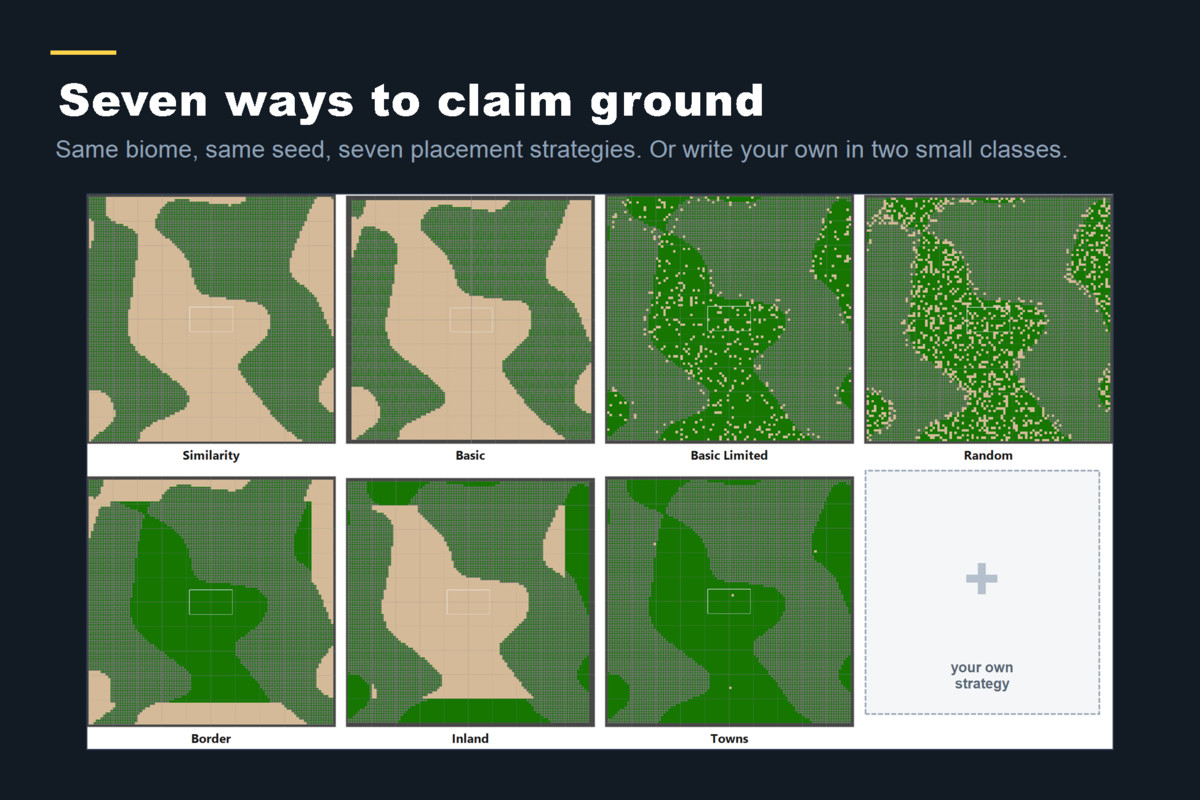
Seven included placement strategies then decide how each biome claims its share — soft gradient borders, hard
cutoffs, scattered points, edge-hugging coastlines, interior-only regions, or evenly
spaced landmarks like towns and ruins — and you can write your own in two small classes,
with your parameters appearing in the graph automatically.
VISUAL GRAPH
Your entire world definition lives in a single graph asset you can version, diff, and
share. Graph Toolkit gives it a genuinely native editing experience: typed, colour-coded
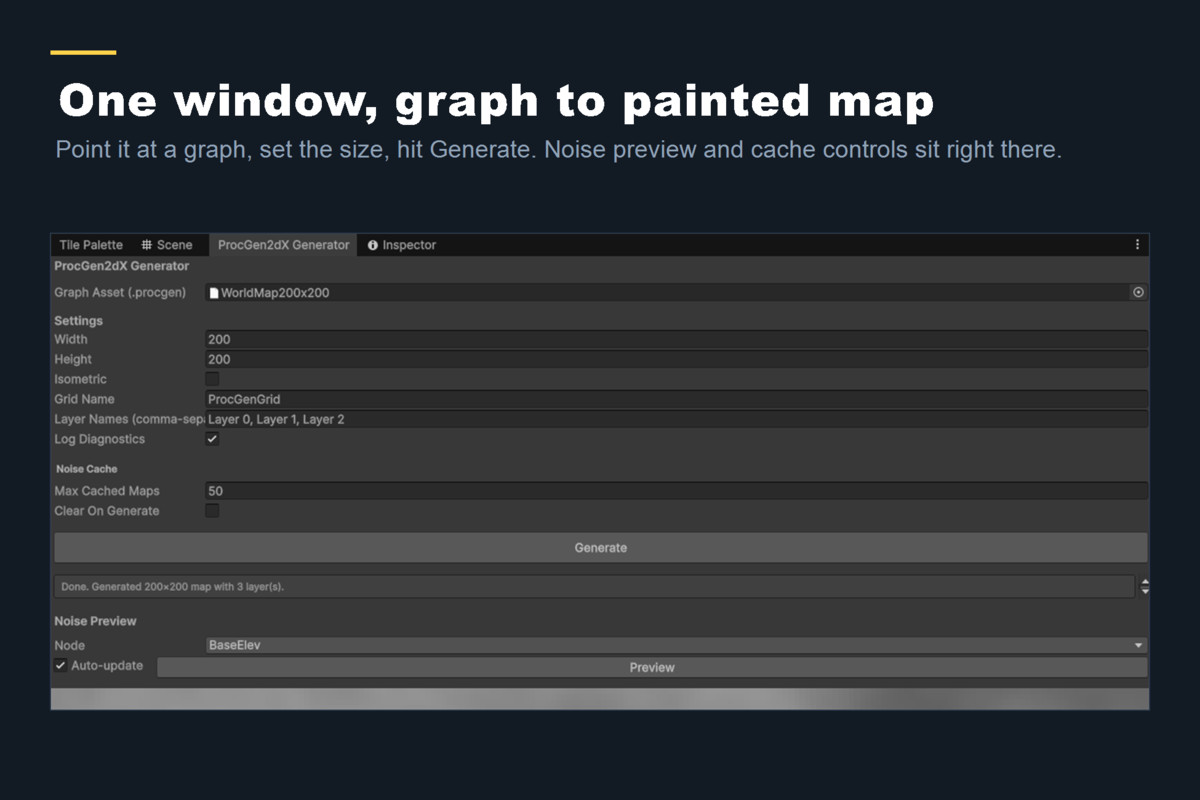
ports that only connect where they should, grouped node menus, and reusable nodes you can fan out across the graph, so one strategy or noise stack can drive as much of the map as you want — and a live preview renders each noise map as you tune it.
Graphs can also be built entirely in code. A builder library ships with the tool, and the five sample graphs are themselves working examples of it, so you can define maps as reviewable source, generate variants programmatically, or roll a single change across every map in your project at once.
MORE
Requires Unity 6.5 or later. Works with the Built-in Render Pipeline and URP.
Working in an older version of Unity? Our earlier tool covers similar ground for pre-6.5
projects:
https://assetstore.unity.com/packages/tools/level-design/2d-procedural-generator-editor-335966
Five ready-to-open sample graphs get you generating immediately.
Walkthrough of Tool and Templates: https://www.youtube.com/@Tecuani-dev/playlists
From the publisher's Asset Store listing.
Technical details
Key Features
- Node-based generation: Visual node graph built on Unity's Graph Toolkit for combining noise, biomes, and strategies.
- Noise control: Supports Perlin, Simplex, Cellular, Value, fractal, and more, with adjustable frequency, amplitude, octaves, lacunarity, sampling offset, and seeds.
- Biome system: Define thematic regions with temperature, humidity, and elevation constraints, nested so each level of the hierarchy paints its own tilemap layer.
- Placement strategies: Seven built in — gradient borders, hard cutoffs, scattered points, coastlines, interior-only regions, random scatter, and evenly spaced landmarks.
- Custom strategies: Extendable scoring logic for fine-tuned biome placement; your parameters appear in the graph automatically.
- Tile support: Works with Sprite, Rule, and Animated tiles.
- Single graph asset: Your entire world definition lives in one .procgen file you can
- version, diff, and share.
- Graphs from code: Builder library for defining maps as reviewable source and generating variants programmatically — the five included samples are working examples of it.
- In-editor previews: Instantly visualize noise maps at your target resolution.
- Generation diagnostics: Per-layer paint counts, plus warnings for biomes that won no tiles or won tiles with nothing to paint.
Support
- Unity 6.5 or later
- Compatible with the Built-in Render Pipeline and URP
- Requires Unity's Graph Toolkit package (com.unity.graphtoolkit), currently an
- experimental package — preview packages must be enabled to install it
- Rule Tiles and Animated Tiles require Unity's 2D Tilemap Extras package
- Documentation (37-page illustrated PDF) and five sample graphs included
Limitations
- Hexagonal tile shapes not supported — square and isometric grids only
- Not compatible with HDRP, which has no 2D Renderer
- Generation runs in the Editor; there is no runtime API for generating maps during play
Compatibility
| Unity version | Built-in | URP | HDRP |
|---|---|---|---|
| 6000.5.0f1 | Compatible | Compatible | Not listed |
As listed on the Asset Store.