
 View on Asset Store (opens in new tab)
Package details
- Latest version
- 1.0.0
- Last updated
- First released
- Unity version
- 6000.0.77 or later
- Package size
- 215 KB
- Files
- 72
- Views in the past week
- 13
Price tracking
- Last checked
- Tracked since
- Lowest recorded
- Free on
Keywords

Settings Kit
Project Settings & Preferences pages from one small class. No boilerplate, no Resources folder, and readable at runtime.
Affiliate link · Purchases support this site
Price history
Last 6 months
USDAsset preview
1 / 3
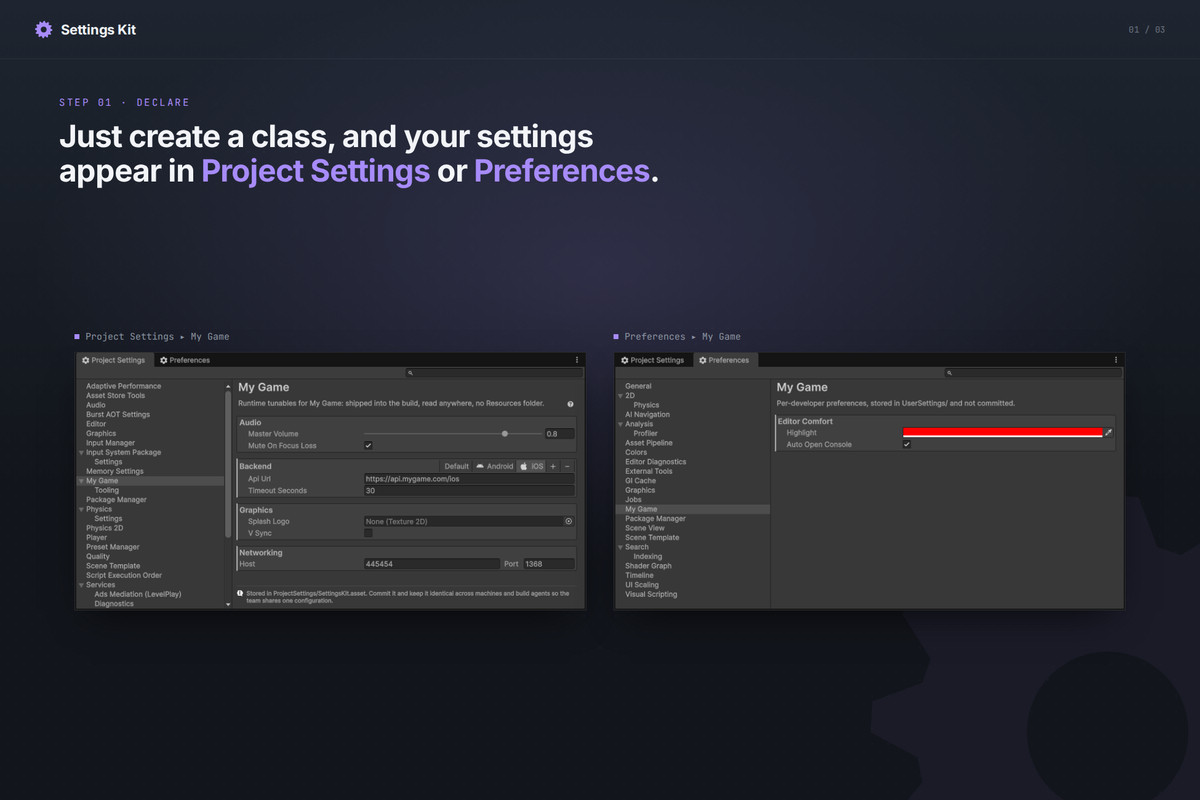
Settings Kit screenshot 1
About this asset
Website | User Manual | Public API
Adding a settings page to a Unity project usually means editor boilerplate, a Resources/ asset to read at runtime, and serialization wired up by hand.
Settings Kit removes all of it: you write one page class and one or more serializable settings classes, and your settings appear in the right window, are saved in the right place, reach your builds when they should, and are read with one line of code.
No asset to create, nothing to register, no Resources/ folder.
- Little to learn: a handful of public types cover every feature.
- Nothing to set up: settings classes are found automatically, saved in ProjectSettings/ or UserSettings/, and kept in sync as you add or remove them.
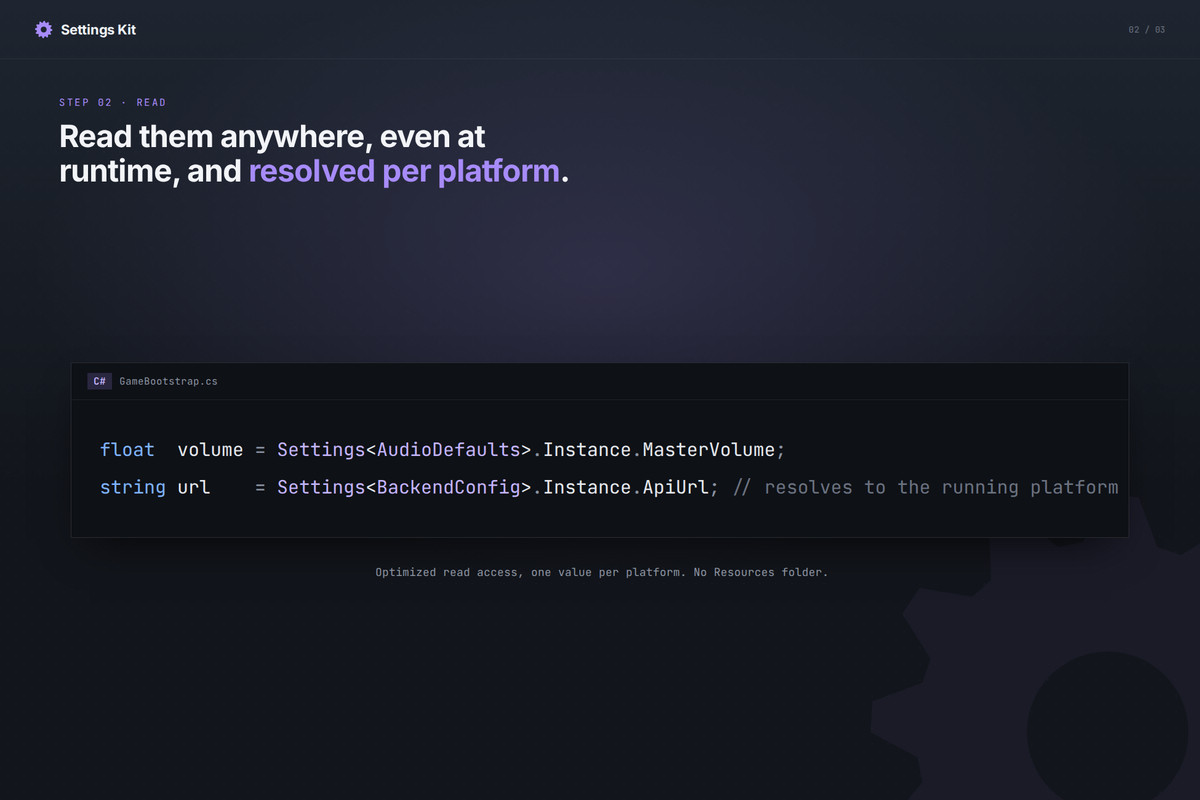
- Readable at runtime: build settings are loaded into the player before the first scene, so Settings<T>.Instance returns the same values in a built game as in the editor.
FOUR KINDS OF SETTINGS
The base class of a settings class decides where it appears and whether it reaches your builds.
- Build settings (BuildSettingsEntry<TPage>): Project Settings window, committed, shipped into the build, and readable at runtime.
- Per-platform settings (PlatformSettingsEntry<TPage>): a build setting whose whole set of values can differ per build target, baked to the target at build time.
- Editor-project settings (EditorSettingsEntry<TPage>): edited under Project Settings, committed for the team, but never shipped.
- User settings (UserSettingsEntry<TPage>): per-developer, edited under Preferences, never shipped.
WHAT'S INCLUDED
- Declare once, read anywhere: one SettingsPage class plus serializable entries; read them through Settings<T>.Instance, in the editor or at runtime.
- The right window automatically: build and editor-project entries land under Project Settings, user entries under Preferences, each window showing only its own.
- Sections, ordering, and tooltips: an optional [SettingsDisplay] attribute sets titles, tooltips, and ordering for pages and sections.
- Custom rendering: style any section with an ordinary PropertyDrawer on your settings type.
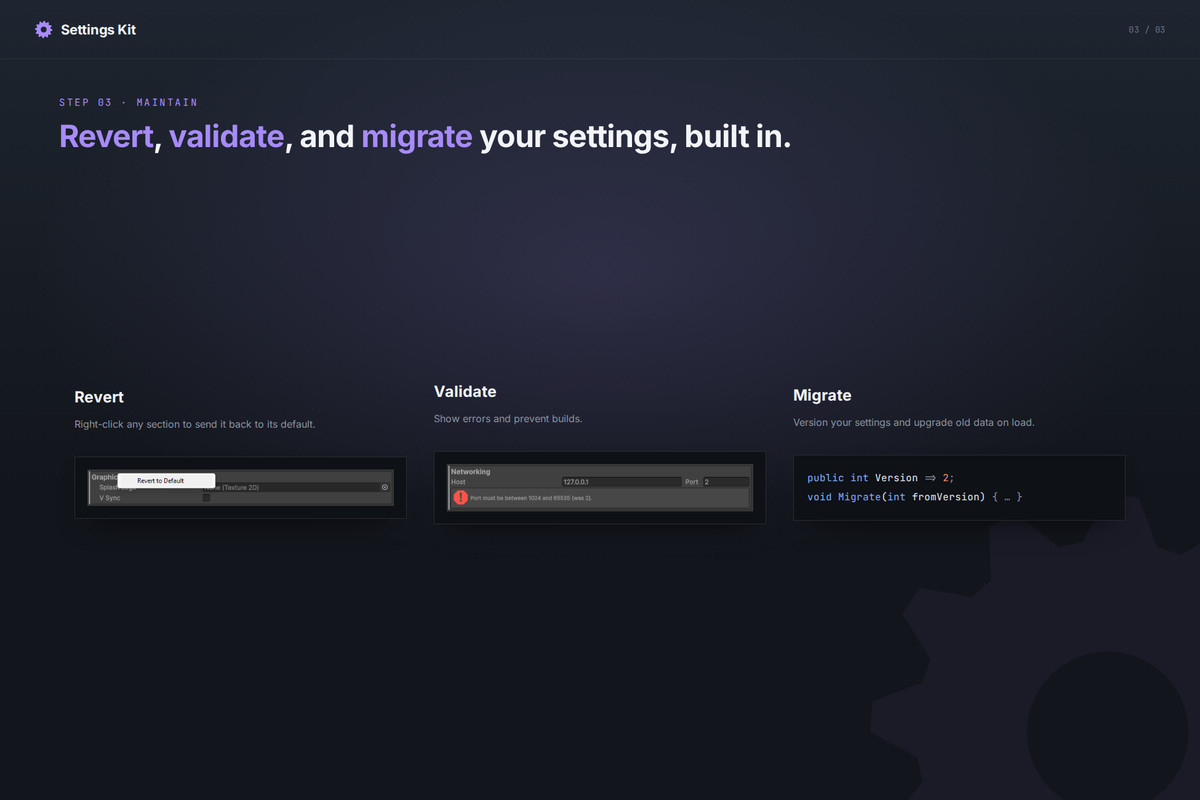
- Validation: implement IValidatedSettings for an inline help box in the window and a build-time gate that fails the build on invalid build settings.
- Migration: IVersionedSettings transforms an entry’s values forward across schema versions, and a [SettingsMigrator] method rescues data from types you deleted.
- Testing seam: Settings.OverrideForTests<T>() substitutes what Settings<T>.Instance returns for the life of a disposable, with no permanent “for tests” setters in the shipped API.
- Navigation: Settings.OpenPage<TPage>() jumps straight to a page from your own tooling.
- A Demo folder: every feature in one place, with a Tools > Settings Kit > Demo menu.
From the publisher's Asset Store listing.
Technical details
Unity 6.0 or later (tested up to 6.6)
Compatibility
| Unity version | Built-in | URP | HDRP | Custom |
|---|---|---|---|---|
| 6000.0.77f1 | Compatible | Compatible | Compatible | Compatible |
As listed on the Asset Store.