
 View on Asset Store (opens in new tab)
Package details
- Latest version
- 1.0
- Last updated
- First released
- Unity version
- 6000.5.0 or later
- Package size
- 216 KB
- Files
- 45
- Favorites
- 7
- Views in the past week
- 22
Price tracking
- Last checked
- Tracked since
- Lowest recorded
- Free on
Keywords
- Search for Noise field
- Search for Voronoi noise
- Search for procedural noise
- Search for Analytical derivatives
- Search for 2D noise
- Search for 3D noise
- Search for Noise derivatives
- Search for procedural texture
- Search for Editor Tools
- Search for 1D noise
- Search for Fractal noise
- Search for Tiled noise

Burst Noise Fields – 1D, 2D & 3D
Procedural noise toolkit with Burst-powered 1D, 2D, and 3D fields, FBM, domain warp, tiled noise, derivatives, profiles, editor viewers, managed arrays, surface export, and flexible job-based APIs.
Affiliate link · Purchases support this site
Price history
Last 6 months
USDAsset preview
1 / 10
Burst Noise Fields – 1D, 2D & 3D screenshot 1
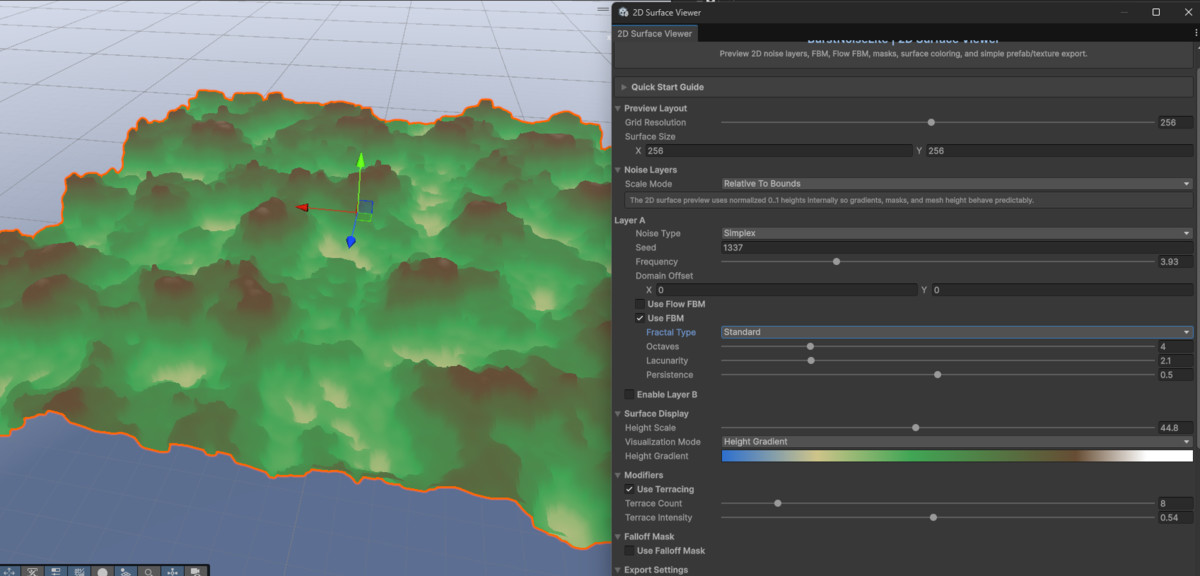
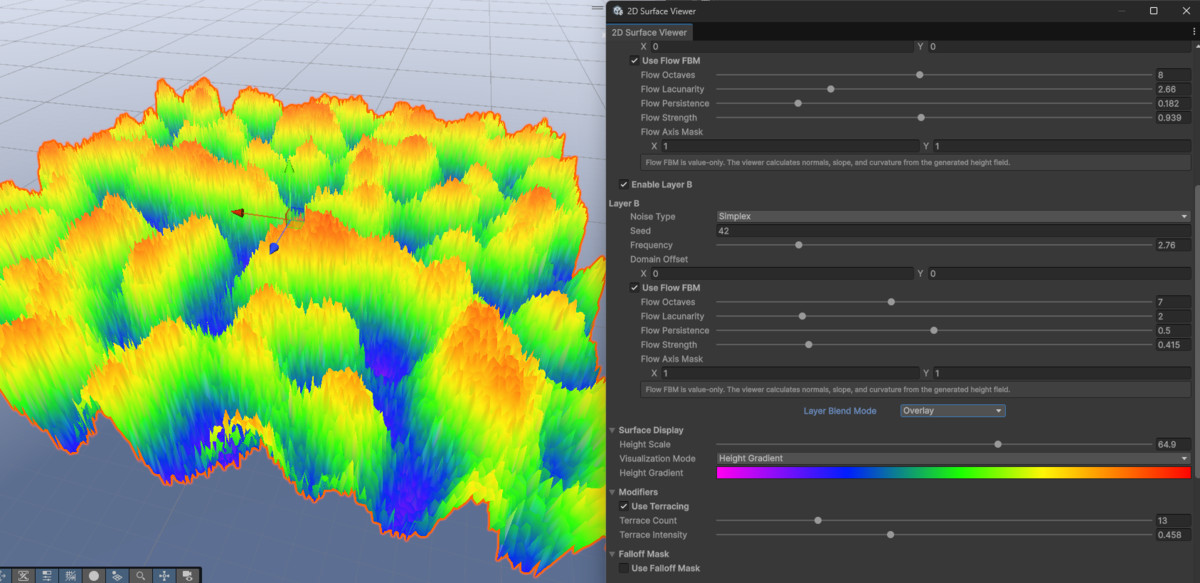
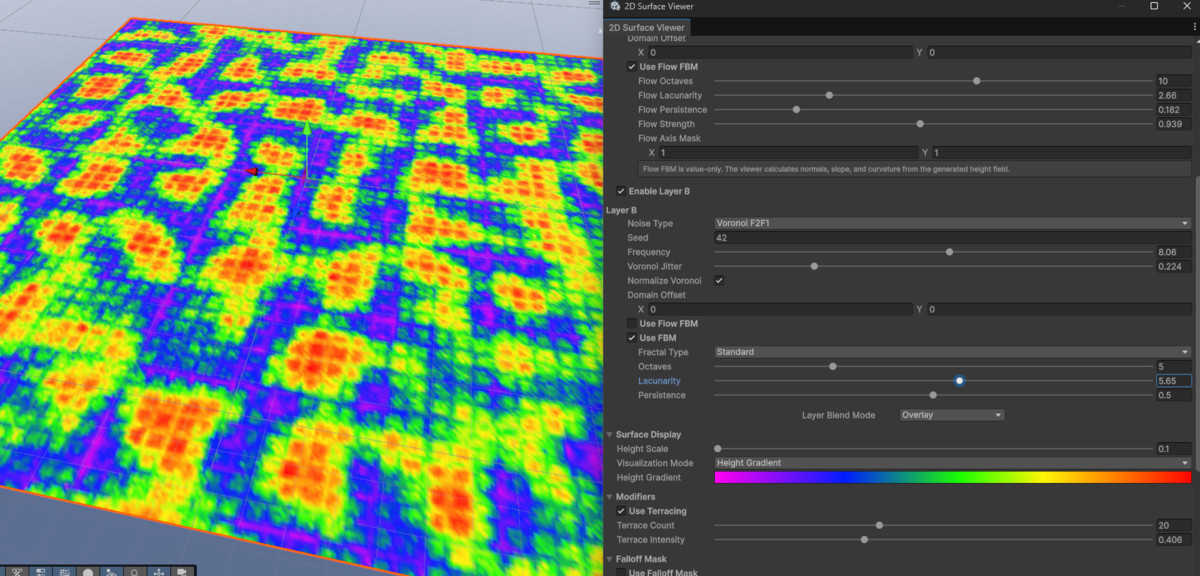
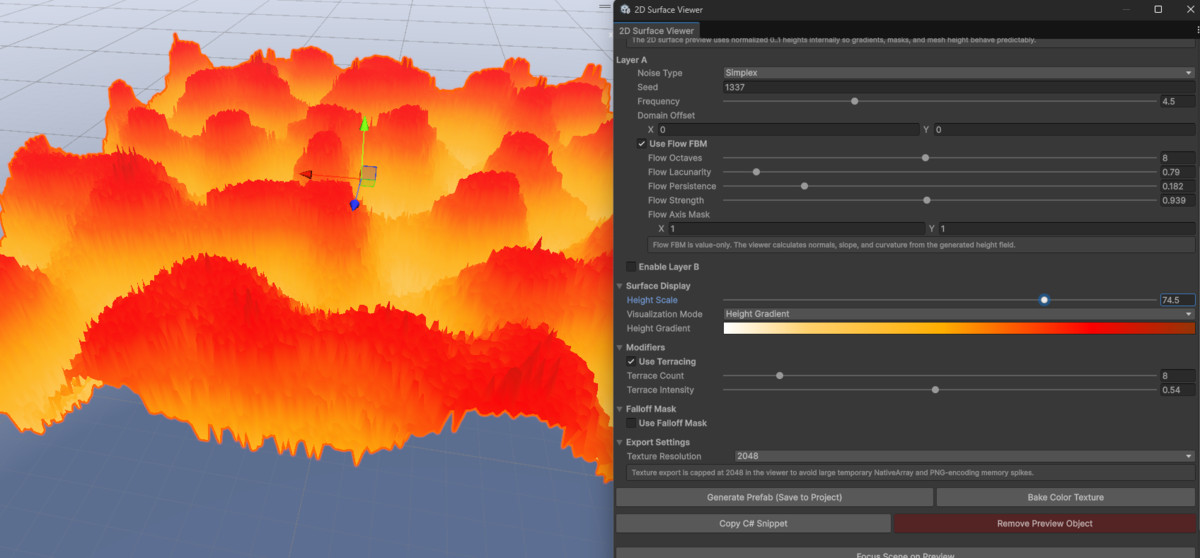
About this asset
Burst Noise Fields is a free CPU-based procedural-noise toolkit for Unity 6. It provides deterministic 1D signals, 2D fields, and 3D volumes for procedural geometry, masks, textures, animation signals, density fields, editor tools, and runtime generation.
In this asset, “noise” means mathematical procedural fields rather than audio noise.
The package is intended for developers and technical artists who want procedural values, derivatives, managed generation, and Unity Job System workflows without adopting a larger node-based framework.
Main Features
- White, Value, Perlin, Simplex, and Voronoi noise in 1D, 2D, and 3D
- Voronoi F1, F2, F2−F1, and Cell ID modes
- Standard, Billow, Ridged, and PingPong FBM
- Domain warp in 1D, 2D, and 3D
- Standard and directional 2D domain warp
- 2D Flow FBM with per-axis control
- Seamlessly repeating 2D noise and tiled FBM
- Analytical derivatives where supported
- Main-thread, managed-array, NativeArray, and explicit Job System APIs
- ScriptableObject noise profiles
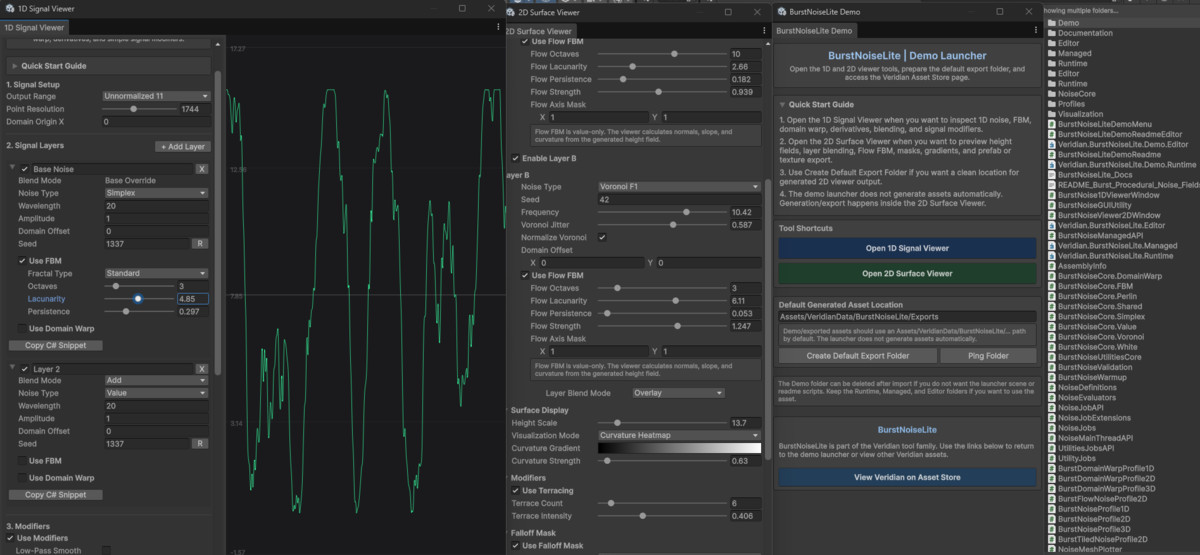
- 1D Signal Viewer and 2D Surface Viewer
- Color texture, mesh, material, and prefab export
- Demo launcher and detailed documentation
See These Methods Used in Complete Production Tools
Many of the same techniques are also used in two separate Veridian tools:
Rock Generator Pro applies related 3D noise methods to procedural rock forms and related 2D methods to texturing. It shows how layered noise, FBM, masks, deformation, and procedural texturing can become part of an environment-art pipeline.
Noise Texture Generator applies related 2D noise, tiling, FBM, and derivative techniques to high-resolution procedural texture generation and PBR material baking.
Both products are self-contained. Neither depends on Burst Procedural Noise Fields, and all three can coexist in one project.
Noise Methods and Fractals
The package includes:
- White Noise for deterministic per-cell values
- Value Noise for smoothly interpolated lattice values
- Perlin Noise for smooth gradient-based fields
- Simplex Noise for general-purpose variation with reduced axis alignment
- Voronoi Noise for nearest-distance, second-nearest-distance, boundary, and cell-ID output
FBM combines multiple octaves of a selected method. Octave count, lacunarity, persistence, seed, frequency, and output range are configurable. Standard, Billow, Ridged, and PingPong transforms provide different field shapes without requiring separate base algorithms.
The same settings model is used across direct sampling, profiles, managed generation, and scheduled jobs. A setup can move from a single sample to a full field or volume without changing its basic structure.
Domain Warp, Flow, and Tiling
Domain warp changes the coordinates before the base field is evaluated, allowing procedural structures to bend, stretch, compress, or fold.
Included paths:
- 1D domain warp
- Standard two-axis 2D domain warp
- Directional 2D domain warp
- 3D domain warp
Base and warp fields have separate seeds, frequencies, noise types, and FBM settings. Analytical derivatives account for the coordinate transformation where supported.
Flow FBM uses derivative information from earlier octaves to move later sample positions. It can create swept, curved, folded, or directional structures. Controls include octaves, lacunarity, persistence, flow strength, and an X/Y flow mask.
The tiled API produces repeating 2D White, Value, Perlin, Simplex, Voronoi, and FBM fields over a defined procedural period. Tiled settings work with direct samples, managed arrays, textures, and NativeArray jobs.
Derivatives
Smooth methods expose derivatives through the direct, profile, and job APIs.
- 1D: X derivative and value
- 2D: X derivative, Y derivative, and value
- 3D: X, Y, Z derivatives, and value
Derivatives can drive surface normals, slope, directional change, flow, masks, placement rules, and field analysis.
Some methods are only piecewise differentiable. White Noise and Cell ID are constant inside cells, Voronoi gradients change at cell boundaries, and terracing or clamping creates nondifferentiable transitions.
Multiple API Levels
- Noise Profiles for reusable Inspector-authored settings
- NoiseMainThreadAPI for individual synchronous samples
- BurstNoiseManagedAPI for managed arrays and RGBA32 grayscale textures
- NoiseJobExtensions for concise NativeArray scheduling
- NoiseJobAPI for explicit dimensions, buffers, and JobHandle dependencies
- BurstNoiseCore for low-level use inside custom Burst jobs
- BurstNoiseWarmup for optional initialization warmup
Public scheduling boundaries validate dimensions, array sizes, finite values, configuration ranges, tiled periods, and compatible noise families.
1D Signal Viewer
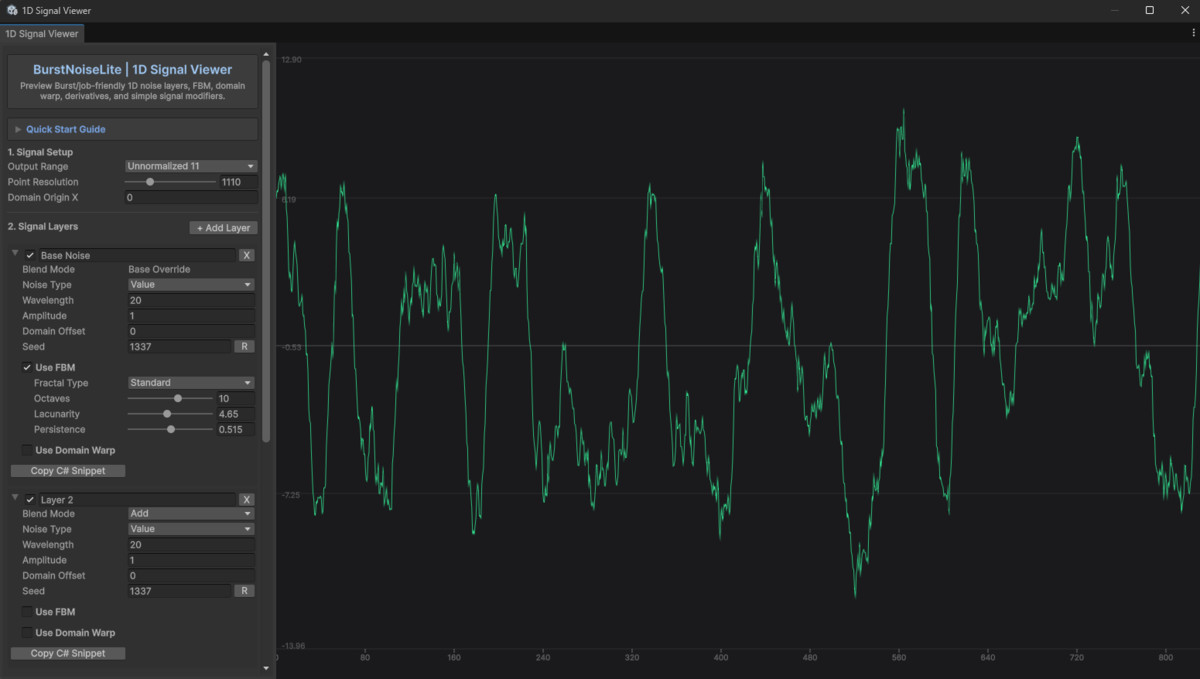
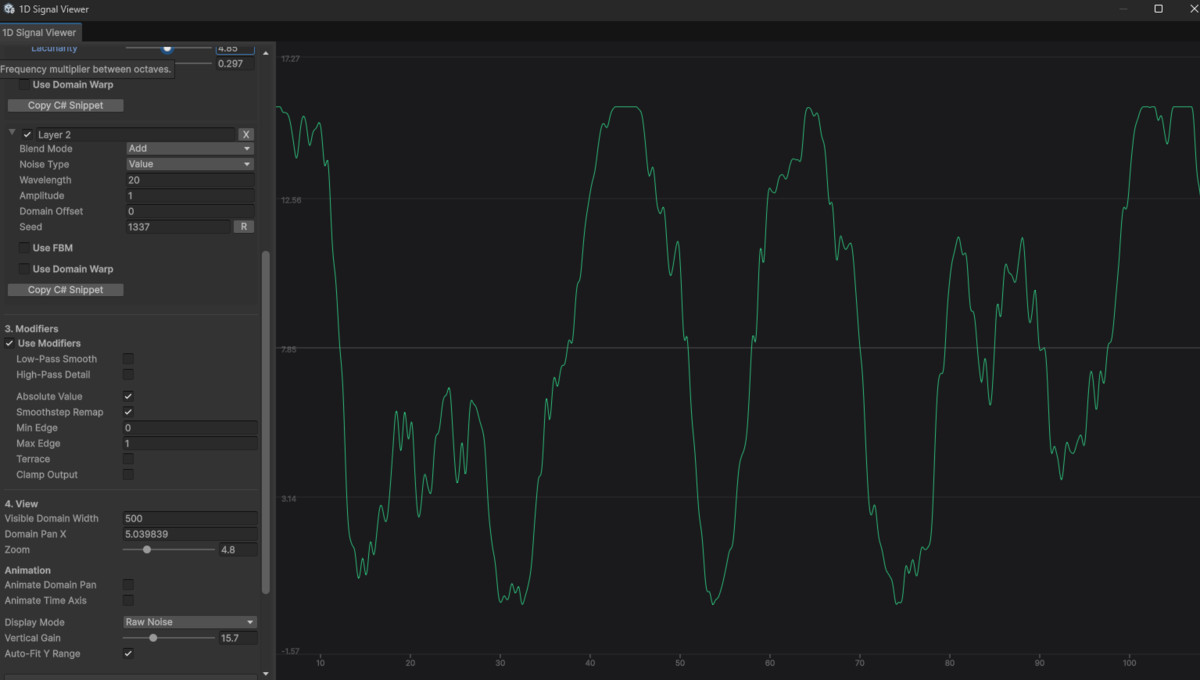
The 1D Signal Viewer is an Editor tool for inspecting and comparing procedural signals.
It includes:
- Layered signals with add, subtract, and multiply blending
- Wavelength, amplitude, seed, and domain-offset controls
- FBM and domain warp
- Low-pass and high-pass filters
- Absolute value, Smoothstep, terracing, and clamping
- Raw-value and first-derivative views
- Domain-pan and time-axis animation
- Per-layer C# snippet copying
The viewer is intended for inspection and tuning. It does not create project assets.
2D Surface Viewer and Export
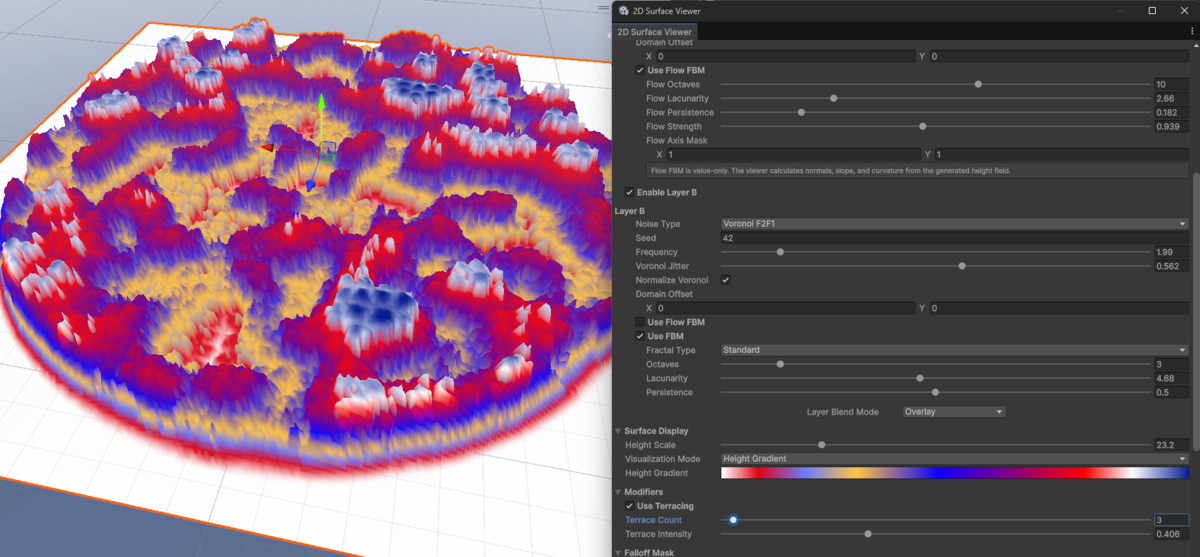
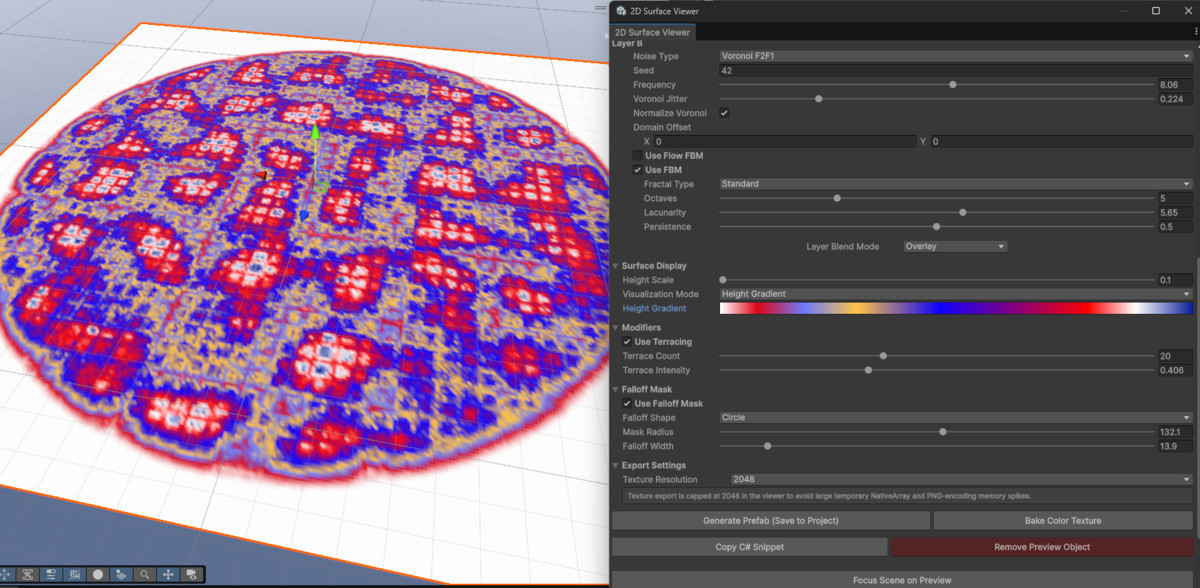
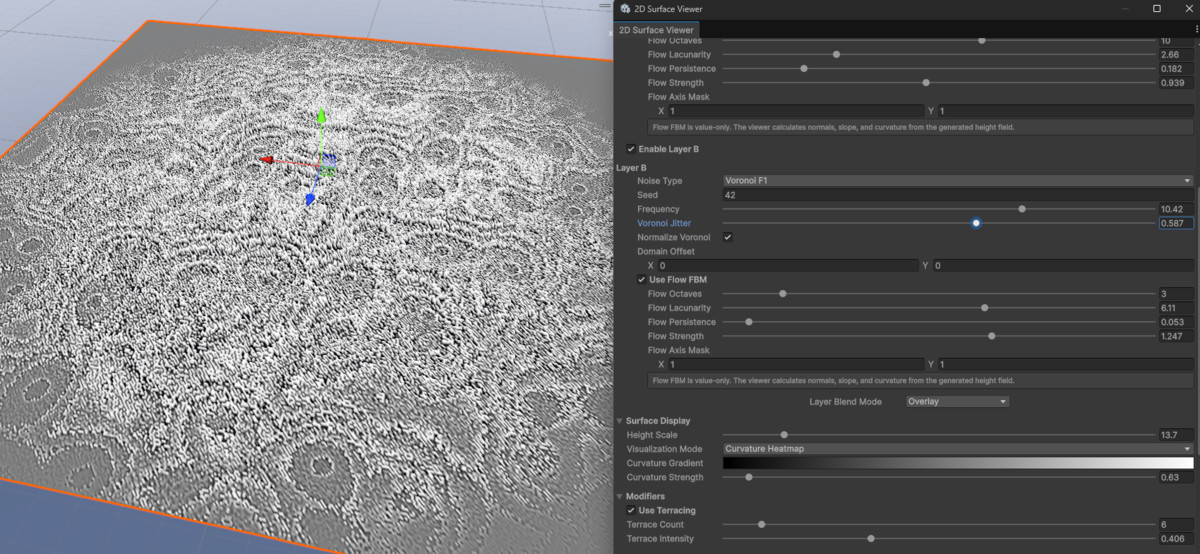
The 2D Surface Viewer displays one or two fields as a temporary Scene-view surface.
It includes:
- Standard noise, FBM, and Flow FBM
- Optional second-layer blending
- Relative and absolute sampling
- Height scaling
- Height-gradient, steepness, signed-slope, and curvature views
- Terracing and shaped falloff masks
- C# snippet copying
- 512, 1024, and 2048 color texture export
- Mesh, material, and prefab export
Prefab export generates its mesh and texture from the same captured settings. It uses unique asset names, recalculates normals and bounds, and attempts to remove assets created by an incomplete export.
The preview object is Editor-only and is not saved into the scene.
Typical Uses
- Procedural mesh displacement and height fields
- Rock, terrain, cave, cloud, and density inputs
- Biome and object-placement masks
- Seeded variation
- Runtime motion and animation signals
- Texture inputs and grayscale maps
- Voronoi regions and cell IDs
- Surface normals, slope, and curvature
- Custom Editor tools
- Job-based generation pipelines
The asset provides fields and utilities rather than a complete world-generation framework. Terrain streaming, voxel meshing, biome management, placement, rendering, and save systems remain project-specific.
Performance and Reliability
The implementation is designed for Unity Mathematics, Burst, NativeArray, and the Job System. It supports direct sampling, managed convenience generation, reusable native buffers, and dependency-based bulk generation.
Cost depends on dimension, algorithm, octave count, derivatives, tiling, warp settings, Flow settings, output size, and hardware. Voronoi, high-octave FBM, tiled derivatives, Flow FBM, and 3D domain warp are naturally more expensive than a single low-dimensional sample.
Related Veridian Production Tools
The free API is intended for custom procedural systems. The related paid tools apply many of the same techniques to complete production workflows.
Rock Generator Pro
Rock Generator Pro uses related 3D methods to generate and vary rock geometry, together with related 2D texturing methods.
Its wider workflow includes:
- Batch rock generation
- Organized rock variants
- Advanced rock placement
- Local brush placement
- Material and texture atlas creation
- Higher texture resolutions
- Additional generation methods
- Expanded texturing workflows
- Runtime-oriented procedural tools
It is a separate rock-generation product, not a Pro edition of this API.
Noise Texture Generator
Noise Texture Generator uses related 2D noise, tiling, FBM, and derivative techniques in a multithreaded procedural texture and PBR material-baking workflow.
It can generate high-resolution tileable patterns and bake:
- Albedo maps
- Normal maps
- Height maps
- Ambient Occlusion maps
- Curvature maps
- Mask maps
Its derivative-based workflows calculate surface information from the underlying procedural field rather than relying only on image-space blur approximations.
It is a separate texture-authoring product, not a required dependency.
Both products are self-contained, do not depend on Burst Procedural Noise Fields, and can coexist with it in the same project.
View the complete Veridian catalog:
https://assetstore.unity.com/publishers/120204
Demo, Documentation, and Scope
The demo launcher opens both viewers and can create:
Assets/VeridianData/BurstNoiseLite/Exports
The Demo folder can be removed when the launcher and readme scene are no longer needed. Keep the Runtime, Managed, and Editor folders for normal use.
The documentation covers setup, algorithms, viewers, derivatives, tiling, domain warp, Flow FBM, API usage, performance, troubleshooting, and limitations.
Important scope notes:
- Unity 6 only
- CPU/Burst implementation; no included GPU, ComputeShader, Shader Graph, or HLSL version
- Tiled convenience APIs are 2D
- Included viewers cover 1D and 2D; there is no 3D volume viewer
- Flow FBM does not expose a complete analytical final-field derivative
- The 2D viewer exports one visualization texture rather than a complete PBR material set
- Texture export is capped at 2048 × 2048
- No terrain streaming, voxel meshing, biome, placement, or save framework is included
- Bit-for-bit cross-platform floating-point identity is not guaranteed
From the publisher's Asset Store listing.
Technical details
Compatibility
- Unity 6 only
- Runtime APIs are available in player builds
- Viewer, preview, demo, and export tools are Editor-only
- Runtime noise generation is render-pipeline independent
- Prefab export uses an available static unlit shader
Required Unity Packages
- Unity Burst
- Unity Collections
- Unity Mathematics
- Unity Job System
Supported Dimensions
- Standard 1D, 2D, and 3D noise
- Tiled 2D noise
- Animated 1D generation through a second time coordinate
- Animated 2D generation through a third time coordinate
Noise Types
- White
- Value
- Perlin
- Simplex
- Voronoi F1
- Voronoi F2
- Voronoi F2−F1
- Voronoi Cell ID
Advanced Methods
- FBM with 1–16 octaves
- Standard, Billow, Ridged, and PingPong transforms
- Configurable lacunarity and persistence
- Domain warp in 1D, 2D, and 3D
- Standard and directional 2D domain warp
- 2D Flow FBM with X/Y flow masking
- Tiled 2D FBM
- Centered and normalized output ranges
- Voronoi jitter and optional distance normalization
Derivatives
- Analytical derivatives for supported ordinary Value, Perlin, Simplex, Voronoi, FBM, and domain-warp paths
- Selected tiled derivative paths use central finite differences
- Flow FBM returns scalar output; final Flow gradients require finite differences
- White Noise reports zero derivative inside constant cells
- Voronoi derivatives are piecewise and change at cell boundaries
Derivative layouts:
- 1D: derivative X, value
- 2D: derivative X, derivative Y, value
- 3D: derivative X, derivative Y, derivative Z, value
Public APIs
- ScriptableObject noise profiles
- NoiseMainThreadAPI
- BurstNoiseManagedAPI
- NoiseJobExtensions
- NoiseJobAPI
- BurstNoiseCore
- BurstNoiseUtilitiesCore
- BurstNoiseWarmup
The public scheduling boundaries validate dimensions, sample counts, buffers, finite parameters, settings ranges, tiled periods, enum values, and compatible Standard or Voronoi scheduler families.
1D Signal Viewer
- 64–4096 preview samples
- Layered signals with add, subtract, and multiply blending
- FBM and domain warp
- Low-pass and high-pass filtering
- Absolute value, Smoothstep, terracing, and clamping
- Raw signal and first-derivative views
- Domain-pan and time-axis animation
- Per-layer C# snippet copying
2D Surface Viewer
- 16–512 preview samples per axis
- One or two procedural layers
- Standard noise, FBM, and Flow FBM
- Layer blending
- Relative and absolute sampling
- Height, steepness, signed-slope, and curvature views
- Terracing and circle, rectangle, or oval falloff masks
- Temporary Editor-owned Scene preview
- C# snippet copying
Export
Color texture resolutions:
- 512 × 512
- 1024 × 1024
- 2048 × 2048
Prefab export creates:
- PNG color texture
- Mesh asset
- Material asset
- Prefab asset
Export behavior:
- Mesh density uses Grid Resolution
- Texture size uses Texture Resolution
- Mesh and texture use the same captured settings
- Existing assets are not intentionally overwritten
- Related files receive a shared unique name
- Incomplete exports attempt to roll back newly created assets
- Mesh normals and bounds are recalculated
- Export paths must be under the project’s Assets folder
The exported texture contains the selected height, steepness, signed-slope, or curvature visualization. It is not a complete PBR material set.
Data Layout and Ownership
2D row-major layout:
index = y × width + x
3D flattened layout:
index = z × (width × height) + y × width + x
Managed generation completes before returning.
Job methods return JobHandle; the caller owns NativeArray completion and disposal.
Dimension-based schedulers require buffers sized for the requested sample count.
Assemblies and Namespaces
Assemblies:
- Veridian.BurstNoiseLite.Runtime
- Veridian.BurstNoiseLite.Managed
- Veridian.BurstNoiseLite.Editor
- Veridian.BurstNoiseLite.Demo.Runtime
- Veridian.BurstNoiseLite.Demo.Editor
Namespaces:
- Veridian.BurstNoiseLite
- Veridian.BurstNoiseLite.Jobs
The public product title differs from the retained internal BurstNoiseLite namespace, menu, assembly, and folder identifiers.
The Demo folder is optional after import.
Main Limitations
- Unity 6 only
- CPU/Burst implementation; no included GPU or shader API
- Tiled convenience APIs are 2D only
- No included 3D volume viewer
- No complete PBR material baker
- Flow FBM has no complete analytical derivative for the recursively advected final field
- 2D texture export is capped at 2048 × 2048
- No terrain streaming, voxel meshing, biome, placement, or save framework
- Some methods and modifiers are nondifferentiable at boundaries or transitions
- Cross-platform bit-for-bit floating-point identity is not guaranteed
Related Product Compatibility
Rock Generator Pro and Noise Texture Generator are separate, self-contained products that use related procedural techniques. They do not depend on Burst Procedural Noise Fields and can coexist with it in the same project.
- Rock Generator Pro focuses on procedural rock generation, placement, and environment-art workflows.
- Noise Texture Generator focuses on high-resolution procedural textures and PBR map baking.
Compatibility
| Unity version | Built-in | URP | HDRP |
|---|---|---|---|
| 6000.5.0f1 | Compatible | Compatible | Compatible |
As listed on the Asset Store.