
 View on Asset Store (opens in new tab)
Package details
- Latest version
- 1.3.0
- Last updated
- First released
- Unity version
- 6000.0.82 or later
- Package size
- 945 KB
- Files
- 35
- Views in the past week
- 6
Price tracking
- Last checked
- Tracked since
- Lowest recorded
- $14.99 on
Keywords

Zion Dependency Graph
Interactive dependency graph and safe cleanup for Unity. Sees serialized references, code string loads, and Addressables bundle duplicates - with timestamped backups and one-click restore.
Affiliate link · Purchases support this site
Price history
Last 6 months
USDAsset preview
1 / 9
Zion Dependency Graph screenshot 1
About this asset
Zion Dependency Graph
See every reference. Trust every delete.
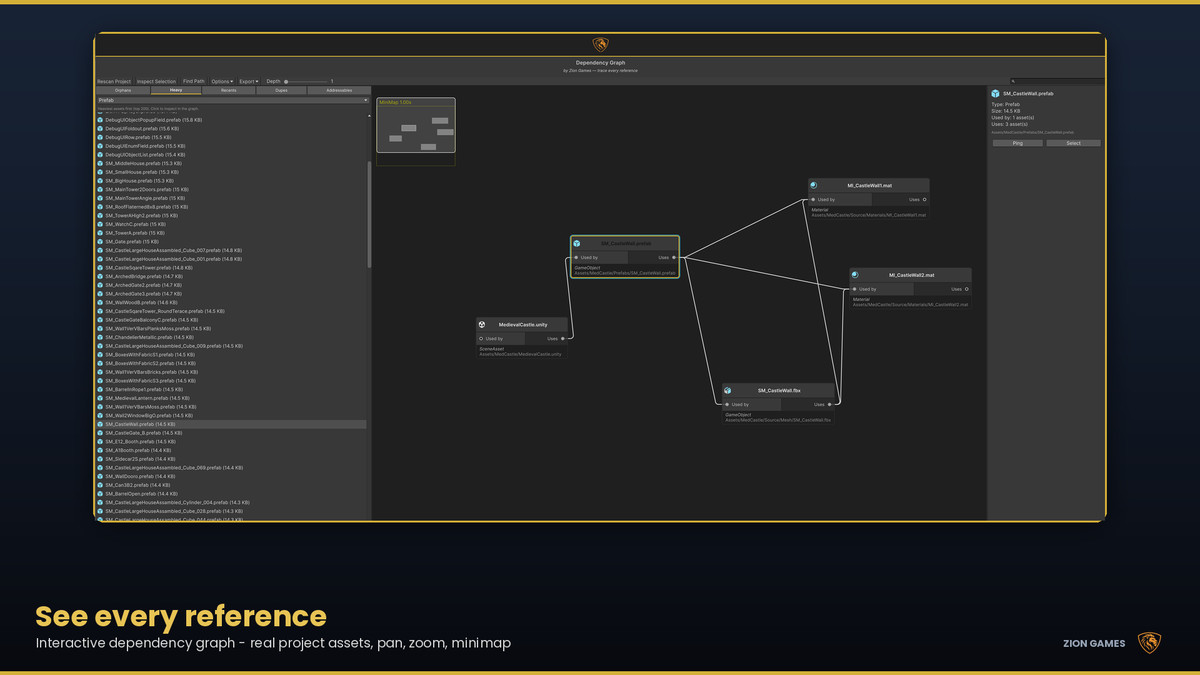
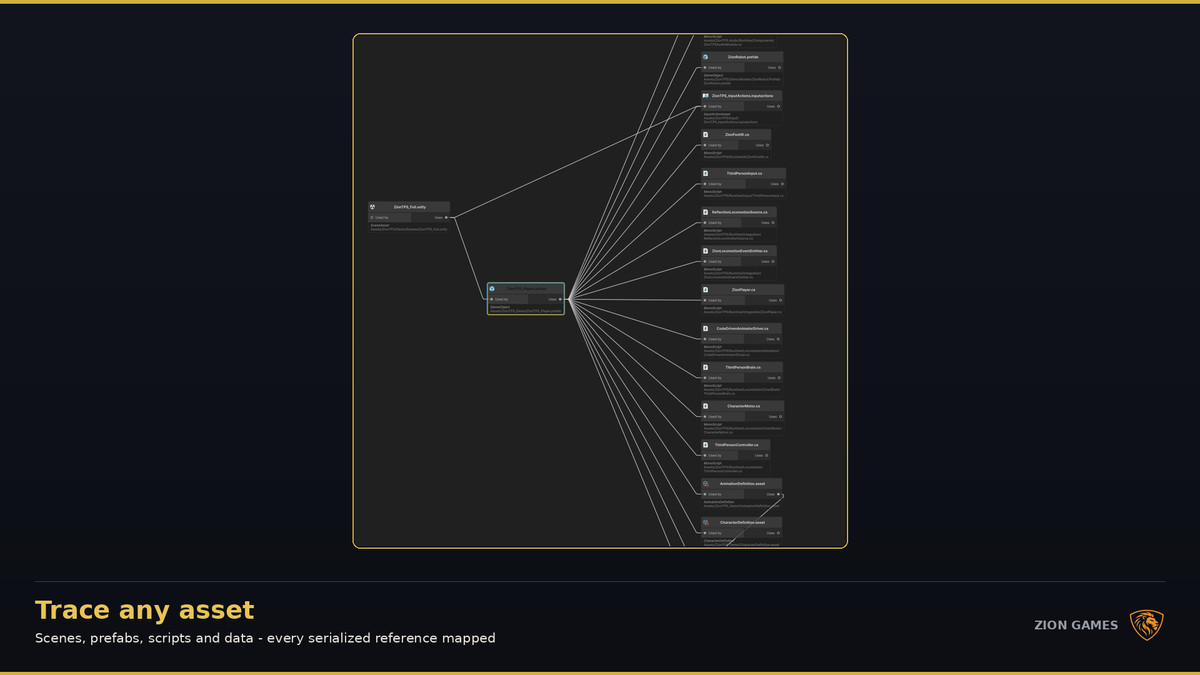
A node-based dependency graph viewer for Unity. Pick any asset and see exactly what references it - and what it references - as an interactive, zoomable graph. Built for the moment before you delete something and aren't sure what'll break.
Why this, not another cleanup tool?
Most asset cleanup tools give you a flat "unused assets" list and ask you to trust it. And every one of them shares the same blind spot: assets loaded from code by string. Nothing in Unity's AssetDatabase records that EnemySpawner.cs calls Resources.Load("Prefabs/Enemy") - so flat-list tools either flag that prefab as unused, or exclude the whole Resources folder and tell you nothing.
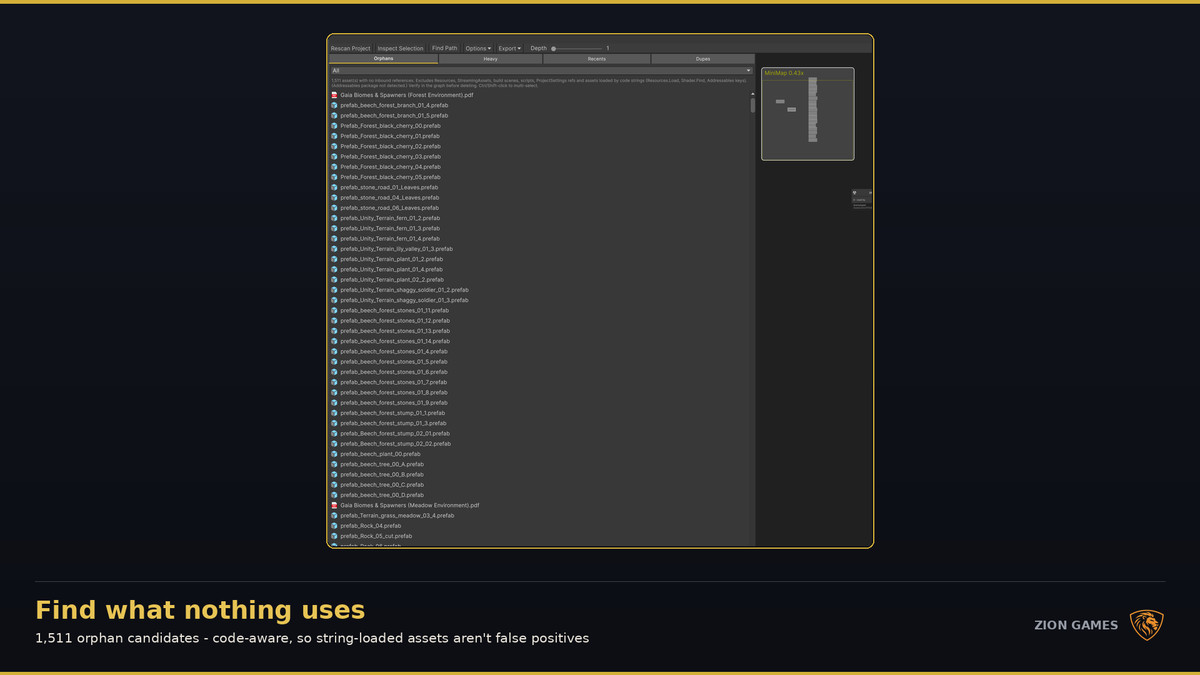
Zion Dependency Graph does both halves. It reads your assets AND your scripts. Find a suspected orphan, open it in the graph, see the empty inbound side with your own eyes, check no code loads it by string, then delete with a timestamped backup. The whole workflow is built so you never delete something you can't recover.
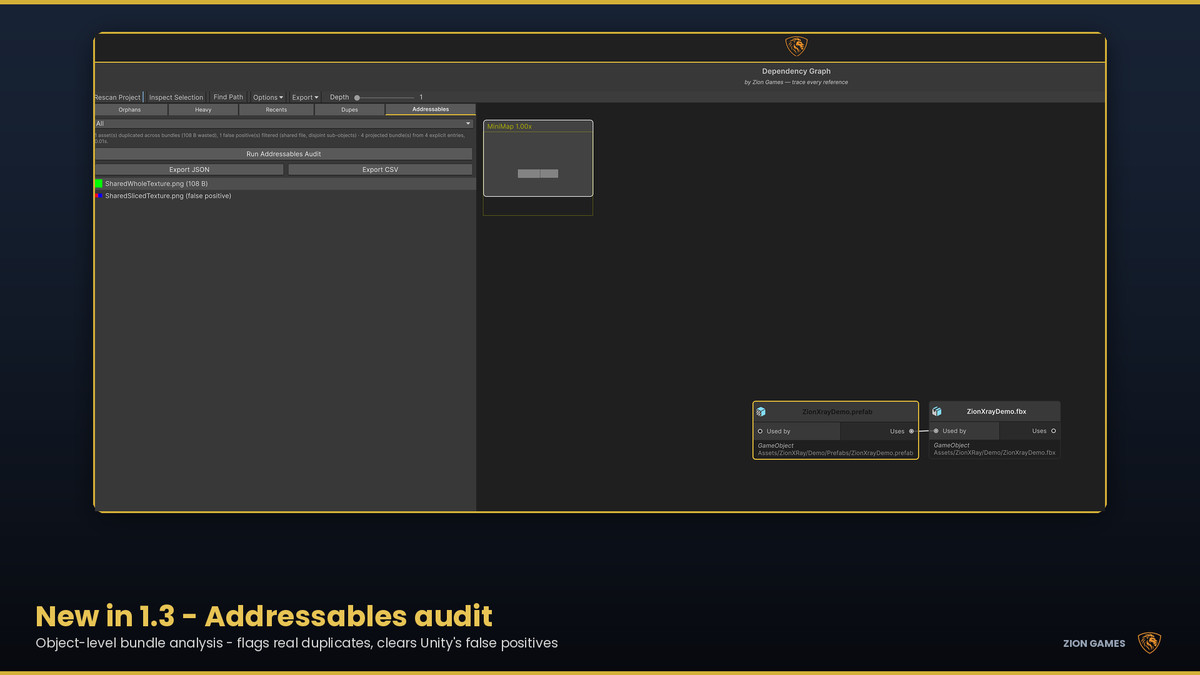
New in 1.3 - the tool now audits your Addressables bundles
* Duplicate bundle analysis - projects your bundle layout statically and walks the dependency tree Addressables would build, in seconds, with no build required. Finds every asset packed into more than one bundle and what it's actually costing you.
* Object-level false-positive filtering - Unity's own Analyze tool compares whole files, so two prefabs sharing nothing but a source texture get flagged as duplicated. This tool resolves duplication at the object level and correctly clears cases where nothing is actually shared.
* Fix guidance, not auto-fix - every real duplicate gets one of four calls (no action needed, accept the duplication, promote to a shared group, or merge groups) instead of an automatic restructure.
* Resources vs Addressables overlap detection - flags assets duplicated between a Resources folder and a bundle, a class of waste Unity's own tooling flags but can't fix.
* Bundle membership on every asset's detail panel - see which bundle(s) any asset lands in, explicit or implicit, and the reference chain responsible.
* CSV / JSON export of the full duplication report.
* Headless CI entry point - fail a build automatically when wasted bytes cross a threshold you set.
Features
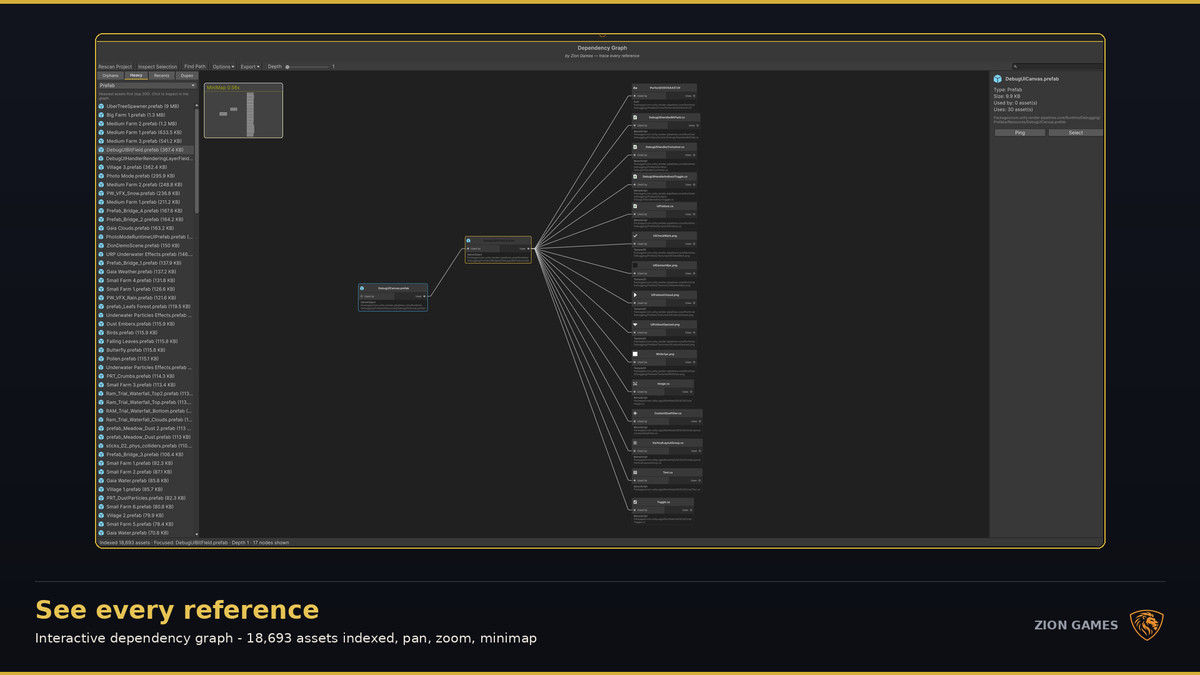
* Interactive dependency graph powered by Unity's GraphView (pan, zoom, minimap)
* "Used by" reverse-lookup for any asset - right-click in Project → Show Dependencies
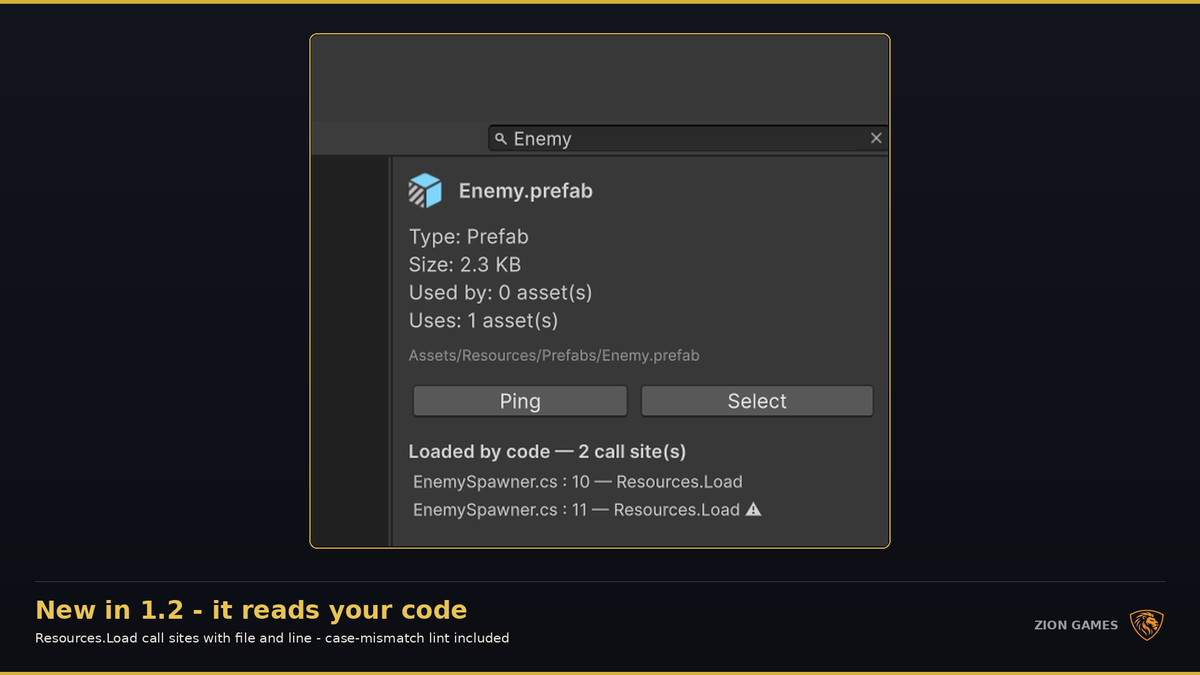
* Code string reference detection - resolves Resources.Load / LoadAsync / LoadAll, Shader.Find, and Addressables key usage in your scripts to the actual asset loaded, with a "Loaded by code" panel listing every call site by script and line - click to jump to it in your IDE
* Conservative orphan detection that excludes Resources, StreamingAssets, build scenes, scripts, ProjectSettings references, assets loaded by code strings, and (when installed) Addressables entries
* Find Path mode - click any two assets to see the shortest dependency chain plus alternative routes, every step clickable
* Case mismatch warnings - flags Resources.Load paths that work in the editor but fail on case-sensitive platforms like Android
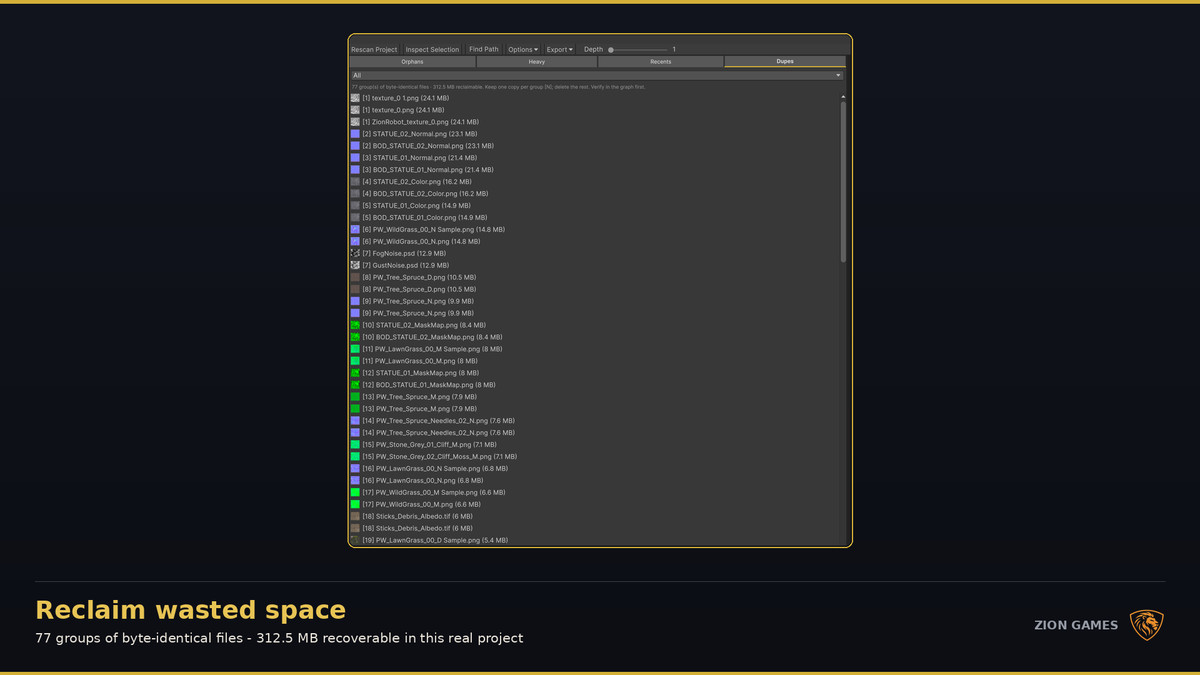
* Dupes tab - finds groups of byte-identical files (SHA-256 verified); click any copy to see which one is actually in use before removing the rest
* Heavy assets view - top 200 by file size, biggest first, to find oversized textures and models fast
* Type filter (textures, materials, prefabs, audio, scenes, shaders…)
* Asset detail panel with size, type, reference counts, code call sites, and Addressables bundle membership (when Addressables is installed)
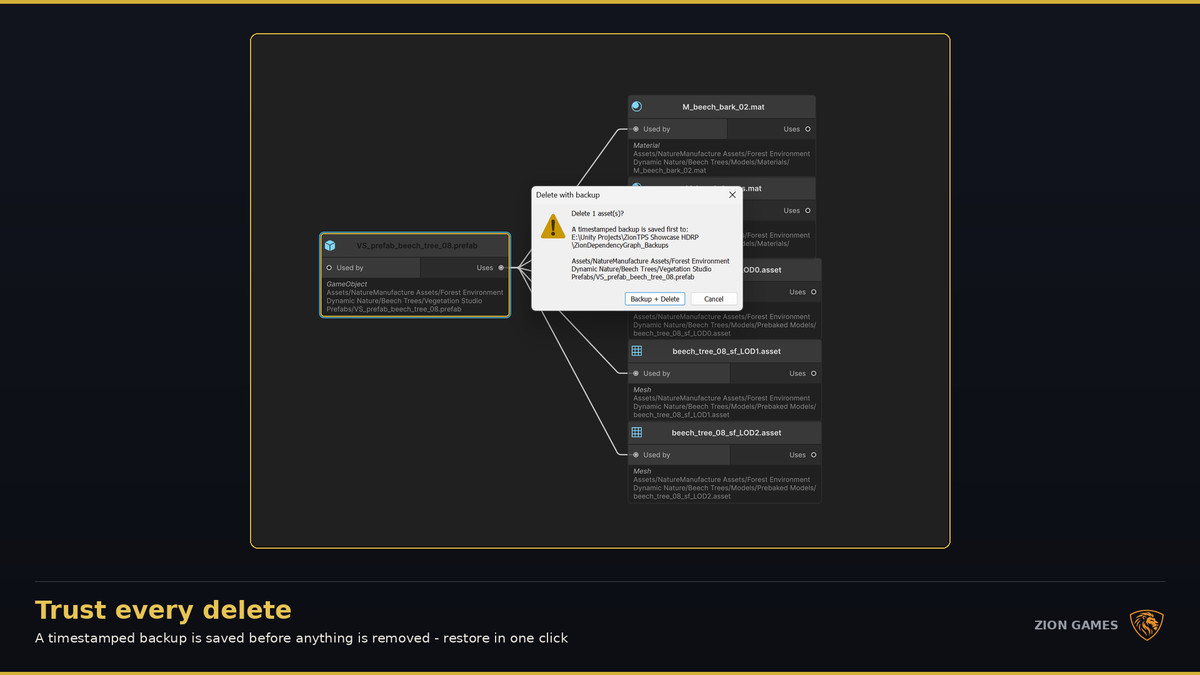
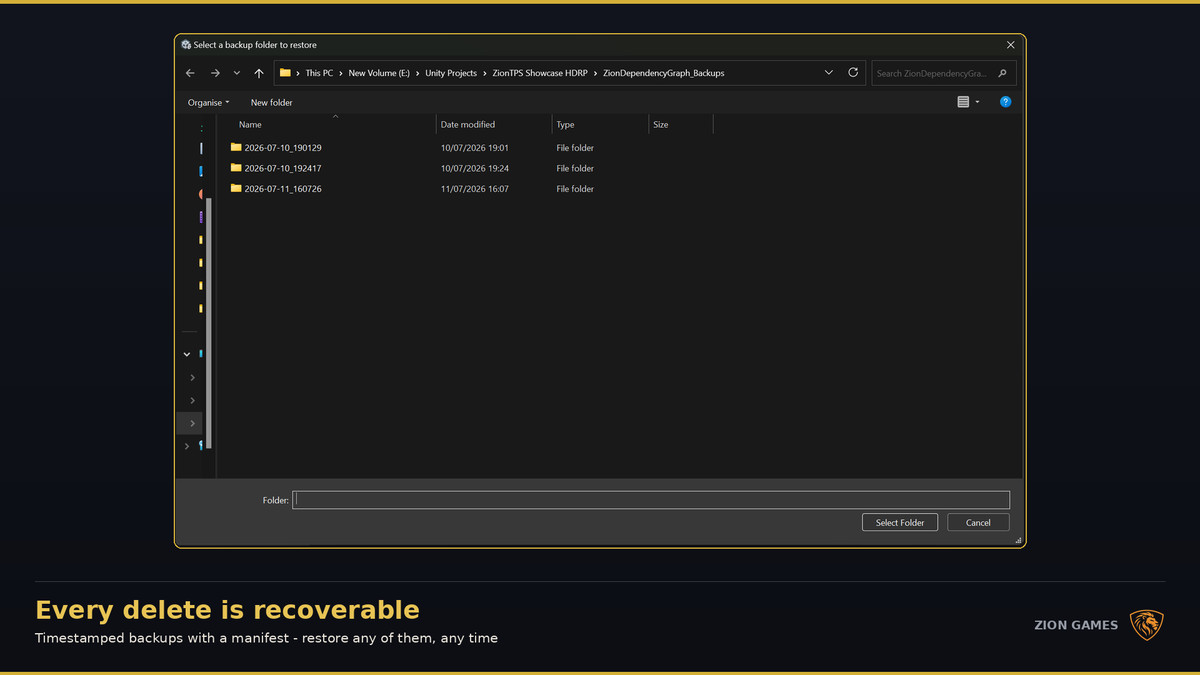
* Safe delete with timestamped backup - every asset and its .meta is copied to ZionDependencyGraph_Backups/ before deletion, with a warning naming the script and line if code still loads it by string; full restore from any backup
* Background scanning - the project index builds incrementally without freezing the editor; cancel at any time
* Keyboard shortcuts - F to focus, P for Find Path, Delete to safe-delete, / to search
* Remembered settings - depth, type filter, active tab, and panel widths persist between sessions
* Graphviz DOT export for high-quality external rendering
* Markdown + CSV cleanup report
* Recently-inspected list persisted per project
Honest limits
* Dynamic string loads (variables, interpolated or concatenated paths) cannot be resolved by any static scan - but as of 1.2 they are detected and listed, so you can see exactly where the blind spots are instead of trusting there are none
* Procedurally assigned materials and runtime-instantiated assets are invisible to static analysis
* Addressables bundle-size figures are uncompressed serialized bytes (source file length), not the final compressed size a real build would produce - accurate for comparing relative waste, not a promise of an exact install-size number
Requirements: Unity 6000.0 LTS or newer. Editor-only - adds nothing to your build or runtime. Addressables analysis is fully optional and supports Addressables 1.21 through 2.x when installed.
🌐 Online docs: Zion Dependency Graph - ZionGames Docs
💬 Support: Discord: Here
🦁 More tools: https://ziongames.co.uk
From the publisher's Asset Store listing.
Technical details
Key features
* Interactive node-based dependency graph (Unity GraphView): pan, zoom, minimap, layered layout
* Conservative orphan detection - excludes Resources, StreamingAssets, build scenes, scripts, ProjectSettings references, and Addressables entries
* Code string reference detection - scans .cs files for Resources.Load / LoadAsync / LoadAll, Shader.Find, and Addressables keys; comment-aware, literal-only, resolved to actual project assets with file + line
* Incremental code index - script saves re-scan just that file, no rescan button
* Find Path - bidirectional search between any two assets; shortest chain plus alternatives, instant even on 50,000+ asset projects
* Case mismatch lint for Resources.Load paths (editor-works / device-fails detection)
* Addressables duplicate-bundle analysis - static bundle-layout projection plus an implicit-dependency walk, no build required; object-level sub-asset resolution distinguishes genuine duplication from files that merely share a source asset
* Per-finding fix classification - no action, accept duplication, promote to a shared group, or merge groups; no automatic restructuring
* Resources vs Addressables overlap detection
* Bundle membership (explicit or implicit, plus reference chain) surfaced on every asset's detail panel
* CSV / JSON export of the duplication report; headless CI entry point via -executeMethod that exits non-zero when wasted bytes exceed a configurable threshold
* Multi select safe delete with timestamped backups + one click restore from any backup
* Heaviest-assets view (top 200 by file size) for quick triage
* Duplicate file detection - Dupes tab finds groups of byte-identical files (SHA-256 verified, size-bucketed for speed); zero false positives by design
* Background scanning - project index builds incrementally without freezing the editor; cancellable at any time
* Asset detail panel - type, size on disk, "used by" / "uses" reference counts
* Type filter: textures, materials, prefabs, audio, scenes, shaders, animations, fonts
* Right-click any Project asset → instant dependency graph
* Recently-inspected list, persisted per project
* Configurable depth (1–5 hops) with auto-capped rendering for responsiveness on 15,000+ asset projects
* Graphviz DOT export of the current graph (renders to publication-quality PNG/SVG)
* Markdown + CSV cleanup report
* Optional Addressables integration (auto-detected via reflection, no hard package dependency) - unlocks the duplicate-bundle audit when the package is installed, no compile errors when it isn't
* Editor-only - zero runtime cost, no build size impact
* Compatible with URP, HDRP, and Built-in render pipelines
* Requires Unity 6.0 LTS or newer
Compatibility
| Unity version | Built-in | URP | HDRP |
|---|---|---|---|
| 6000.5.10f1 | Compatible | Compatible | Compatible |
| 6000.3.23f1 | Compatible | Compatible | Compatible |
| 6000.0.82f1 | Compatible | Compatible | Compatible |
As listed on the Asset Store.