
 View on Asset Store (opens in new tab)
Package details
- Latest version
- 1.0
- Last updated
- First released
- Unity version
- 6000.3.11 or later
- Package size
- 5.4 MB
- Files
- 26
- Favorites
- 3
- Views in the past week
- 13
Price tracking
- Last checked
- Tracked since
- Lowest recorded
- $10.50 on
Keywords
Quest Pixel Display - VR URP LCD Shader
A stylized URP display shader for Meta Quest with LCD subpixels, distance fade, pulse glitches, dirt, and grime. Turn any quad or mesh into an in-world monitor, TV, or screen.
Affiliate link · Purchases support this site
Price history
Last 6 months
USDAsset preview
1 / 4
Quest Pixel Display - VR URP LCD Shader screenshot 1
About this asset
Make every monitor, TV, and CRT in your VR scene look like a real glowing display. Quest Pixel Display is a URP surface shader that layers a physically-believable LCD subpixel grid, dirt, grime, and an optional pulse glitch over any image, video, or RenderTexture you point at it, all from a single material in one forward pass.
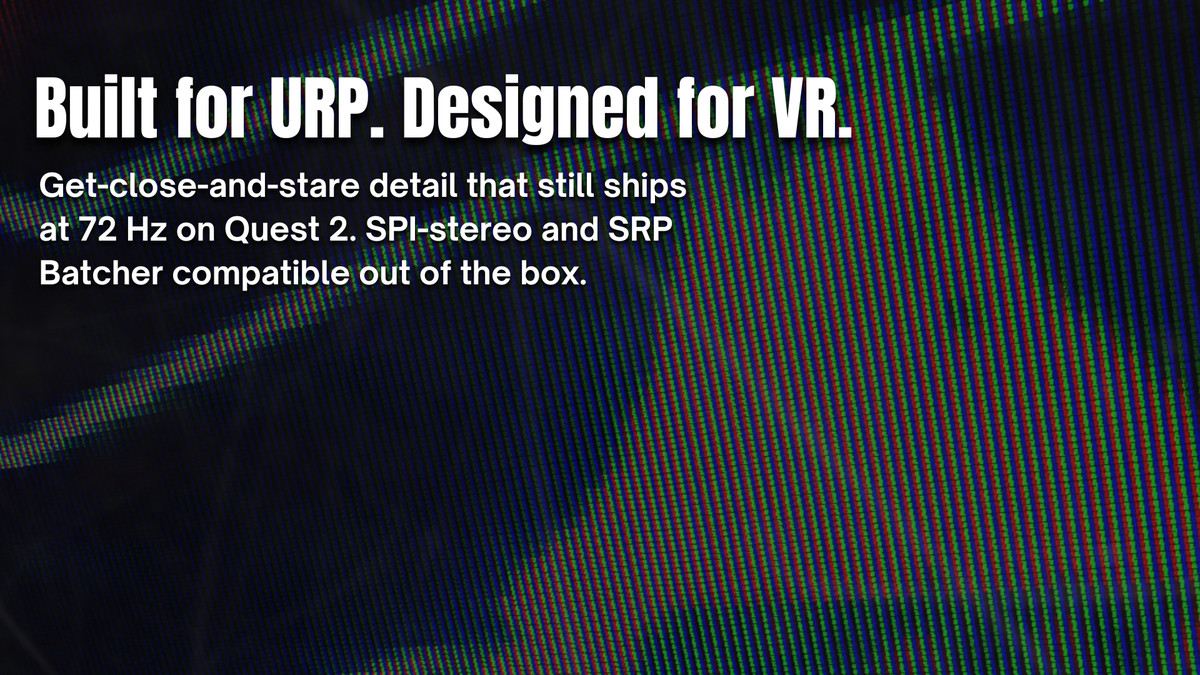
Built specifically for Meta Quest 2 and Quest 3 under the Universal Render Pipeline. Single-Pass Instanced stereo, SRP Batcher compatible, four texture samples per fragment, and Adreno-friendly fragment ALU. It looks right on a default Unity Quad with zero configuration, then opens up to deep customization through a branded material inspector.
This is a surface shader, not a post-process. It runs on a 3D mesh such as quad, a TV model, an arcade cabinet and makes that mesh look like a physical display in your scene. It does not affect the camera output or full-frame rendering.
Walk up to a screen in VR and watch real RGB subpixels resolve out of the surface: the unmistakable moment your players realize they're looking at a physical display, not a texture.
Works with mobile & PC too!
Fully customizable
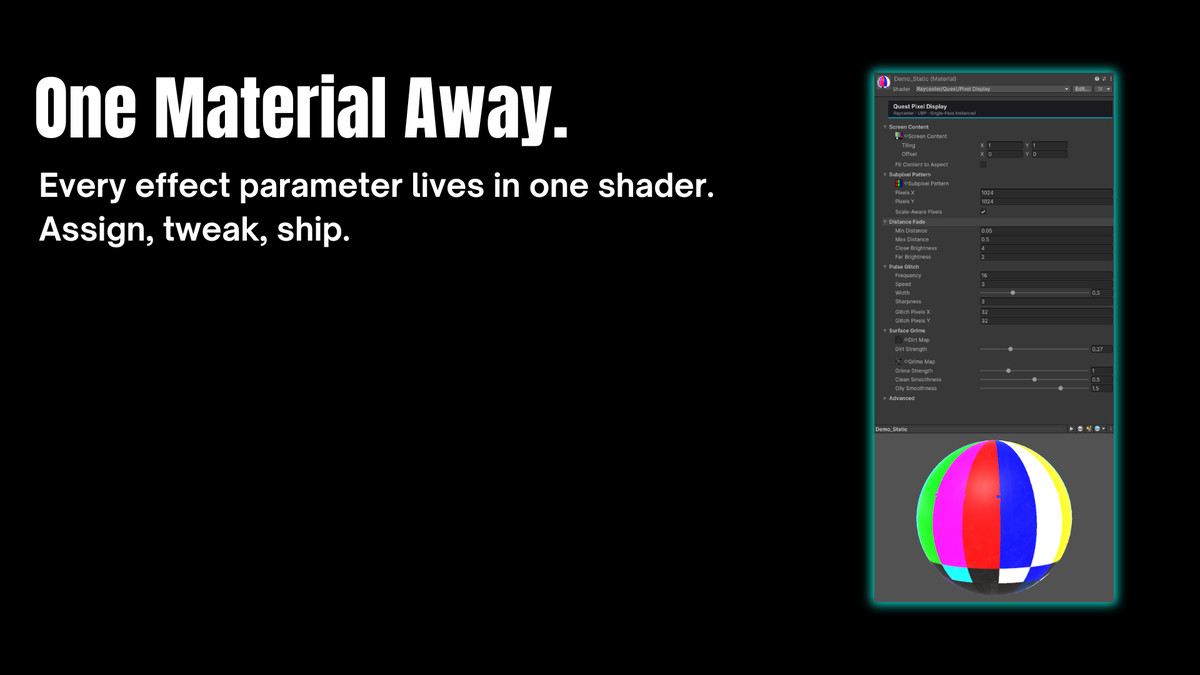
Every aspect of the look is exposed on the material: subpixel tile count, near/far brightness, glitch frequency and width, dirt and grime strength, and clean/oily smoothness response. Scale-Aware Pixels keeps cells physically square on any mesh shape;
Genre fit
Designed for sci-fi, retro-tech, horror, and cyberpunk VR. Use it on cockpit instrument panels, arcade cabinets, security monitors, in-world TVs and computer screens, dystopian advertising boards, broken-down terminals, retro CRTs, hacker laptops, signage, and HUD diegetics.
From the publisher's Asset Store listing.
Technical details
- Surface shader for in-world displays. Renders on any 3D mesh (quad, TV, monitor, arcade cabinet) to make it look like a physical glowing display. Not a post-process or screen-space effect.
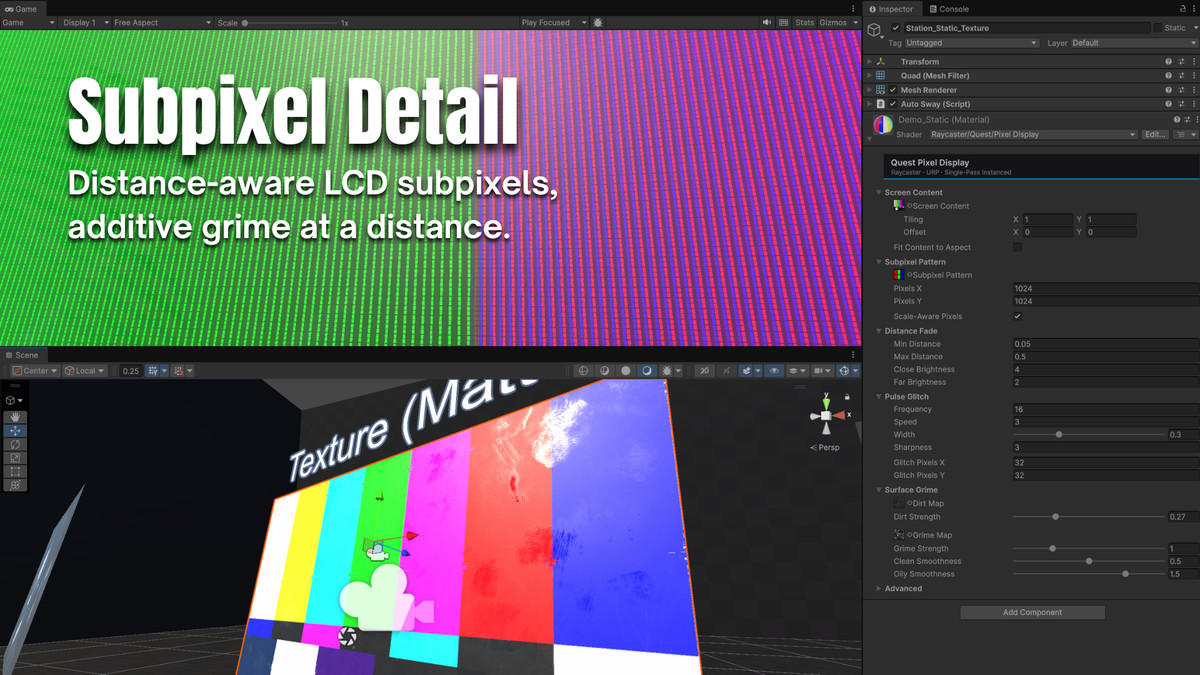
- LCD / CRT subpixels with distance fade. A real RGB subpixel mask multiplies over your content and fades naturally as the viewer moves away while close-up displays look detailed, far-away ones stay readable.
- Cinematic pulse glitch. A configurable pulse drops the display to a coarse, power-of-two pixel grid in time with a tunable wave, perfect for "this monitor is dying" moments, sci-fi instability, or stylized rhythmic effects.
- Dirt and grime overlays. An additive dirt map adds matte gunk to the emission; a grime map shifts smoothness from clean to oily where the surface has been touched. No material variants needed.
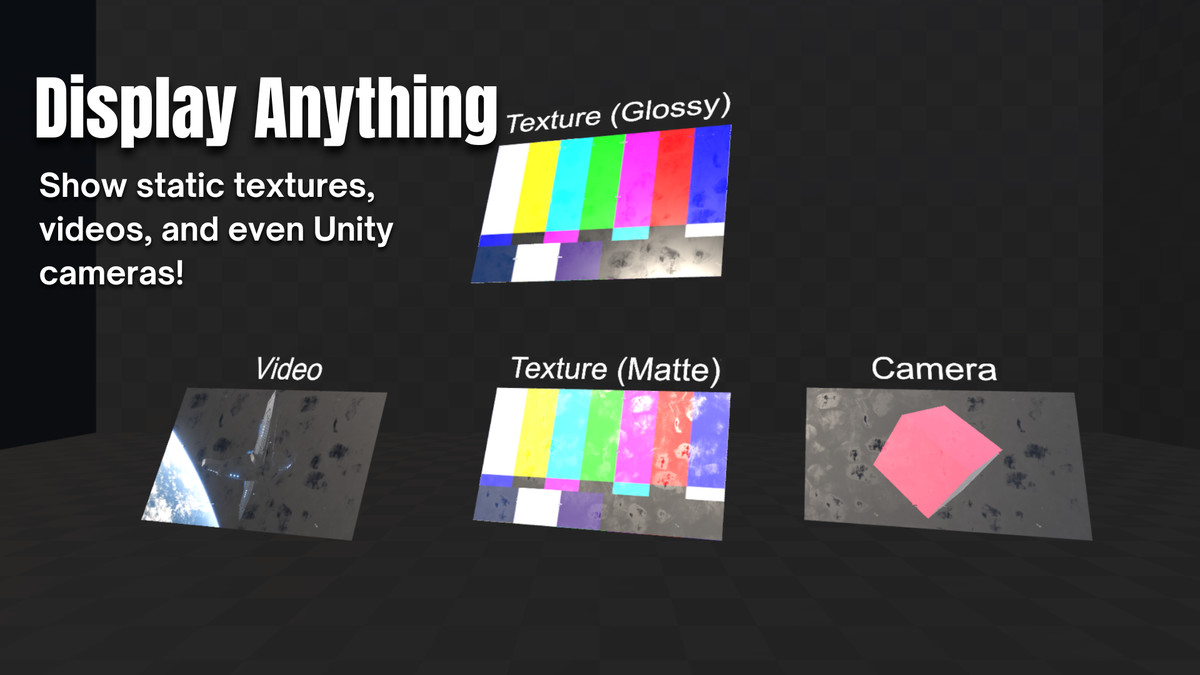
- Texture, video, or live camera input. It's all the same shader with three different workflows. Demo scene includes a static texture station, a VideoPlayer → RenderTexture station, and a live second-camera station.
- Quest-tuned performance. Single-Pass Instanced stereo, SRP Batcher compatible, four texture samples per fragment, fragment ALU within Quest 2 / Quest 3 comfortable budget.
- Full URP pass set. ForwardLit, ShadowCaster, DepthOnly, and DepthNormals. Works with
shadow-receiving floors, depth-based effects, and SSAO.
- Full HLSL source included. Readable, commented, and modifiable. Custom inspector source included as well.
- Tested hardware. Meta Quest 2 (Adreno 650), Meta Quest 3 (Adreno 740). Unity 2022.3 LTS and Unity 6.
Package contents:
- 1 URP surface shader (Raycaster/Quest/Pixel Display)
- 1 custom material inspector
- 1 ready-to-use prefab (PixelDisplayScreen.prefab)
- 1 demo scene with three example stations
- 4 textures (LCD subpixel pattern, dust, fingerprint, scratches)
- 2 demo helper scripts (AutoRotate, AutoSway)
- Offline Markdown / PDF user manual
Compatibility
| Unity version | Built-in | URP | HDRP |
|---|---|---|---|
| 6000.3.11f1 | Not listed | Compatible | Not listed |
Universal Render Pipeline only. Built-in Render Pipeline and HDRP are not supported. The shader uses URP's PBR lighting library and will not compile in BiRP or HDRP projects.
Minimum URP version: 14.x (Unity 2022.3 LTS). Tested on URP 14.0.11 (Unity 2022.3) and URP 17.3 (Unity 6).
Stereo rendering: Supports both Multi-Pass and Single-Pass Instanced (recommended on Meta Quest for best performance)
As listed on the Asset Store.