
 View on Asset Store (opens in new tab)
Package details
- Latest version
- 1.0.1
- Last updated
- First released
- Unity version
- 2022.3.62 or later
- Package size
- 5.9 MB
- Files
- 335
- Favorites
- 1
- Views in the past week
- 18
Price tracking
- Last checked
- Tracked since
- Lowest recorded
- $49.99 on
Keywords

Monster Creature Synth: Procedural Beast Audio
Real-time procedural creature and monster voice synthesizer. Every growl, roar, and howl is generated fresh on the fly. 50+ presets, infinite variation. Pure C#, no plugins, no middleware.
Affiliate link · Purchases support this site
Price history
Last 6 months
USDAsset preview
1 / 9
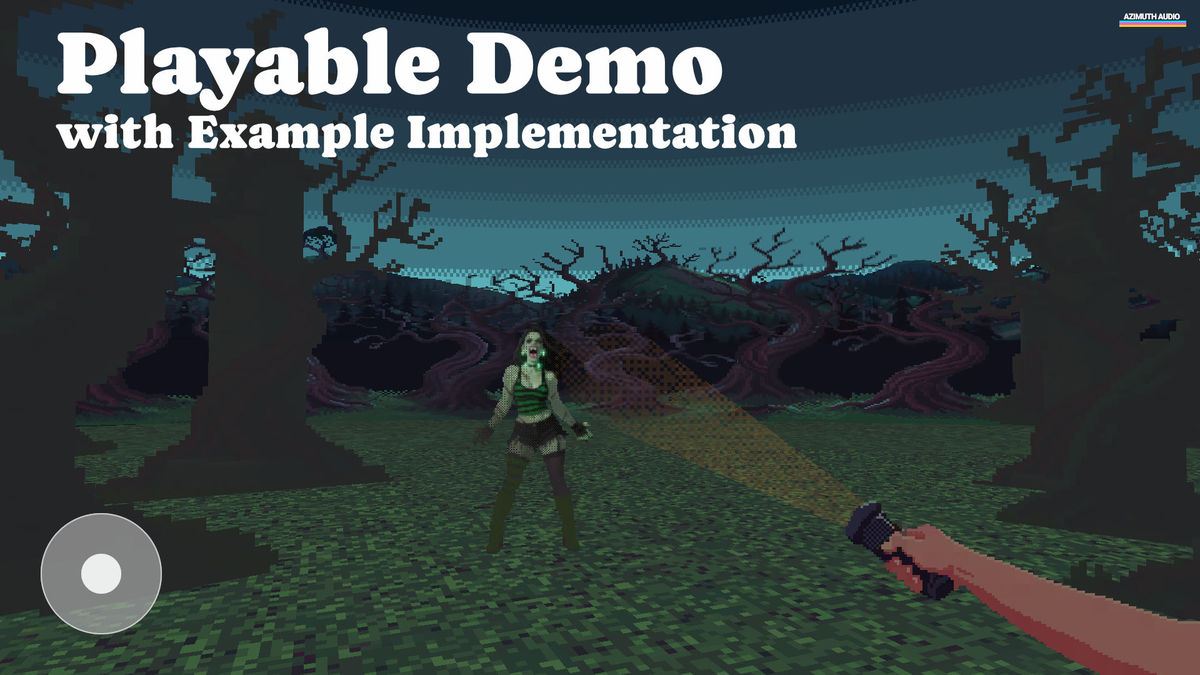
Monster Creature Synth: Procedural Beast Audio screenshot 1
About this asset
Stop recycling the same monster roars
Every game with creature audio has the same problem: a library of recorded growls that players hear three times and recognise forever. No matter how many variations you record, loops repeat. Immersion breaks. Your dragon sounds like every other dragon.
Procedural Monster Synth fixes this permanently. It generates creature vocalisations in real-time, directly inside Unity's audio system. Every sound is synthesised fresh, every time. No two roars are ever identical.
One engine. Every creature.
A single unified synthesis engine models a complete creature vocal system, from the larynx to the lips. A massive kaiju and a skittering insect both come from the same synthesizer, just at different settings. Adjust a handful of parameters and your wolf becomes a cave troll, your dragon becomes a banshee, your alien becomes a demon.
MIDI pitch is a creative tool, not just a tuning knob. Play any preset at different notes and discover entirely new creatures. A Dragon Roar played two octaves higher becomes a wyvern screech. A Goblin Cackle dropped an octave becomes a troll. Every preset contains dozens of hidden voices waiting to be found.
50+ ready-to-use presets
Ship creature audio today with over 50 curated presets across seven categories:
- Hero / Animal - Lions, tigers, bears, dragons, kaiju, banshees, cave stalkers
- Action / Combat - Rage bellows, beast charges, impact grunts, war pulses, quick snarls
- Adventure / Fantasy - Goblins, trolls, wyverns, giant spiders, wraiths, bog creatures
- Sci-Fi - Robot voices, alien comms, mech servos, energy drones, xenomorph hisses
- Horror - Demon whispers, possessed voices, wendigo howls, abyssal leviathans, swarm buzz
- Cinematic / Atmosphere - Trailer braams, tension risers, sub-drones, cathedral drones, wind effects
- General Game / Utility - Power downs, alarm klaxons, magic surges, steam vents, acid sizzles
Every preset is a ScriptableObject asset. Duplicate any preset and make it your own.
Three ways to design sounds
The Sound Stage editor gives you three powerful approaches to creature design:
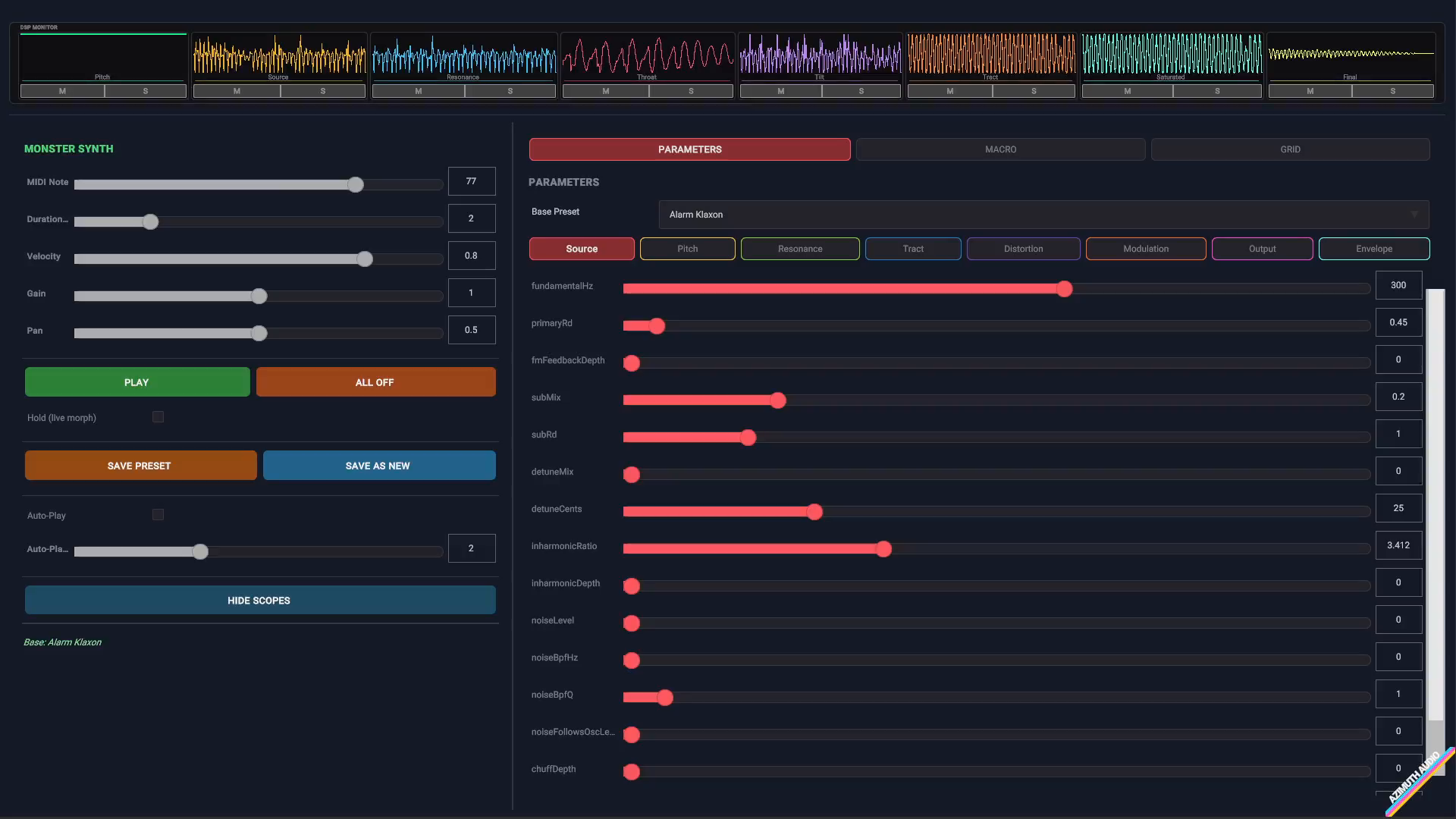
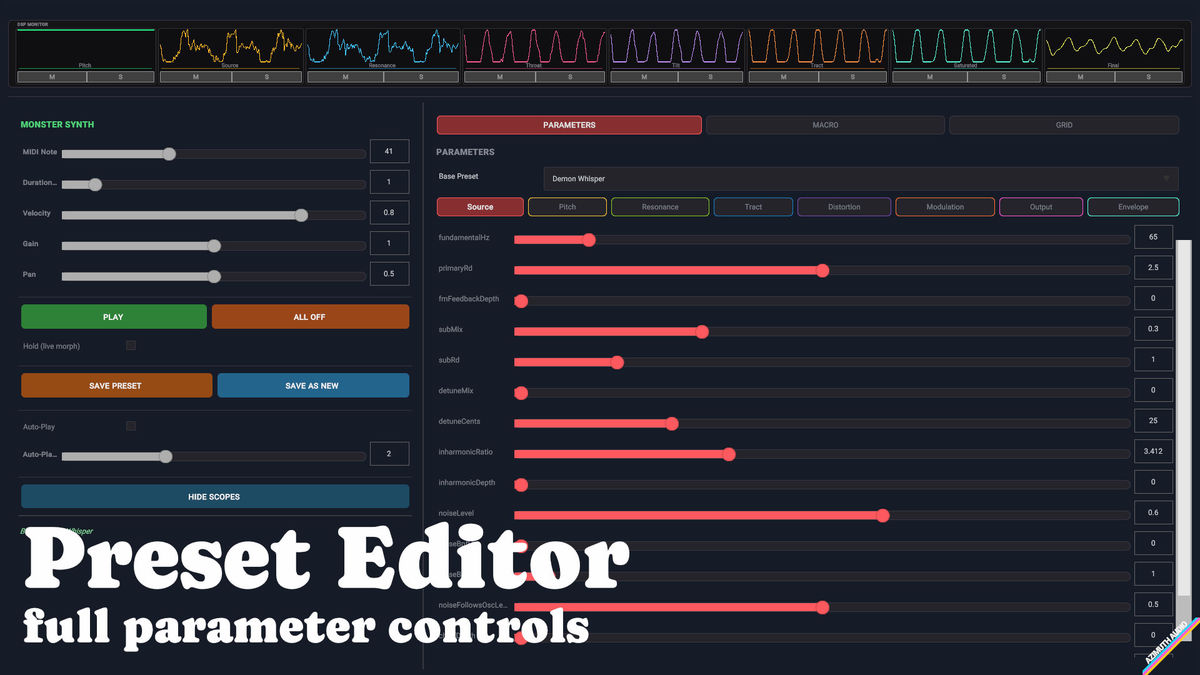
Parameters Mode - Full access to every control in the synth, organised by domain. For when you need surgical precision over a specific formant, a distortion curve, or an envelope shape.
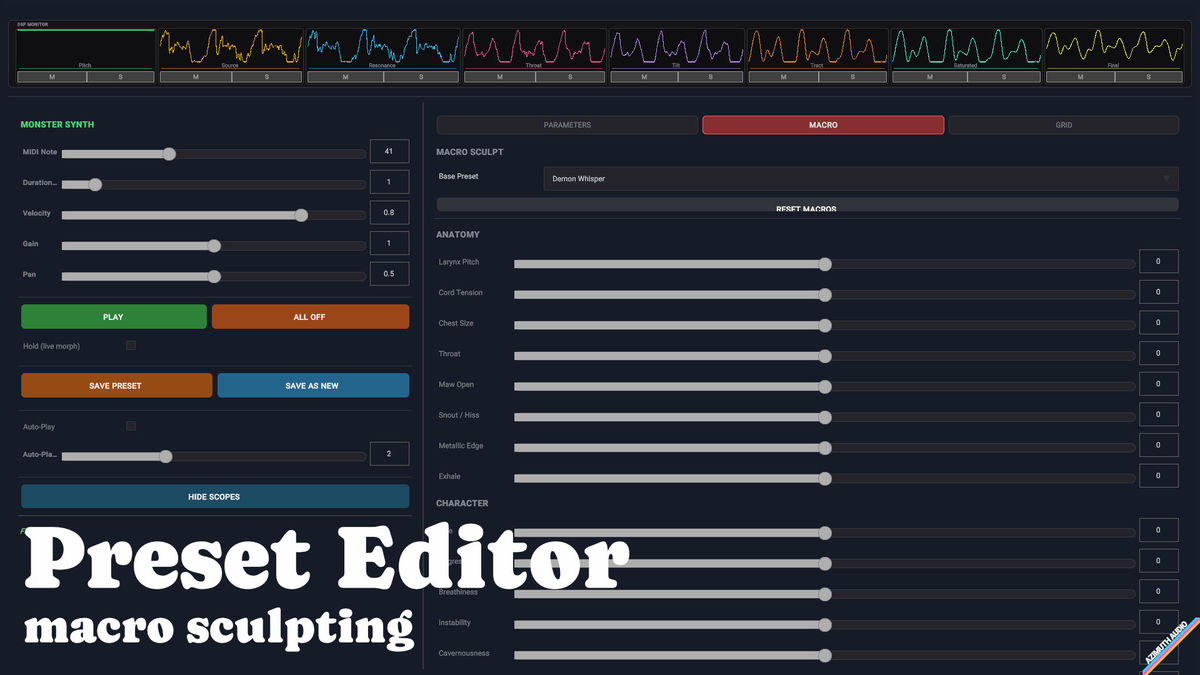
Macro Mode - 17 high-level sliders grouped into Anatomy macros (Larynx Pitch, Cord Tension, Chest Size, Throat, Maw Open) and Character macros (Size, Aggression, Breathiness, Instability, Cavernousness). Load a preset and push a few sliders to reshape the creature in seconds. Macros stack additively, so Chest Size and Aggression both contribute without fighting each other.
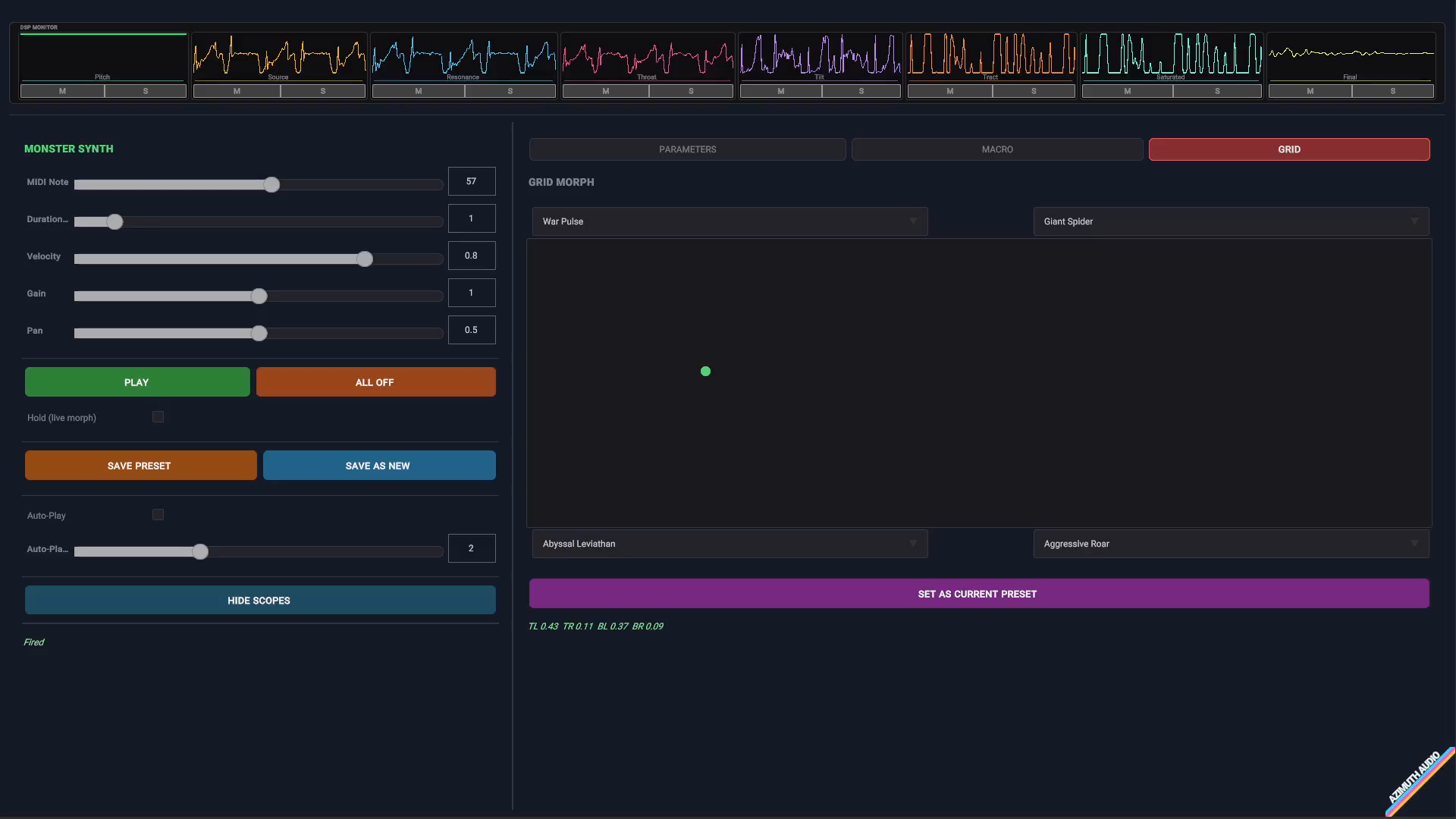
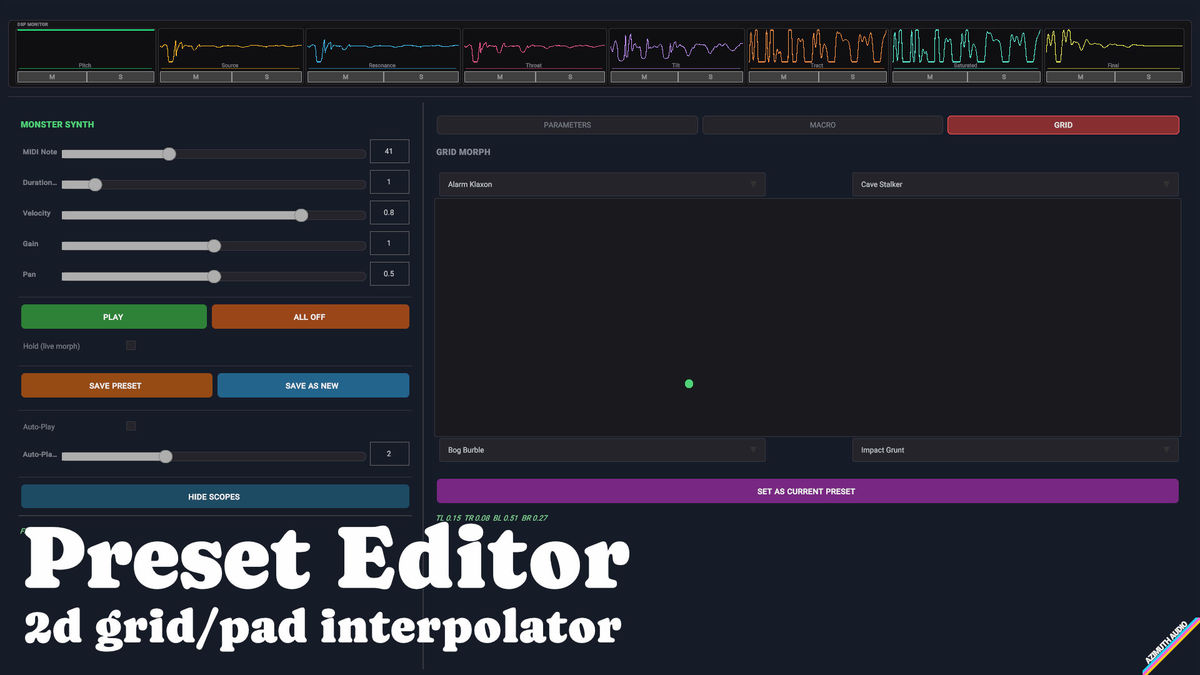
Grid Mode - A 2D XY pad that blends between four presets in real time. Assign a Lion Roar to one corner, a Banshee Howl to another, a Kaiju to a third, and a Giant Spider to the fourth. Drag across the pad and hear creatures that would be impossible to reach by adjusting sliders alone. When you find a blend you like, bake it into a new preset with one click.
Real-time parameter control from gameplay
Every parameter can be updated on a sounding voice while it plays. Tie creature vocalisations directly to gameplay state:
- A monster that growls louder and more aggressively as its health drops
- A dragon whose roar deepens as it charges a fire breath
- A creature whose voice morphs as it transforms between forms
- Smooth pitch glide when a voice shifts between notes
Natural breath exhale on release
When a creature stops vocalising, it does not just cut to silence. The Release Tail captures a reservoir of the creature's own breath material while the note is sounding, then plays it back as a natural exhale after the voice stops, through the same vocal tract, so it sounds like the same creature breathing out. A small detail that makes a surprisingly big difference to realism.
Polyphonic and layerable
The engine supports configurable polyphony with intelligent voice stealing. Layer multiple presets simultaneously for rich, complex creatures: a deep sub-heavy preset for body, a mid-range preset for vocal character, and a noise-heavy preset for breath texture. Trigger all three on the same note event.
From the publisher's Asset Store listing.
Technical details
Platform Support
Works on all platforms supported by Unity except WebGL
Standalone (Windows, macOS, Linux), Mobile (iOS, Android), Console
No native plugins, no platform-specific binaries, no middleware dependencies
Requirements
Unity 2022.3 LTS or newer (URP recommended)
No additional packages or dependencies required
Architecture
Pure C# - the entire synth runs as managed C code inside Unity's audio thread via `OnAudioFilterRead`. Nothing to compile, no DLLs to manage, no plugin compatibility headaches
Zero-allocation audio thread - no garbage collection pauses, no audio glitches from GC spikes. The audio thread is completely allocation-free by design
ScriptableObject-based - engines and presets are ScriptableObject assets. Drag-and-drop workflow, full Inspector support, easy serialisation
Lock-free architecture - game thread and audio thread communicate through a lock-free command queue with sample-accurate scheduling. No mutexes, no blocking, no priority inversion
What You Get
- 1 unified procedural synthesis engine (`MonsterEngineSO`)
- 50+ curated preset assets across 7 categories
- Full Sound Stage editor UI with Parameters, Macro, and Grid modes
- 17 macro controls (8 Anatomy + 9 Character)
- 2D Grid pad for real-time preset blending
- Configurable polyphony with 4-strategy voice stealing
- Real-time parameter morphing API
- Sample-accurate note scheduling
- Built-in multiband compression
- Natural release tail (breath exhale)
- Stereo Haas widening and equal-power panning
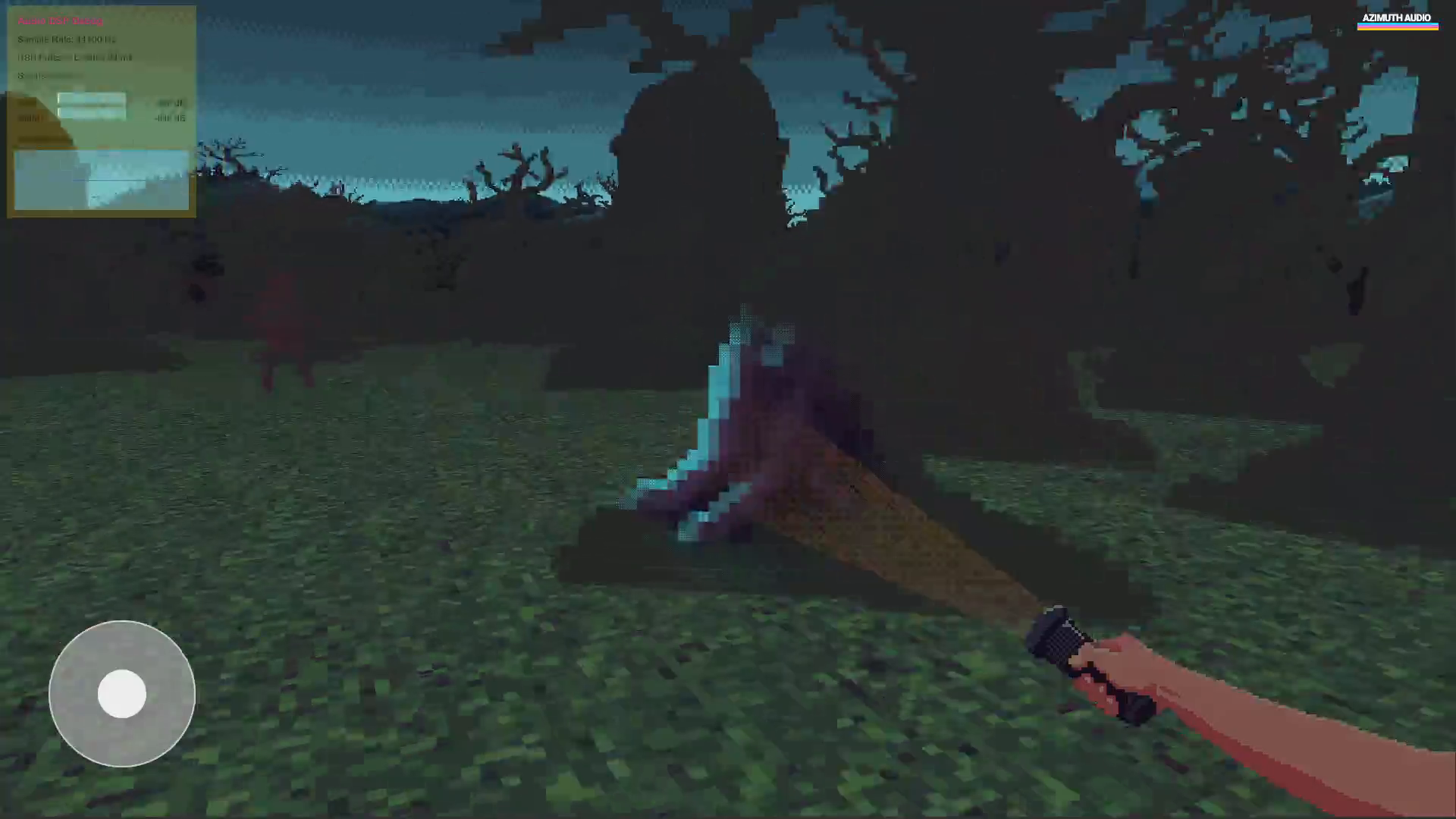
- Demo scene with working examples
- Full source code included
Audio Capabilities
Physically-inspired vocal tract modelling (glottal source, body cavities, throat tube, 5 formant filters)
Two oscillator models: LF glottal pulse and exponential decay
Sub-octave and detuned oscillator layers
FM feedback for harmonic complexity
Band-limited aspiration noise with formant tracking
Pre-tract and post-tract saturation with asymmetric bias
Spectral tilt control
Pitch sag, pitch AHD envelope, growl LFO, Perlin pitch wander
Tremolo from gentle breathing to audio-rate epiglottal flutter
Formant wander for evolving sustained vocalisations
Jitter and shimmer for micro-instability
Metallic inharmonic layer for alien/insectoid voices
Release tail with tape-delay exhale reservoir
Code Integration
Clean public API: `TriggerOneShot()`, `TriggerHeld()`, `TryTriggerNote()`, `ReleaseNote()`, `UpdateVoiceParameters()`, `SetVoiceNote()`
Parameters struct for full state serialisation and interpolation
Voice index and token system for tracking individual voices
DSP time scheduling for precise audio event timing
Compatibility
| Unity version | Built-in | URP | HDRP |
|---|---|---|---|
| 2022.3.62f3 | Compatible | Compatible | Compatible |
The demo scene is built using URP but the core synthesis is render pipeline agnostic, it will work in all render pipelines.
As listed on the Asset Store.