
 View on Asset Store (opens in new tab)
Package details
- Latest version
- 1.2
- Last updated
- First released
- Unity version
- 6000.6.3 or later
- Package size
- 1.3 MB
- Files
- 95
- Views in the past week
- 6
Price tracking
- Last checked
- Tracked since
- Lowest recorded
- $19.99 on
Keywords

Lidar Component - Mini Map System (Pro)
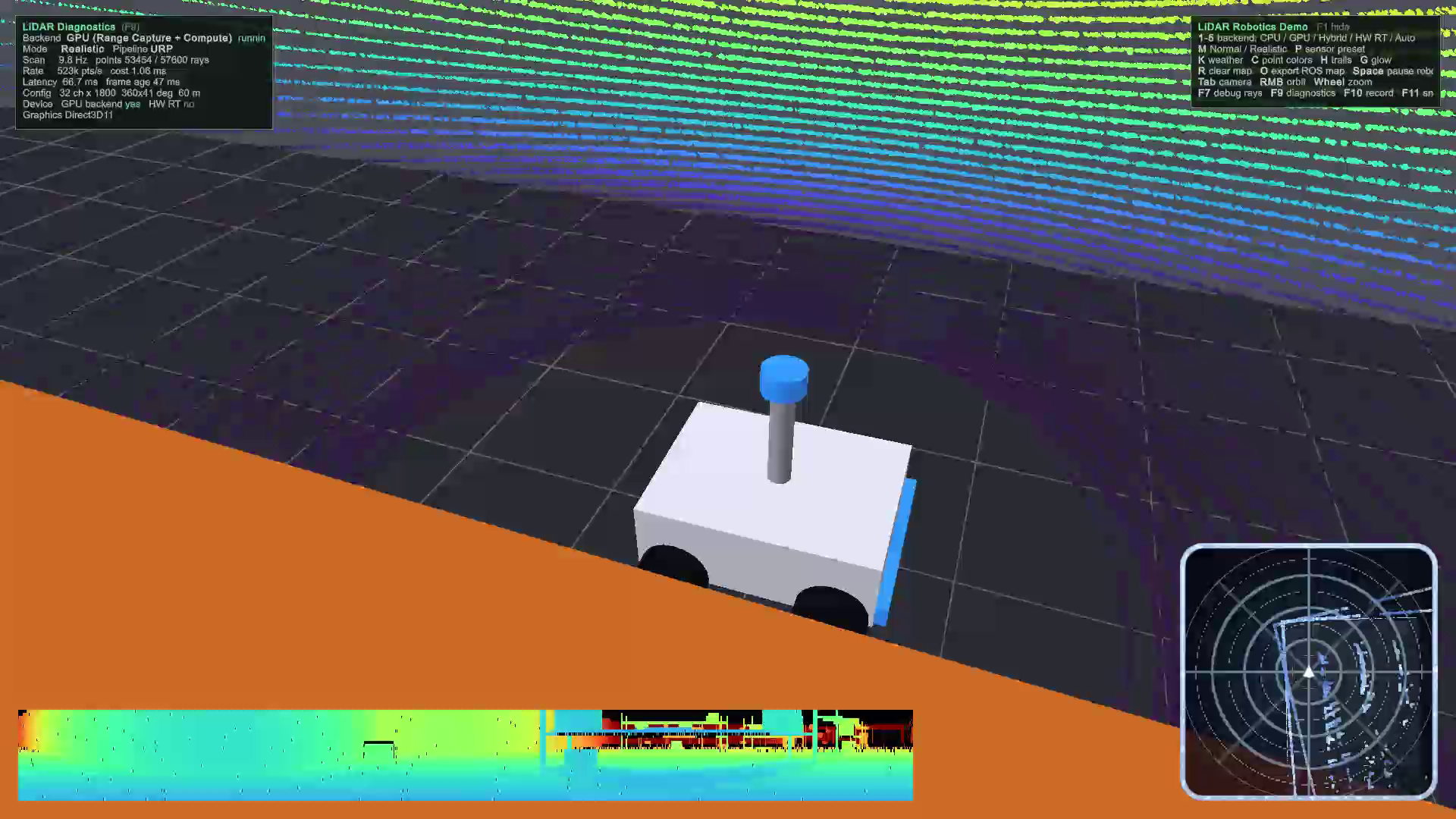
Pro LiDAR for Unity: CPU/GPU/Hybrid/RT backends, scan patterns, reflectivity, ROS/ROS2 PointCloud2, minimap + depth/point-cloud views. Built-in/URP, HDRP RT.
Affiliate link · Purchases support this site
Price history
Last 6 months
USDAsset preview
1 / 10

Lidar Component - Mini Map System (Pro) screenshot 1



About this asset
Lidar Component Pro extends the Basic package into a complete simulation and integration framework for advanced robotics and autonomous systems development.
Whether you're developing autonomous vehicles, SLAM pipelines, perception systems, or conducting academic research, Pro gives you the tools to simulate, visualize, debug, and export realistic LiDAR data efficiently.
🧠 Designed For
- Robotics developers
- Autonomous vehicle simulation
- Research & academic projects
- SLAM / mapping development
- ROS-based pipelines
- Simulation-heavy AI prototyping
- Hardware-in-the-loop setups
⚡ Key Advantages
🔥 High Performance GPU Backend
Accelerated LiDAR raycasting using GPU-based processing for large scan counts and high-frequency sensors.
🎯 Optional Raytracing Backend
High-fidelity simulation mode for realistic beam interactions and advanced research scenarios.
🛰 ROS Publisher Integration
Built-in ROS topic publishing support for seamless integration into robotics pipelines.
🗺 Live Occupancy Grid Generation
Generate 2D occupancy grids directly from scan data in real-time.
🔌 Hardware Integration Hooks
Interface-ready architecture for hybrid simulation + real sensor data.
🧰 Advanced Debugging & Visualization
- Beam visualization
- Noise model inspection
- Live scan statistics
- Backend switching at runtime
- Diagnostic logging modes
🏗 Modular Architecture
Pro is built around a backend-based architecture:
- CPU backend (baseline)
- GPU backend
- Raytracing backend
- Hybrid Backend (CPU+GPU)
You can switch backends or disable them depending on performance and simulation needs.
From the publisher's Asset Store listing.
Technical details
Core Simulation
- Configurable scan frequency
- Adjustable horizontal FOV
- Configurable vertical layers
- Max range configuration
- Per-beam angular resolution
- Layer mask filtering
- Noise model (Gaussian / configurable)
- Per-frame or fixed update execution
Backends
CPU Backend
- Physics.Raycast-based implementation
- Reliable and deterministic
- Suitable for small scenes and prototyping
GPU Backend
- Compute shader accelerated
- High beam count support
- Optimized for large-scale environments
- Suitable for real-time high-frequency sensors
Raytracing Backend (Optional / HDRP)
- Unity raytracing integration
- Physically accurate beam simulation
- Research-grade fidelity
Hybrid Backend
- Hardware-in-the-loop setups
- Gradual migration from simulation to real-world testing
- Sensor validation workflows
- Mixed-reality robotics environments
ROS Integration
- Publish LaserScan messages
- Configurable topic name
- Adjustable publish rate
- Supports ROS1 (via bridge)
- Designed for extension to ROS2
Occupancy Grid
- 2D grid generation
- Adjustable resolution
- World-aligned or sensor-aligned modes
- Real-time update
- Export support (optional)
Debug & Diagnostics
- Beam gizmo visualization
- Hit point visualization
- Range statistics display
- Performance monitor (scan time / frame cost)
- Backend selection UI
- Logging verbosity levels
- Mini Map
- Capture View
Performance
Optimized for:
- Large scan counts
- Multi-layer LiDAR
- Autonomous driving simulations
- Multi-sensor setups
Compatibility
| Unity version | Built-in | URP | HDRP | Custom |
|---|---|---|---|---|
| 6000.6.3f1 | Compatible | Compatible | Compatible | Compatible |
As listed on the Asset Store.