
 View on Asset Store (opens in new tab)
Package details
- Latest version
- 6.4.6
- Last updated
- First released
- Unity version
- 6000.3.23 or later
- Package size
- 128.6 MB
- Files
- 900
- Favorites
- 90
- Views in the past week
- 114
Price tracking
- Last checked
- Tracked since
- Lowest recorded
- $24.60 on
Keywords
Flora
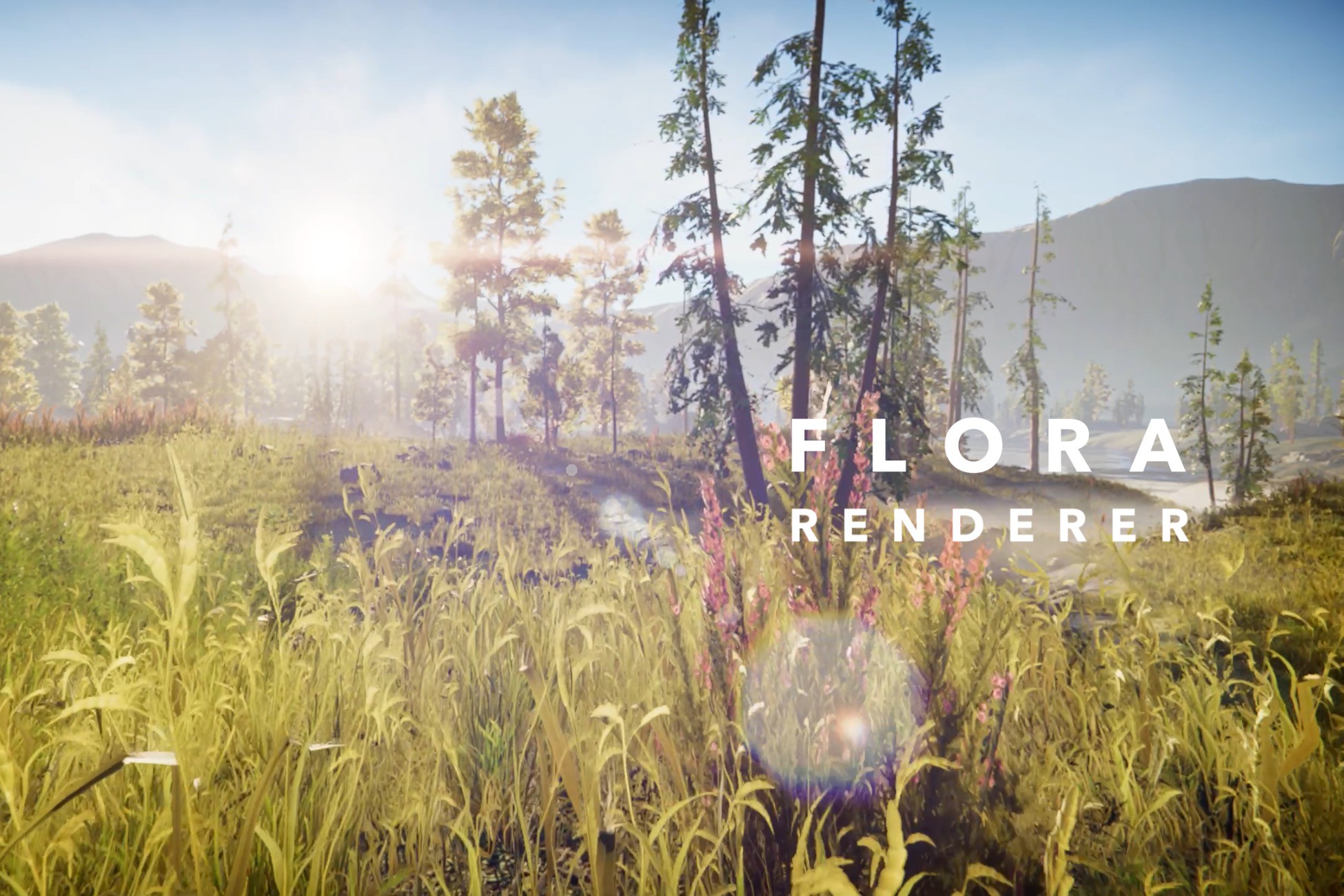
A GPU-driven renderer built around native-memory, data-oriented backend with spatial culling to render dense Terrain vegetation, prefab scatter and dynamic instance populations.
Affiliate link · Purchases support this site
Price history
Last 6 months
USDAsset preview
1 / 12

Flora screenshot 1




About this asset
GPU instancing, data-oriented from storage to rendering.
Flora renders Terrain vegetation, dense prefab populations and procedural environments through Unity’s BatchRendererGroup, GPU compute and Burst.
Its backend uses native memory throughout instance storage, transform processing, spatial queries and upload preparation. A GPU-driven dynamic hierarchical spatial hash organizes arbitrary instance populations, supporting moving objects, prefab-contained scatter and procedural content alongside Terrain vegetation.
Use familiar Unity authoring workflows or manage populations through native APIs and Unity Jobs, without a GameObject for every instance. GPU-driven culling and indirect drawing handle visibility, while persistent GPU buffers and change tracking keep instance updates focused on affected data.
- Terrain vegetation. Render Terrain trees and detail meshes with automatic streaming. Detail placements are generated directly into GPU rendering buffers without a CPU instance record for every placement.
- Instance containers. Store foliage, rocks, debris and other repeated objects without individual GameObjects. Embed containers inside prefabs to create reusable detail and scatter arrangements that move with each prefab instance.
- Runtime control. Create, transform, query, enable, disable and destroy instances through individual and bulk APIs. Scheduled transform updates integrate with Unity Jobs through explicit JobHandle dependencies. Dedicated Terrain-detail queries report nearby prototype populations.
- Unity integration. Render Terrain foliage through Terrain Providers, with optional automatic registration in the Scene Settings scene. Standard Scene view and runtime cameras work without additional camera components.
- Materials and SpeedTree. Use supported Shader Graph shaders and custom BRG-compatible shaders. Compatible SpeedTree assets receive wind animation with shared or position-dependent sampling.
- Per-instance shader data. Use stable random IDs and a custom four-component vector per instance to drive color variation, material effects and other shader behavior through Shader Graph or HLSL.
- LOD, density and shadows. Supports LODGroups, Mesh LOD, cross-fading, SpeedTree fading, screen-size culling and range-based density. Configure rendering distance, shadow distance and density through Volume overrides.
- Occlusion and lighting. Supports GPU occlusion, Unity’s baked occlusion, per-instance motion vectors, legacy Light Probes and Adaptive Probe Volumes, depending on content and render-pipeline support.
- GPU Resident Drawer integration. On Unity 6.3 or later with URP RenderGraph or HDRP, eligible cameras share GPU Resident Drawer’s depth pyramid. Flora retests rejected instances against current-frame depth to recover newly visible content.
- Editing and diagnostics. Select, move, rotate and delete instances in the Scene view. Convert supported prefab objects into containers or Terrain trees, and convert instances back to GameObjects. Inspect rendering data and diagnose visibility with the Rendering Inspector and Rendering Debugger.
Includes runtime, Terrain and container samples demonstrating spawning, animation, Unity Jobs and instance interaction.
Requirements: Unity 6.0 or later, compute shader support, and a supported URP, HDRP or compatible custom Scriptable Render Pipeline configuration. Built-in Render Pipeline is unsupported.
From the publisher's Asset Store listing.
Compatibility
| Unity version | Built-in | URP | HDRP | Custom |
|---|---|---|---|---|
| 6000.3.23f1 | Not listed | Compatible | Compatible | Compatible |
As listed on the Asset Store.