
 View on Asset Store (opens in new tab)
Package details
- Latest version
- 2.22.0
- Last updated
- First released
- Unity version
- 2022.3.62 or later
- Package size
- 5.2 MB
- Files
- 497
- Favorites
- 170
- Views in the past week
- 42
Price tracking
- Last checked
- Tracked since
- Lowest recorded
- Free on
Keywords

Maestro - Midi Player Tool Kit - Pro
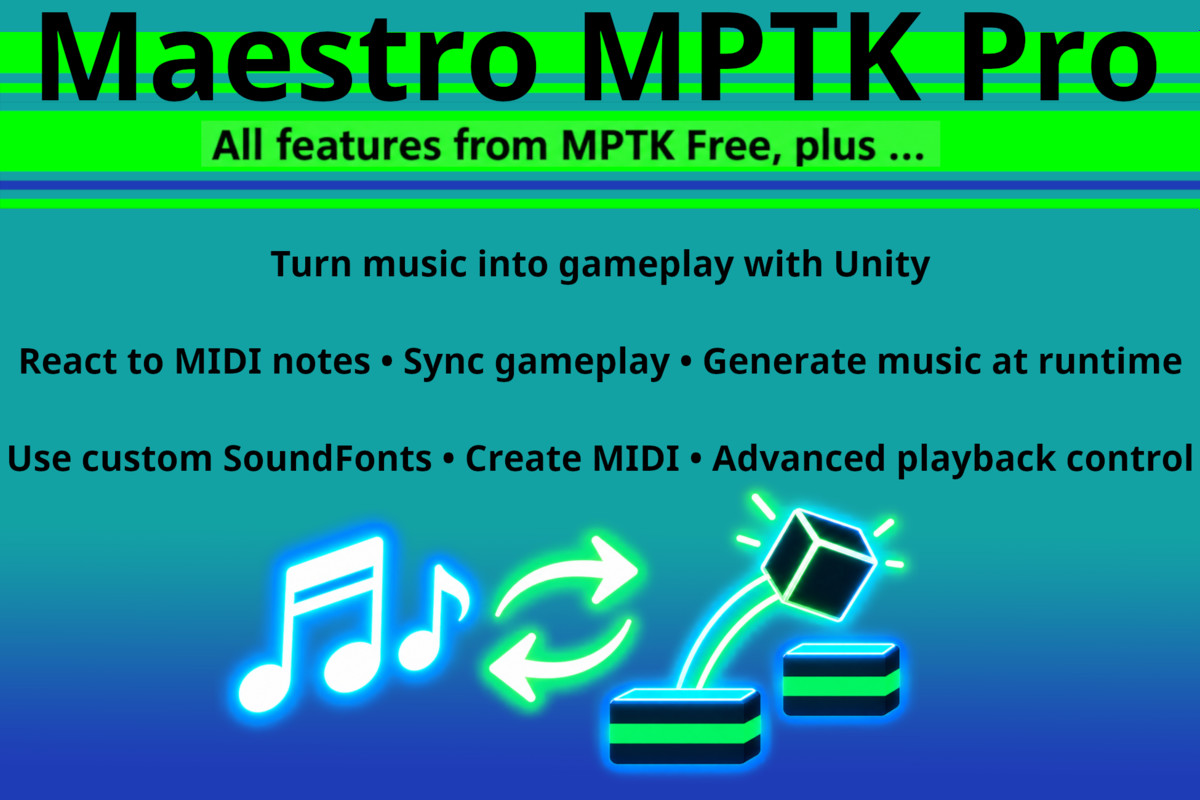
Turn music into gameplay with Unity. React to MIDI notes, sync gameplay, generate music at runtime, use custom SoundFonts, and build interactive music systems. Now MPTK AI Skills simplify integration!
Affiliate link · Purchases support this site
Price history
Last 6 months
USDAsset preview
1 / 15
Maestro - Midi Player Tool Kit - Pro screenshot 1



About this asset
Maestro MIDI Player Tool Kit Pro is a complete toolkit for building interactive music systems in Unity.
Instead of treating music as a fixed audio file, Maestro gives your game access to its musical structure: notes, instruments, channels, tempo, timing and MIDI events.
Your gameplay can react directly to the music — and your code can modify or generate the music while the game is running.
Tell your AI what you want to build with Maestro. MPTK Skills show it how.
Maestro includes ready-to-use AI Skills designed around real Unity and MPTK workflows. Tell your AI coding assistant - Codex, Claude, GitHub Copilot, Mistral and other compatible assistants - what you want to build, and the Skills guide it toward the appropriate Maestro components, APIs and implementation patterns.
With Maestro Pro, the Skills can use the full MPTK feature set, including MIDI creation and editing, advanced playback, external MIDI devices, runtime SoundFont management, harmonic tools and spatial music workflows.
See how to set up and use Maestro AI Skills with your coding assistant:
What can you build with Maestro?
Rhythm Games - Receive individual note events and use them to drive lanes, targets, scoring, animation, visual effects or any other gameplay system.
Music-Synchronized Gameplay - Synchronize objects, characters, lighting, particles and game logic with notes, beats, instruments and tempo.
Piano and Music Learning Apps - Know exactly which notes are expected, currently playing or received from an external MIDI device.
Music Visualizers - Drive visual effects, environments and animations directly from musical events instead of analyzing a rendered audio signal.
Interactive Instruments - Play notes instantly from your game, UI or MIDI controller and control instruments and synthesis parameters at runtime.
Procedural and Generated Music - Create notes, chords, scales and complete MIDI sequences from code.
Adaptive Music - Change tempo, instruments, channels and loops, or intercept, transform, reroute and filter MIDI events while the game is running.
Why MIDI?
Traditional audio files contain the final rendered sound.
MIDI keeps the music structured.
With Maestro, your application can know:
- which notes are playing
- when each note starts and stops
- which instrument plays it
- its velocity
- its channel
- the current tempo
- musical timing and position
This makes MIDI especially useful when music must interact with gameplay.
Maestro also includes its own SoundFont synthesizer, so MIDI can be rendered directly to audio inside Unity without requiring an external synthesizer.
Maestro Pro
The Pro edition extends the core Maestro engine with the tools required for advanced and production use.
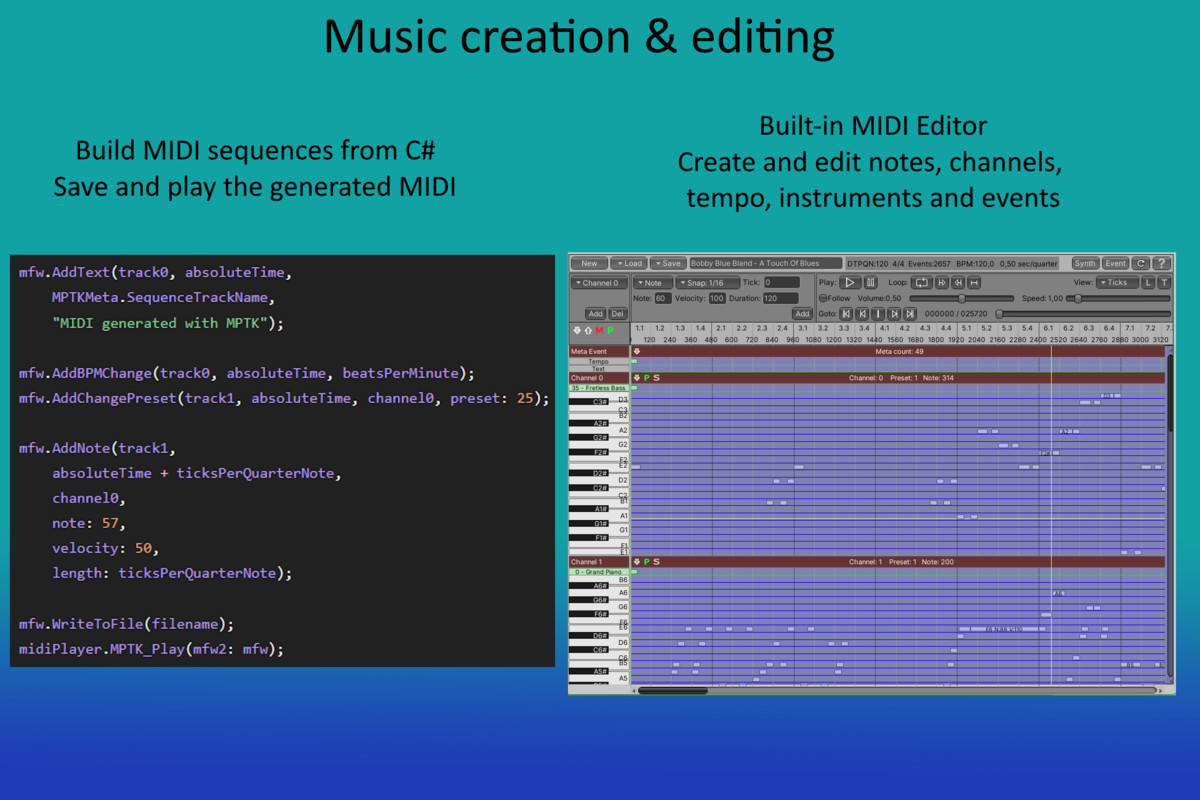
Create - Generate MIDI notes and events, create complete MIDI sequences from code, and work with chords, scales and progressions.
Edit - Use the integrated visual MIDI Editor, or create, modify, merge and save MIDI files directly from C#.
Control - Intercept, transform, reroute or discard MIDI events before synthesis, and control playback, tempo, instruments, channels and loops in real time.
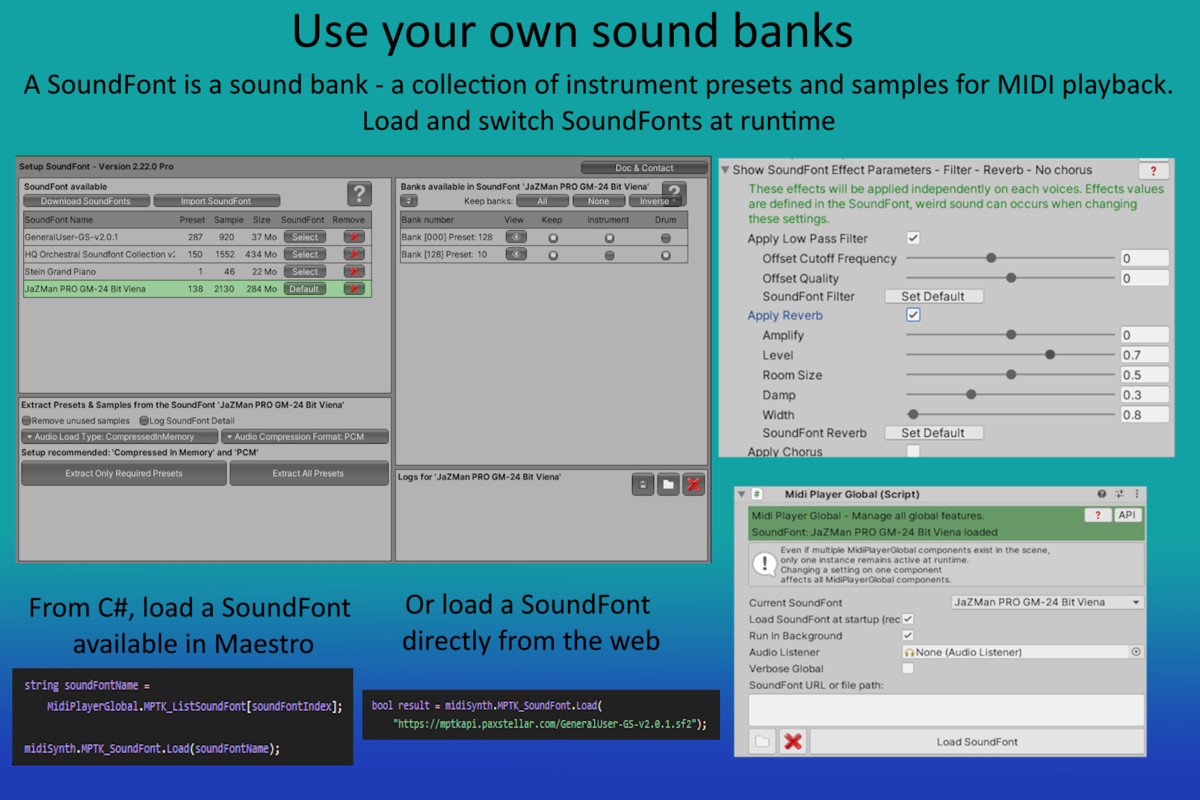
Customize - Import your own SoundFonts, load or switch them at runtime, and control synthesis parameters and audio effects.
Connect - Load MIDI from external sources and communicate with MIDI devices where supported by the target platform.
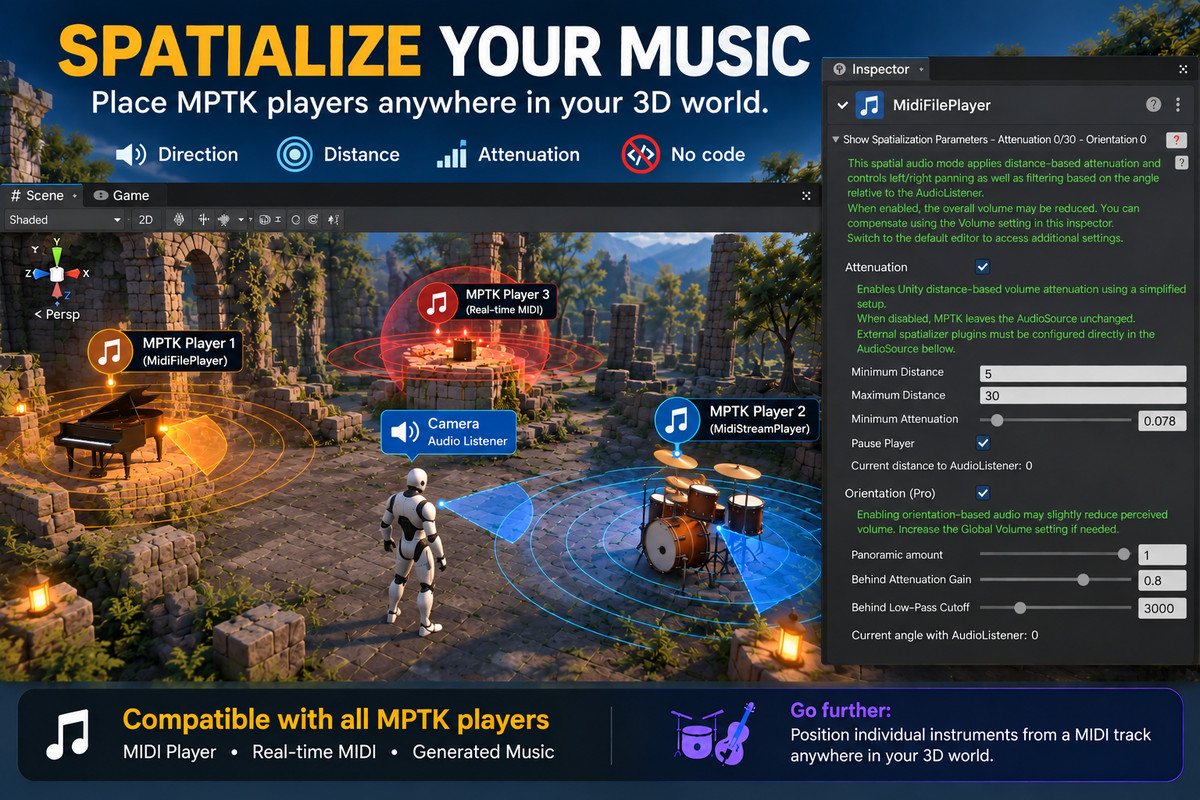
Spatialize - Position instruments or musical parts independently in a 3D scene with directional and distance-based attenuation.
Build - Use the included runtime components, editor tools, demos, AI Skills and documented C# API to integrate Maestro into your own gameplay architecture.
See Technical Details below for the complete Maestro Pro feature list.
Built for Unity
Maestro has been developed specifically for Unity and is actively maintained. Full documentation, examples and support resources are available to help you integrate it into your project.
Quick Start | Documentation | API | Demos | Forum | Discord
Start with Maestro Free
A free edition of Maestro is available on the Unity Asset Store.
Maestro Free includes MIDI playback, an integrated General MIDI SoundFont, real-time MIDI note and event generation, playback callbacks and the core controls needed to build interactive music experiences.
Both editions include the Maestro AI Skills library. With Free, the Skills guide you through core MPTK workflows. Pro unlocks the advanced Maestro features used by more sophisticated workflows.
Choose Pro for advanced rhythm games, adaptive or procedural music, music creation and editing, music-learning applications, or interactive spatial music - with custom SoundFonts, real-time event transformation, advanced playback features, external MIDI devices, and spatial routing.
Third-Party Licensing
Asset uses FluidSynth under GNU Lesser General Public License 2.1, NAudio under Microsoft Public License (Ms-PL), GeneralUser GS SoftSynth under License v2.0, and ScreenLogger under the MIT License.
See Third-Party Notices.txt included in the package for details.
From the publisher's Asset Store listing.
Technical details
Main Features
- MIDI playback from Unity resources, local files, byte arrays, generated content, and web URLs
- Real-time MIDI note and event generation from C#
- Intercept, transform, reroute, or discard MIDI events before synthesis
- Play, pause, resume, stop, seek, loop, tempo, and speed control
- Advanced looping, playlists, overlap, crossfade, and delayed or gradual start and stop
- MIDI file loading, reading, inspection, and analysis
- MIDI creation, modification, merge, and saving from C#
- Integrated visual MIDI Editor inside Unity
- Chord, scale, and chord-progression tools
- Program, bank, controller, and drum kit management
- MIDI device input/output on supported Windows and macOS platforms
- Multiple SoundFont support
- Custom SoundFont import and runtime loading
- Integrated SoundFont-based synthesizer
- Real-time synthesis parameter control
- Audio effects including filter, reverb, and chorus
- Spatial routing by MIDI channel or track
- Beat, audio-frame, and advanced playback callbacks
Unity Integration
Maestro is designed as a Unity-native C# toolkit.
It provides runtime components, editor tools, and a documented C# API that can be integrated with your own gameplay systems.
MIDI events can be received, transformed, and used like any other gameplay event, allowing music to control objects, animation, UI, VFX, scoring, or custom logic.
Sound Generation
No external MIDI synthesizer is required.
Maestro includes its own SoundFont-based synthesis engine and generates audio directly inside Unity.
Custom SoundFonts can be imported, loaded, switched, and used at runtime.
Package Content
Includes:
- Runtime components
- Editor tools
- MIDI Editor
- Demo scenes
- Example scripts
- Documentation
- API documentation
- MIDI examples required by the demos
Compatibility
- Unity 2022.3 LTS and later
- Compatible with Unity 6
Supported functionality depends on the target platform, particularly for external MIDI device input/output.
See the documentation for the current platform compatibility matrix and platform-specific limitations.
Documentation and Support
Complete documentation and API reference are available online.
The package also includes offline getting-started documentation.
A free edition of Maestro is available for projects that only need core MIDI playback, synthesis, real-time note generation, and playback callbacks.